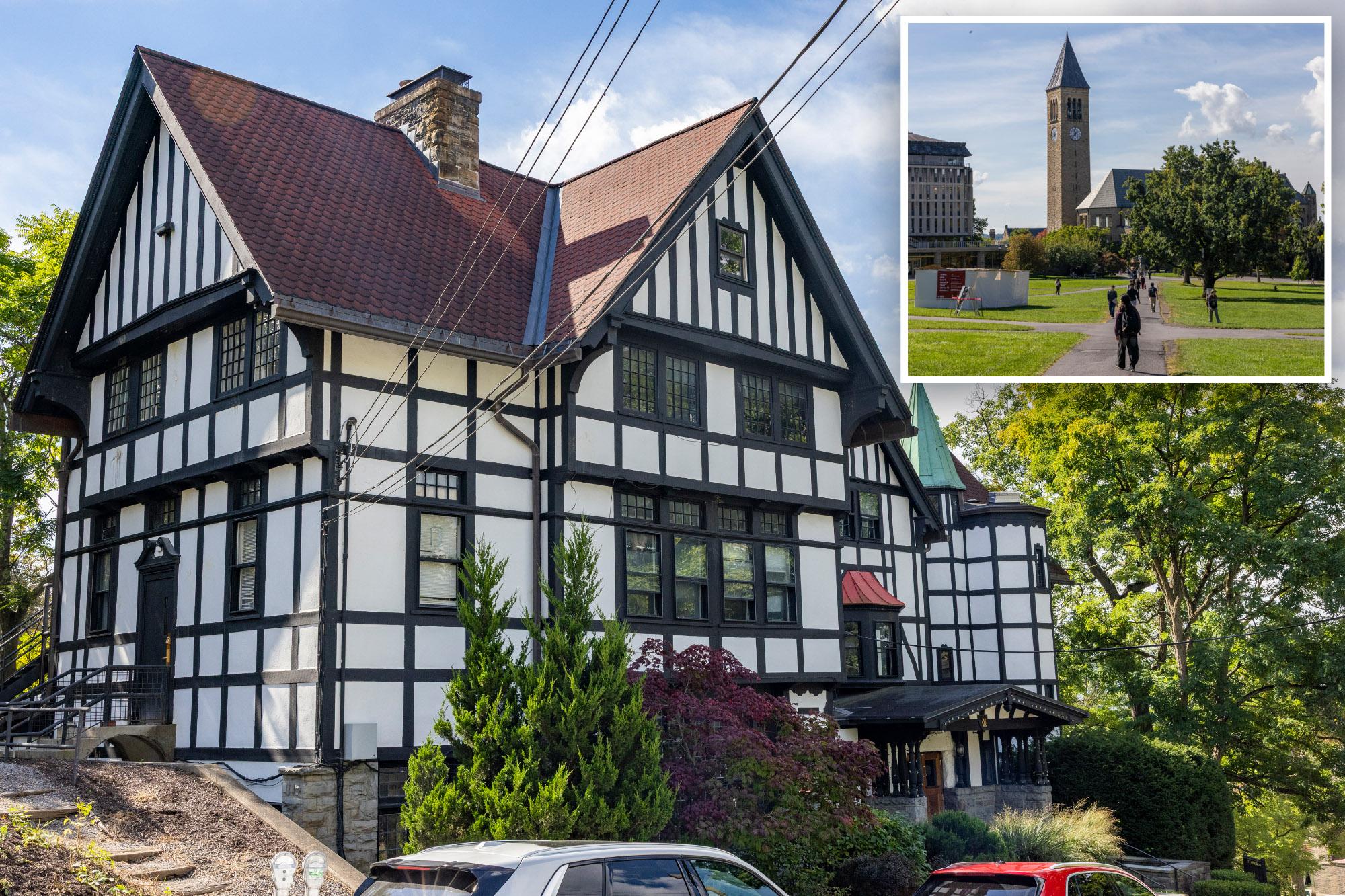
Make New York Post a Preferred Source Disturbing allegations of a drug-fueled gang rape at a Cornell University fraternity house have captured the nation’s attention since the case exploded into public view last month.
The public furor has only grown as new, and at times conflicting, details have emerged in the weeks since — with all of the involved parties vying to control the horrific case’s twisting and turning narratives.
“The Cornell case raises questions that go far beyond the alleged sexual assault itself,” said Sarah Klein, a prominent civil attorney who specializes in representing survivors of sexual abuse.
Beyond the sickening claims made against seven then-members of the Chi Phi fraternity, Cornell University, the local upstate New York district attorney and campus police have all been forced to defend their actions in the aftermath of the alleged 2024 incident.
The drama started on September 16 when the woman, identified only as Jane Doe in court papers, filed the sprawling 101-page lawsuit accusing the seven men of plying her with alcohol and ketamine and subjecting her to an hours-long sexual assault at the Chi Phi house.
Doe — who was then-a 20-year-old junior at the Ivy League school — said that a night out partying turned ugly after she arrived at the frat house on Oct. 19, 2024, and a brother she was crushing on propositioned her for a threesome.
“In her drunken state, [Doe] was incapable of consenting to this proposition,” the suit states — yet the fraternity member still led her upstairs.
He and a fellow Chi Phi brother allegedly “pressured” her into snorting ketamine — a powerful tranquilizer she’d never tried before — and also plied her with marijuana and high-proof rum, the suit states.
Soon after, both men “began engaging in sexual acts” with her — and the night devolved even further as more fraternity members slunk into the room, snorting lines of ketamine off of her body and having sex with her, according to the lawsuit.
Unbeknownst to the at the time, a sick clarion call had allegedly been sent out on a fraternity Snapchat group called “Chi Phi Actives,” declaring there was “free p–sy” in the house.
“Like you can walk in and whip it out,” one brother replied, while others said “I f–king love chi phi” and “CHI PHIII,” according to a screenshot included in the suit.
The ordeal began around 1:40 a.m. and didn’t end until just before 6 a.m. on Oct. 20, the suit alleged.
“With the encouragement of her friends,” she reported the incident to campus police on Nov. 8, and claimed her attackers were merely suspended before being allowed to “mitigate their conduct by submitting essays,” her suit stated.
The claims sparked national outrage — with critics demanding to know why the fraternity brothers hadn’t been charged with any crimes in the nearly two years since the alleged gang-rape.
Facing fierce backlash, Tompkins County District Attorney Matthew Van Houten on Monday attempted to explain why his office hadn’t pursued charges at the time, claiming all he had received was a signed statement submitted by campus police that “did not allege that she was drugged against her will or gang raped.”
“On the contrary, Jane Doe’s statement described her participation in drug use and sexual conduct as voluntary, conscious, and consensual,” Van Houten said.
He released excerpts from that statement, which seemed to depict Doe as willingly, if drunkenly, agreeing to have a threesome until “around 5:45am, [Doe] said [she] was tired and needed to turn in.”
“At that point, both guys stopped the threesome with [her] as far as [she] can remember,” Van Houten quoted from the statement — while also announcing that his office was reopening an investigation and convening a grand jury to potentially bring criminal charges.
The following day, excerpts from the six-page statement were reported by ABC News, showing Doe had said the boozing and drug-taking “felt like coercion,” and that she only kept taking ketamine so she could “pass out” and escape the ordeal.
“I had become extremely uncomfortable with how this night was turning out so my thought was, if I do ketamine again maybe I will pass out,” the statement read, according to the outlet.
“My thought was that if I passed out and these men had sex with me, then they could be charged with rape.”
Then a bombshell dropped Wednesday in the form of a transcript from Doe’s interview with campus police on Nov. 14-15, 2024, in which she reportedly told authorities: “I can say with 100% confidence I was raped.”
“It was coercion,” read another line from the transcript, obtained by CBS News, along with descriptions of Doe saying she was “completely and totally incapacitated” during the encounter.
Doe made those blunt and startling statements when she met with campus police and a Title IX investigator to discuss the incident, which she’d become increasingly alarmed by in the three weeks since.
It was a conversation that sprawled across about 120 pages, but was condensed the next day to the six-page document the DA apparently saw — and which Doe signed after saying she felt “very confident about this.”
It remains unclear how why assertion that she was sure she’d been raped during the interview did not appear in the statement included in the police report.
Van Houten insisted he “certainly” would have considered charges if he’d been aware of the statements.
Cornell Campus Police told The Post “all investigatory information” had been given to the DA’s office at the time.
The renowned Ithaca university’s Title IX office also conducted a lengthy investigation, compiling more than 1,000 documents, including interviews with Doe’s friends and roommates, the accused fraternity brothers and the alleged victim herself, as well as scores of text messages, The New York Times reported Thursday.
Those documents paint a picture of a young sorority girl traumatized by what she’d experienced in the immediate aftermath, with the full gravity of the situation taking days and weeks to sink in.
“I could tell that — just from personal experiences — that what she was going through is that she had not yet processed what had happened,” a sorority sister whom Doe had confided in told investigators, according to the Times.
Doe even continued to talk to the brother she’d initially gone to Chi Phi to see, texting him “at the end of the day non of the sexual stuff was illegal and honestly i really liked being w u” after he’d apologized for “how things went down the other night.”
But as word began to get around campus about her supposed “eightsome” with Chi Phi brothers, Doe’s lurking misgivings about the night quickly molted into horror when she saw online comments about how the brothers “gang r*ped a sophomore.”
“That’s the first time I had ever heard the narrative change that I wasn’t a whore and that I was assaulted,” she told investigators. “I was a sex doll for all intents and purposes, which is sad.”
She even confronted the brother she once liked — texting him on Nov. 3, “let’s be clear that 90% of what happened that night was not consensual. i was given more [ketamine] than i can remember.”
Within four days, she had gone to a local hospital for a rape kit and had begun the process of reporting the accusations to authorities.
At least two brothers were later revealed to have been expelled over the incident, while the others were apparently allowed to finish their studies.
Start your day with all you need to know Morning Report delivers the latest news, videos, photos and more.
The Chi Phi chapter was also disbanded by the university in 2024, though beer cans and bottles of booze still littered the lawn outside the old Tudor-style mansion with darkened windows this week.
Cornell, however, staunchly denied Doe’s allegations that the school’s response to her claims was inadequate — going so far as to call her “irresponsible” for claiming the brothers were let off the hook by merely penning essays.
But many questions remain about the school’s Title IX investigation, the details and results of which are kept private as such offices generally investigate allegations in-house and privately determine punishments for possible crimes that could result in decades behind bars in a real-world court of law.
“One of the most important issues in the civil litigation will be what Cornell knew, how university officials responded and whether they failed in their legal obligation to protect the student,” said Klein.
Attorney Julie Rendelman, who tackled sex-crime cases during her two decades as a Brooklyn prosecutor, agreed that “Civil litigation can expose institutional failures that a criminal prosecution may never address.”
Many students don’t seem to think the consequences Cornell meted out were adequate to the allegations in Doe’s lawsuit, and student protests are expected to spread across campus this weekend and into next week.
“This is obviously a horrible look for the university,” said 20-year-old junior Alex Walters, who has been part of the Cornell Student Assembly for two years as the VP of communications.
“I think they’ve not done much to respond well, or they’ve not improved the university’s image throughout the duration of this nationally-watched crisis,” he told The Post.
“It is purely evil the way that Jane Doe was treated,” he said. “It is not a way that I’ve ever imagined anyone I’ve interacted on this campus treating another person.”