play Live Sign upShow navigation menuplay Live Click here to searchsearchSign upNews Analysis|HouthisIran downplays possible role in Houthis’ recent Yemen victoriesIran has long been accused of links with the Houthis in Yemen, but how far do these links go?
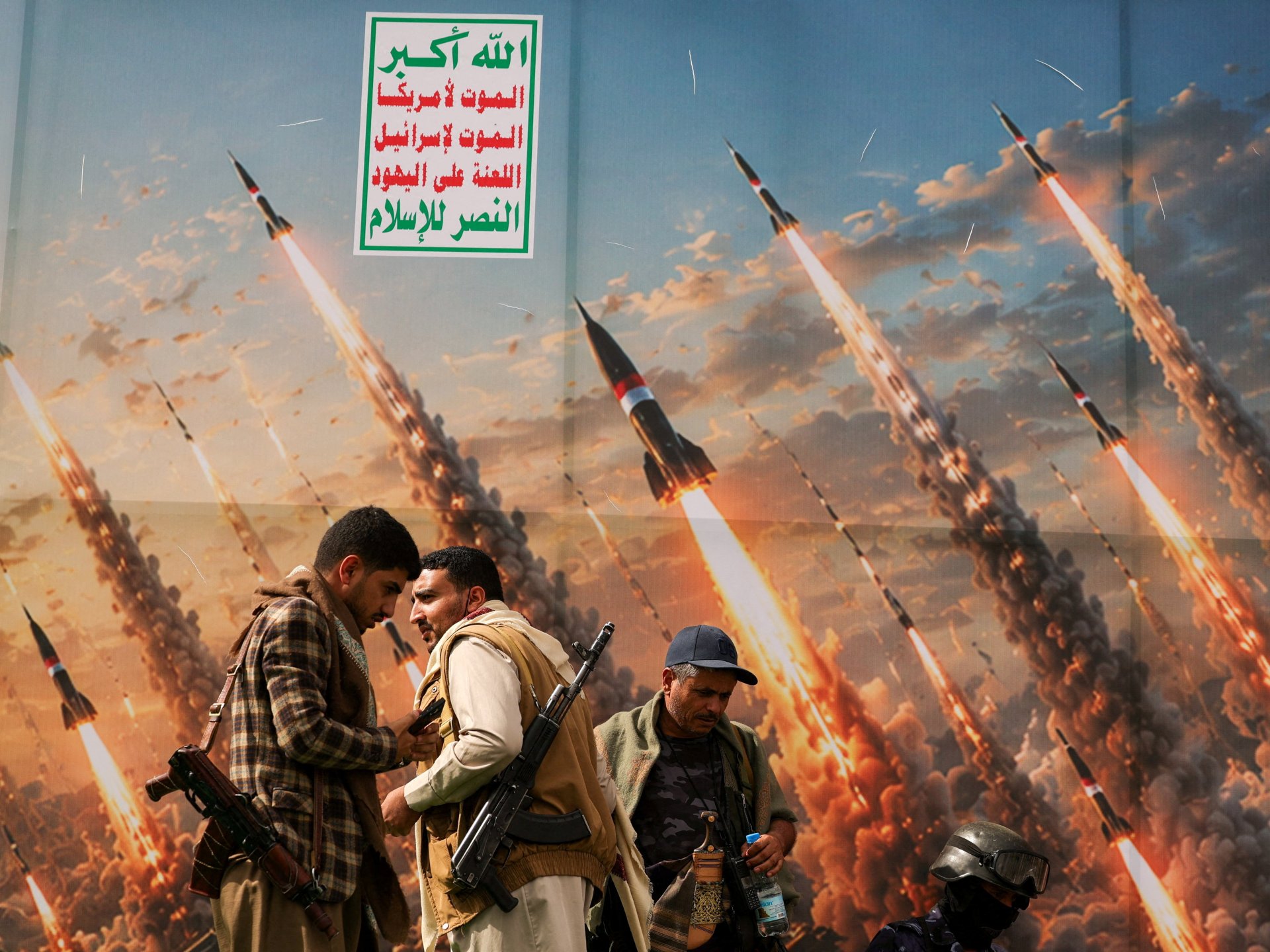
xwhatsapp-strokecopylinkgoogleAdd Al Jazeera on GoogleinfoHouthi activists stand on a platform against a banner depicting Houthi missiles, at an anti-Saudi rally amid an escalation with the kingdom, in Sanaa, Yemen, July 31, 2026 [Khaled Abdullah/Reuters]By Maziar MotamediPublished On 29 Sep 202629 Sep 2026Tehran, Iran – Strategic military victories in Yemen by the Tehran-allied Ansar Allah, also known as Houthis, have directed attention towards Iran’s role in the war against the internationally recognised Yemeni government.
According to recent US media reports, the Islamic Revolutionary Guard Corps (IRGC) helped direct an offensive in western Yemen that solidified Houthi control over the Bab al-Mandeb strait and the port city of Mocha.
The Houthis gains on the coast coincide with Iran’s disruptions of shipping in the Strait of Hormuz to pressure Washington to lift its naval blockade, US media have reported in recent weeks.
IRGC advisers worked with front-line commanders, assisted with communications and satellite-intelligence analysis, and promised ongoing military support to the Houthis, according to unnamed officials and soldiers cited.
Iranian authorities have not commented on details of the latest allegations but have broadly denied directing the Houthis. They and the Houthis have long stressed the Yemeni group’s independence, despite their geopolitical views often converging.
The IRGC said it viewed the Houthis recent advances in Yemen as a “divine triumph” that followed years of steadfastness.
Earlier this week, President Masoud Pezeshkian rejected a connection between Iran and Houthi actions during an interview with Al Jazeera. He also urged Saudi Arabia, which supports the Yemeni government, and the Houthis to negotiate to end the war. But he did offer Iranian assistance in resolving their years-long conflict, which has included Houthi missile and drone attacks on cities in Saudi Arabia.
Iran’s Ministry of Foreign Affairs earlier this month rejected a charge by US Secretary of State Marco Rubio that the Houthis are a proxy of Iran. It also highlighted the dire humanitarian consequences of a Saudi blockade on Yemen.
In mid-July, an Iranian passenger aircraft attempted to break the blockade by landing in the Houthi-run airport in the capital Sanaa. The aircraft was redirected after the Saudi-backed Yemeni government bombed the airport shortly before it was due to land.
The aeroplane ended up touching down in Hodeidah, and a Houthi official denied government allegations that the plane carried IRGC personnel.
Iran’s authorities said the plane carried a Houthi delegation which had participated in the funeral of slain Iranian Supreme Leader Ayatollah Ali Khamenei, as well as a number of Yemeni nationals who had received medical treatment in Iran.
This September, the Houthis captured Mocha, Dhubab and Mayyun (or Perim) Island, giving them command of Yemen’s west coast and the Bab al-Mandeb strait, which links the Red Sea to the Gulf of Aden. It also cut the internationally recognised Yemeni government’s access to the Red Sea.
In September 2024, a confidential United Nations report leaked to US media claimed that, with the help of the IRGC, Lebanon’s Hezbollah and Iraqi specialists, the Houthis had grown “from a localised armed group with limited capabilities to a powerful military organisation”.
Members of the Houthis were receiving tactical and technical training outside Yemen and members were travelling on fake passports to Iran, Lebanon and Iraq, the report alleged.
Iran played an important advisory and logistical role, although it is important not to overstate it, Yemen expert and political risk researcher Nicholas Brumfield told Al Jazeera.
“Iran has had advisers embedded with the Houthis for years, the IRGC [and Hezbollah] is involved in senior Houthi decision-making, and Iran continues to supply weapons and technology to the Houthis,” Brumfield said.
“That said, the west coast offensive reportedly involved 76,000 Yemeni fighters that the Houthis raised using their own governance apparatuses, and there is increasing evidence of the Houthis possessing domestic military industrial capabilities.”
Intense fighting in Yemen has focused on strategic high ground around Taiz and Lahij, including the Kahboub Mountains, as the Houthis seek to consolidate their recent gains and government forces attempt to recoup losses.
With Yemeni government forces now positioned in more favourable mountainous terrain with air support, the Houthis are not expected to repeat the same rapid advances they achieved in September.
This was achieved through their ability to deploy large numbers of fighters with strategic backing against relatively untested government-linked forces in Mocha.
They also exploited continued divisions among Yemeni government-aligned forces, including technically compromising their communications and command-and-control, and the unwillingness or unpreparedness of Saudi Arabia to provide air support during the coastal campaign.
Saudi Foreign Minister Faisal bin Farhan travelled to Washington for talks with Rubio on Tuesday, while UAE Vice President Mansour bin Zayed is scheduled to visit Riyadh after an invitation by Saudi Defence Minister Prince Khalid bin Salman. The UAE withdrew from Yemen after Saudi-backed government forces launched an offensive against Southern Transitional Council (STC) separatists, long accused of being supported by Abu Dhabi.
It is unknown why these meetings are taking place, but they come after conflicting reports about the level of support Washington is providing Saudi Arabia regarding Yemen. The US also reportedly declined Saudi requests for strikes in Yemen to support the government.
Since taking over Yemen’s west coast, the Houthis have stressed that they have no plans to disrupt Red Sea trade, but will continue to target Saudi-linked vessels.
US President Donald Trump said his administration had established contact with the group and was assured they would not target international shipping, at a time when global markets are in flux over disruptions in the Strait of Hormuz.
But since Yemen’s war restarted, the Houthis have successfully targeted several Saudi tankers and are believed to be behind disruptions to the critical East-West oil pipeline, as well as targeting multiple Saudi cities.
Both the Houthis and Tehran denied Saudi allegations that the Yemeni group was responsible for the launch of a drone towards the holy Muslim city of Mecca.
Pakistan’s Prime Minister Shehbaz Sharif told the UN General Assembly that any threat to Muslim holy sites in Mecca and Medina would constitute a “red line that must never be crossed”.
Pakistan and Turkiye, which have a defence pact with Riyadh, have so far refrained from entering the conflict despite sustained Houthi attacks on their ally Saudi Arabia.
The developments in Yemen have come as experts say Iran and the US appear to be on a course for military escalation, even as they maintain contact via mediators such as Pakistan, Qatar, Oman and Turkiye to reach a deal on reopening the Strait of Hormuz.
Yemen expert Brumfield said that despite attempts to distinguish the two parties, it is fair to describe the Houthis as a very close ally of Iran.
“There is a great deal of trust between them and Iran, they’ll go out of their way to help Tehran, and the strategic alignment between the two is such that they rarely have irreconcilable interests,” he said.
But the implications of acknowledging clear Houthi-Iran links would put Riyadh in a difficult position, as Saudi Arabia has suffered from Houthi attacks, as well strikes from Tehran-backed Iraqi militias.
“Earlier in the war, this vulnerability pushed the Saudis to be incredibly conciliatory to Iran even amid intense attacks, and it may be Riyadh simply has no option but to capitulate or cut a deal after the Houthis’ west coast advance, especially without major external support from the US or its Mecca Agreement allies,” Brumfield said.
The other choice for Saudi leaders would be to follow the UAE in adopting a more hardline stance against Iran and its allies. A major escalation would be the involvement of Saudi ground forces in Yemen, “something Riyadh has been very hesitant to do for over a decade”.