To play this video you need to enable JavaScript in your browser.This video can not be played
Watch: Correspondent takes cover as approaching drone interrupts report
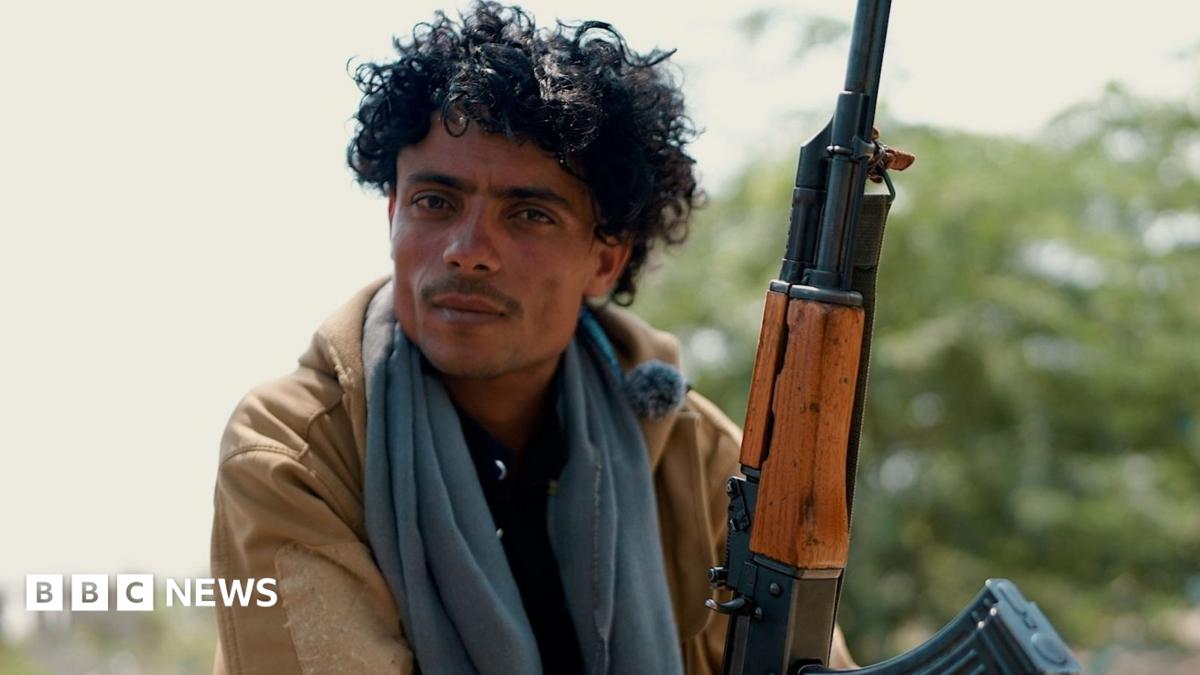
"This is the first drone," said the soldier accompanying us in south-western Yemen. "It's usually followed by an attack."
The buzzing sound overhead got louder as we took cover under the bushes, before climbing back into the vehicle and driving away.
Within about 10 minutes, the loud thuds of strikes followed, one after another, though it was unclear where they landed.
It is hard to tell where the front line begins in the mountains south-west of the city of Taiz.
Saudi-backed pro-government forces are battling to push back Houthi fighters, who swept down the coast of the Red Sea earlier this month, taking control of a key shipping chokepoint and escalating Yemen's civil war.
We travelled with government forces from Taiz through checkpoints to the line where their control ends and no man's land begins, in order to see the fighting up close.
Homes are scattered across the slopes, but many stand abandoned after families fled to escape the fighting.
It is eerily quiet, no sound of the cars or motorbikes that are continuously whizzing through the city. All you can hear is the bleating of livestock and the sound of incoming and outgoing fire.
"Two mortars landed here on my property," said Ali, sitting outside his home with a herd of goats, about 1km (0.6 miles) from the front line.
Image source, Liam Weir/BBCImage caption, Ali has remained at home under mortar fire to look after his goats
He told me he had sent his children to a displacement camp because they could no longer cope with the shelling and gunfire. He had stayed with his wife and sisters to look after their animals.
"I am terrified," he said, "but I have no choice, we will all go hungry without our animals and die anyway."
He gave only his first name, fearful of repercussions if the Houthis take over the area in the days ahead. Contacts from the Houthi side have told us they are consolidating troops, preparing for a major offensive. When we asked government forces about this they said they are aware and were preparing too.
At the closest checkpoint to the front line, we met some fighters who had just returned from positions high on the mountain, just a few hundred metres from advancing Houthis. One of them said the bodies of 18 government soldiers lay in an area his unit could fire across but not reach.
"We shoot over them, but we can't pull them out," he said.
Fighting around Taiz has intensified since the Houthis seized the strategic Red Sea port of Mokha, 85km to the west of the city, on 10 September, after a ceasefire that had largely held for four years unravelled.
The group took control of a swathe of territory overlooking the strategic Bab al-Mandab Strait – a crucial shipping corridor linking Europe and Asia. This contributed to a rise in oil prices as fears rose of further disruption to supplies from the region.
Taiz is Yemen's third biggest city and its cultural capital, and is home to close to a million people. It sits at a vital intersection between Houthi-controlled areas in northern Yemen and government-held ones in the south – and is hemmed in by front lines in several directions.
Government forces hold the centre of Taiz, while Houthi positions lie to its north and east. The fiercest recent fighting has been on the western approaches, where the two sides are contesting high ground overlooking the city's route south. If the Houthis secure these areas, government forces could find it much harder to retake Mokha.
We travelled to Taiz from Aden in the south, where Yemen's internationally recognised Presidential Leadership Council and government are based.
About 30 checkpoints along the route marked stretches of road controlled by different commanders – a clear sign of the fractured make-up of the forces fighting on the government side.
As we neared the city, ambulances began to pass us. We counted at least five within half an hour, heading towards Taiz's main hospital. It was clear that we were driving into a city at the heart of a brutal battle.
We arrived after dark. The shops were lit, the restaurants were packed and children were playing in the streets. But every so often, other sounds broke through – the thud of shelling and the crack of gunfire from the mountains around the city.
Image source, Liam Weir/BBCImage caption, An international coalition led by Saudi Arabia is providing the Yemeni government with weapons
Taiz has been a major battleground in the country's devastating civil war. After ousting the government from Sanaa in 2015, the Houthis attempted to also seize control of Taiz but were driven out of most of the city by local militiamen.
Now, in their latest offensive, Houthis are making extensive use of drones alongside other weapons.
Their main outside supplier is Iran, which has provided weapons, funding and military advice, according to Saudi Arabia, Western countries and UN experts. Iran, however, has previously denied supplying weapons to the Houthis and says it only supports them politically.
There have been persistent reports over many years of the Houthis recruiting child soldiers, and a government soldier told us he had faced them on the front line.
"It's difficult to look at a Yemeni child and shoot at him. But then they are pointing the gun at you and you have to defend yourself," he said.
The Houthis signed an "action plan" with the UN in 2022 pledging to end the practice. The BBC has also spoken to teenagers serving with government forces.
Meanwhile a coalition led by Saudi Arabia is backing the Yemeni government, and providing it with weapons. The Saudi military has carried out hundreds of air strikes on Houthi positions on the Red Sea coast, while the Houthis have launched drones and missiles at cities and infrastructure in south-western Saudi Arabia.
Image source, Liam Weir/BBC NewsImage caption, Twelve-year-old Ghana was seriously injured by a mortar while herding goats
In the evening, at al-Thawra hospital in Taiz, casualties from the front lines were being brought into an intensive care unit where every bed we saw was occupied.
Some patients were fighters, others were civilians. Twelve-year-old Ghana Nabeel had been herding goats when shrapnel struck her head. Her family said an incoming Houthi mortar had landed nearby.
She lay unconscious, her head wrapped in bandages, her face swollen and bruised. Her family were waiting at her bedside to learn what life might be like if she wakes up.
A doctor told me the injury had damaged her brain. "She will never be the same again," he said.
Image source, Liam Weir/BBCImage caption, The UN says 130,000 people have been displaced by fighting in Yemen so far this month
About 20km south of Taiz, at the al-Monig displacement camp, families who had fled Mokha and villages hit by fighting were arriving, among hundreds of tents.
We were told that 200 families had arrived in the previous 10 days.
Maryam Saleh, not her real name, had come a week earlier from Mokha with her husband and five children. The youngest is aged seven. Maryam sat weaving a hat to sell so she could buy food for the day.
"We walked barefoot and we didn't carry anything with us, just our children," she told me.
Her nephew was killed by shrapnel from a mortar as they fled, she said. He had been walking behind her. She described clashes and sniping both ahead of and behind the family and said she then saw armed men on the mountain.
"We thought we were finished," she said. The children were screaming and crying, but the family kept walking, she added.
Image source, Liam Weir/BBCImage caption, Fatma Mohammed Saleh, who cannot walk, says she crawled for two days before being given a lift by a motorcyclist
Fatma Mohammed Saleh was lying on an empty rice sack outside another family's tent. She has a disability and cannot walk, and told me she had nowhere of her own to sleep: "I have nothing… no shelter, no mattress, no family. Nothing."
Fatma said she had been with her two sons and their children when the fighting reached their village. But she was slowing them down so told them to take the children and run, she said.
She spent the next two days crawling on her hands and knees, she said.
"I was crawling and the bullets are coming from here and the shells are there. And the bullets are here, and the shells are here. And above me it was like thunder. I was praying to God."
A man on a motorbike then saw her and drove her to the camp, she said. She has not seen her family since.
On 22 September, the UN refugee agency said more than 130,000 people had been displaced across Yemen so far this month, on top of 5.2 million already displaced by the civil war.
It warned that another 100,000 could – like Fatma – be forced from their homes over the next three months.
Additional reporting by Jasmin Dyer
How escalating Saudi oil crisis could drive up prices everywhere