play Live Sign upShow navigation menuplay Live Click here to searchsearchSign upEXPLAINERSport|FootballWho is Gavin Bazunu, and why is he boycotting the Ireland vs Israel match?Gavin Bazunu says his decision to withdraw was based on a ‘personal belief that the killing of innocent people is wrong’.
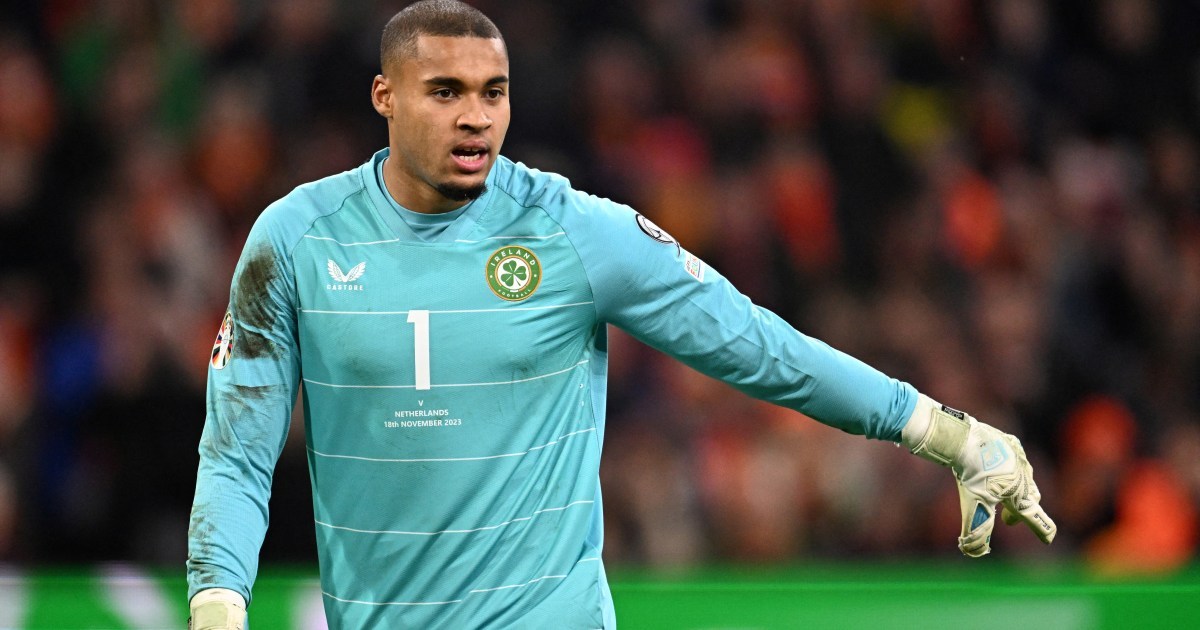
xwhatsapp-strokecopylinkgoogleAdd Al Jazeera on GoogleinfoIreland's goalkeeper Gavin Bazunu has withdrawn from both legs of his team's fixture against Israel in football's UEFA Nations League [File: John Thys/AFP]By Hafsa Adil and Ruqayyah FomboPublished On 27 Sep 202627 Sep 2026Footballer Gavin Bazunu is being hailed as a hero following his decision to withdraw from Ireland’s squad to face Israel in a UEFA Nations League match, which has been a point of contention between the Irish public and football officials since its confirmation in February.
Bazunu, who has been the Republic of Ireland’s first-choice goalkeeper in recent games, posted a statement on his social media accounts on Saturday, saying he felt “it would be wrong to participate in the upcoming fixtures against Israel”.
Subsequently, the Football Association of Ireland (FAI) announced that the 24-year-old would be replaced in the squad for Sunday’s fixture, which will be the first of two games that Ireland will play against Israel in a period of eight days.
Bazunu’s public stance to opt out of the game has been hailed by football fans, former Irish footballers, politicians, and pro-Palestine activists.
Al Jazeera breaks down the background to his withdrawal, the reaction to it, and the FAI’s decisions leading up to the match:
The six-foot-two-inch (1.88m) goalkeeper is a Dublin-born footballer of Irish and Nigerian descent, who rose through the ranks of Ireland’s youth football system to become the country’s first-choice shot-stopper.
Nigerian on his father’s side, Bazunu was part of Ireland’s age-group teams from the under-15 level before making his senior team debut as a teenager in 2021.
Bazunu’s brilliance in goal was spotted by English Premier League giants Manchester City, who signed him for their academy, where he played for three years.
According to reports in Irish media, Nigerian football officials were keen on signing Bazunu to their national squad, but the player pledged allegiance to the country of his birth.
He has represented Ireland in 22 international fixtures over the past five years and wears the goalkeeper’s preferred number one shirt for the country.
Bazunu found himself at the centre of a row involving Ireland’s match against Israel, which is part of the Nations League competition held by European football’s governing body, UEFA.
After the FAI confirmed that it would participate in the match despite months-long calls for a boycott due to Israel’s genocidal war on Gaza, Bazunu became the only player to publicly opt out of the fixture.
He withdrew from both legs of the fixture, scheduled on Sunday in Debrecen, Hungary, and on October 4 in Backa Topola, Serbia. Bazunu has not participated in the squad’s training at the Nagyerdei Stadion since the team arrived in Hungary.
He posted a statement on his social media account confirming his withdrawal, saying:
“Representing my country means everything to me. I have the utmost respect for every single one of my teammates, the manager, his staff, and the Irish people.
However, I have reached a decision that I have not taken lightly. I am a man of strong faith and try my best to be a person of character and principle. Therefore, I feel it would be wrong to participate in the upcoming fixtures against Israel.
My decision is based purely upon my personal belief that the killing of innocent people is wrong.
It is important to note that my stance is not in opposition to the Israeli people or the Jewish community, but against the atrocities in the region.
There are few times in life when you get a chance to stand up for something bigger, and I strongly believe that this is one of them.”
What has been the reaction to Bazunu’s decision?Former Irish footballer and manager Brian Kerr voiced strong support for the goalkeeper and directed his anger towards the FAI for proceeding with the fixture despite months-long protests in Ireland.
“It’s a very legitimate position for him to take,” Kerr told Irish broadcaster Virgin Media Sport on Saturday. “It’s a heroic decision,” he said of Bazunu’s call.
The 73-year-old revealed his communication with the goalkeeper, saying Bazunu was “feeling quite low and shunned by some of the players and the FAI”.
“It has been suggested to him that it would be better if he left the squad, which I think is disgraceful because there’s a game against Austria to be played, and why shouldn’t he be involved in that game?”
Ireland play Austria on Thursday in their third Nations League game of the international football window.
Kerr also revealed that Bazunu was kept out of the FAI’s meeting with the players earlier on Saturday, when a vote was taken on the Israel game.
“He wasn’t involved in the vote. They presumed and they knew his vote and didn’t bring him into discussions, which is sad.”
Meanwhile, politicians, football fans, and Palestinian activists have also lauded Bazunu’s call to sit out of the game and go public with his sentiment.
“Well done to Ireland goalkeeper Gavin Bazunu for taking the principled decision to withdraw from the game against Israel,” said Jeremy Corbyn, former leader of the United Kingdom’s Labour Party.
“He should never have been put in this position, but he has shown immense moral courage and integrity by doing the right thing in the face of genocide,” Corbyn, who is a human rights and Palestinian rights advocate, wrote on X.
Sayeeda Warsi, British Muslim politician and Member of the UK’s House of Lords, commended Bazunu.
“Taking a principled stand is a hard decision to take but the easiest one to live with,” she wrote in a social media post.
Earlier this month, Mary Lou McDonald, leader of Ireland’s main opposition party, Sinn Fein, also called for the FAI to “do the right thing by its players” by telling them not to take the field.
Irish actor and pro-Palestine activist Liam Cunningham said the FAI and UEFA “passed the buck” on the row surrounding the fixture and lambasted their move to leave the decision to Bazunu.
“The man is a hero!” he said of the goalkeeper.
Palestinian activist and journalist Abubakr Abed said Bazunu’s stance “means the world to the players of Gaza”.
Ireland-based pro-Palestine rights group Irish Sport for Palestine termed the decision “a colossal failure” in a statement following Saturday’s confirmation.
“If they let this game go ahead, they will have let the bullies win. Symbolic gestures won’t cut it. The only acceptable action is to StopTheGame. There is still time to do the right thing. Ireland will support you.”
Who will replace Bazunu in Ireland’s squad?While Caoimhin Kelleher and Max O’Leary are the other goalkeepers in Ireland’s squad, head coach Heimir Hallgrimsson has named outfield defender Jimmy Dunne as one of two reserve goalkeepers since UEFA rules require three goalkeepers to be named in the squad.
Ireland began their UEFA Nations League 2026-27 campaign with a match against Kosovo on Thursday, following which the players and staff met in the capital, Pristina, to decide how they would approach the upcoming games against Israel.
It was agreed that players would travel to Debrecen ahead of the first leg.
On Saturday morning in Hungary, Ireland’s pre-match press conference was delayed by several hours due to continued team discussions.
The chief executive of the FAI, David Courell, later clarified that a player had “expressed their discomfort” about playing the game and intended to withdraw from the squad.
He also announced that players voted on whether to fulfil the two fixtures. Courell said the outcome was in favour of playing both games by a “significant majority”.
Following Ireland’s decision to fulfil the match, Israeli Football Association communications chief Shlomi Barzel said “football has won”.
Barzel commended the Irish federation for agreeing to go ahead with the game and stated that “separation between football and politics must be maintained”.
Ever since the fixture was first confirmed on February 12, the FAI has been under pressure to boycott the matches due to Israel’s genocide in Gaza and Ireland’s status as a Palestine ally.
In May, leading Irish footballers joined celebrities in a campaign by Irish Sport for Palestine, urging Ireland to boycott the match against Israel. A United Nations inquiry confirmed in June 2025 that Israel was committing a genocide in Gaza.
The campaign group says Israel has breached UEFA and FIFA statutes by allowing teams to play on occupied Palestinian land and should be stripped of its membership at both football bodies.
As a result of team discussions, players decided on a range of actions to demonstrate their support for the Palestinian cause.
“There will be elements of the pre-match ceremony not be partaken in by the Republic of Ireland,” Courell said in his press conference, adding that his players will not partake in the traditional pre-match handshakes or exchange team pennants.
Exemption from media obligations for the remainder of the international break has also been requested by the players.
They will pay tribute to “all lives lost in the [Gaza] conflict” by wearing black armbands.
A significant proportion of match fees from the upcoming games against Israel and Austria will be donated to charitable causes.
A shared sense of struggle underpins the bond, with Dublin making landmark diplomatic moves against Israel in the past few years and especially during the Gaza genocide.
In the West, Ireland has been home to some of the loudest criticism of Israel and support of Palestinian rights.
After Israel began striking Gaza in October 2023, the Republic of Ireland, a member of the European Union, was one of the first countries to call for an “immediate humanitarian ceasefire” to meet the “urgent” needs of civilians.
In 1980, Ireland was the first European country to call for the establishment of a Palestinian state. Thirteen years later, it became the last EU member to open an Israeli embassy in Dublin, which Israel subsequently shuttered in 2024 in response to Irish protests over the Gaza war.
In 2021, Ireland became the first EU country to declare that Israel was involved in the “de facto annexation” of Palestinian land, upsetting Israel’s Foreign Ministry, which said the move “constitutes a victory for extremist Palestinian factions”.
“Ireland’s own history of colonisation by the British has made many Irish people empathetic towards other nations under occupation or colonisation,” said Cathal O’hEanna, a representative of the left-wing nationalist party Sinn Fein.
“Our centuries-long struggle for the right to self-determination resonates with the Palestinian struggle for statehood and independence,” he told Al Jazeera.
In June, Ireland barred Israel’s National Security Minister Itamar Ben-Gvir and its Finance Minister Bezalel Smotrich from visiting the country, citing their conduct towards pro-Palestinian activists and support for policies that would displace Palestinians from their homeland.
Earlier this month, Ireland became the second country, after the Netherlands, to announce a boycott of next year’s Eurovision Song Contest over Israel’s participation.
Irish rap group Kneecap’s members – who rap in Gaeilge, the Irish language, as well as English – have been outspoken in their condemnation of Israel’s genocide against Palestinians in the Gaza Strip.
Kneecap’s Liam O’Hanna was charged in May of last year with displaying a Hezbollah flag during a November 2024 concert in London, in violation of the United Kingdom’s 2000 Terrorism Act. The rap group called the attempted prosecution a “British state witch-hunt”.
Speaking after the British prosecutors lost an appeal seeking to reinstate a “terrorism” charge against him in March, O’Hanna, also known as Liam Og O hAnnaid, said that the case was “never about me, never about any threat to the public and never about terrorism”.
“It was always about Palestine,” he said, “about what happens if you dare to speak up, about what happens if you can reach large groups of people and expose their hypocrisy, about the lengths Britain will go to cover up Israeli and US war crimes.”