Video Dolph Lundgren opens up about cancer battle, becoming US citizen in ‘Fights Worth Fighting’ Actor Dolph Lundgren joins Fox & Friends to discuss his new memoir ‘Fights Worth Fighting,’ his journey to Hollywood and his battle with cancer.
This story discusses suicide. If you or someone you know is having thoughts of suicide, please contact the Suicide & Crisis Lifeline at 988 or 1-800-273-TALK (8255).
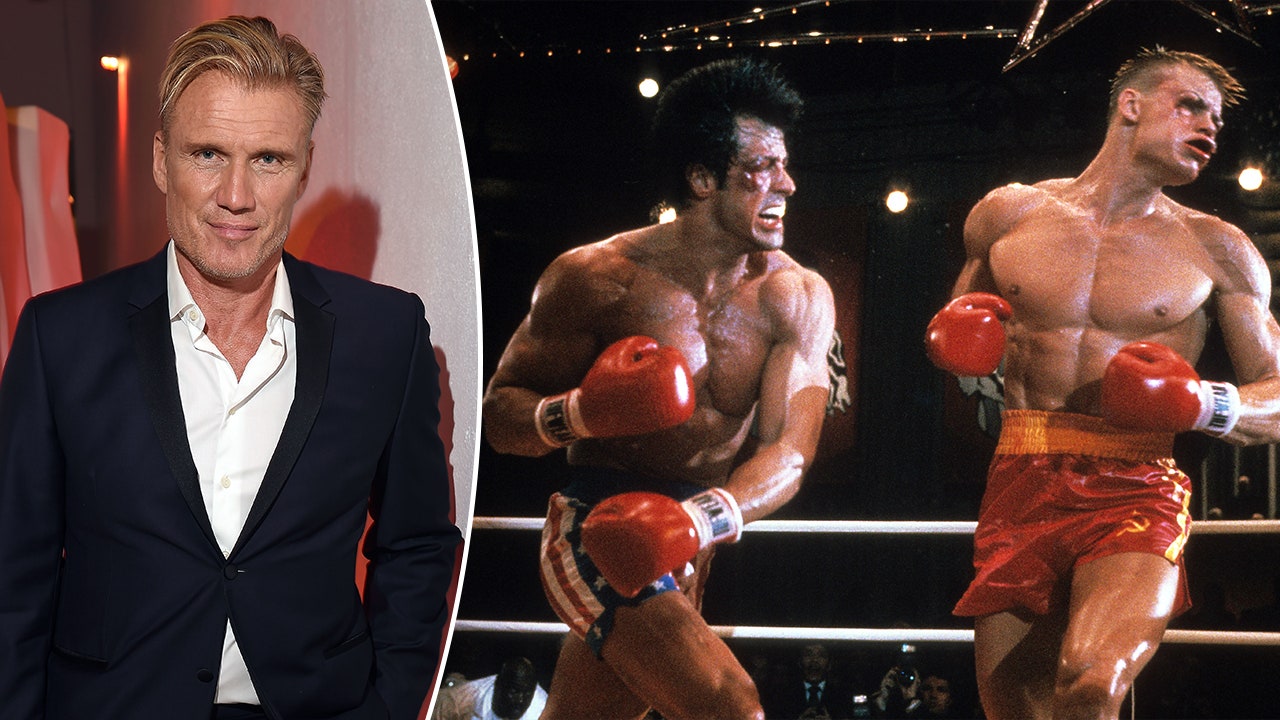
The Swedish actor, who famously played Soviet boxer Ivan Drago in "Rocky IV," has written a new memoir, "Fights Worth Fighting: Finding Strength in Struggle." In it, the 68-year-old details his grueling journey with cancer.
‘ROCKY’ STAR DOLPH LUNDGREN SWEARS BY THIS SECRET FOR STRONG MARRIAGE
Fox News may be compensated for or earn a commission if you buy through our referral links.
"Fights Worth Fighting: Finding Strength in Struggle" by Dolph Lundgren is available now. (Harper Horizon)
The star was diagnosed in 2015 after doctors found a cancerous tumor in his kidney. Lundgren had surgery to remove the tumor and continued appearing in movies like "Creed II" and "Aquaman."
After remaining cancer-free for five years, doctors discovered more tumors in 2020. He later learned the cancer had spread to his liver, both lungs, spine and in and around his left kidney.
Dolph Lundgren opened up about the dark moments in his cancer journey. (© Per Bernal)
"I had a lot of difficult conversations with myself," Lundgren told Fox News Digital. "I definitely had a few tough ones. Of course, as most older men do, you do estate planning. You plan your will and who's going to get what. But in this case, it was around the corner. It was something I had to plan a little more in detail, like funerals and trying to figure out where I would be, what would be better for my family. Planning your own funeral is kind of a saying, but I literally was doing that. That was tough."
WATCH: DOLPH LUNDGREN OPENS UP ABOUT CANCER BATTLE, BECOMING US CITIZEN IN ‘FIGHTS WORTH FIGHTING’
During that time, Lundgren said he considered ending his life.
"At some point, which was even harder, I started thinking, 'Do I really want to be in bed weighing 60 pounds and having people come and see me like that? Or should I just end it myself?'" Lundgren said. "I started considering that. I spoke to my brother. We made a deal, and he would help me out if it came to that, if I made that decision. But it was a tough conversation."
Swedish actor Dolph Lundgren with American actor, director and screenwriter Sylvester Stallone on the set of his movie "Rocky IV." (Sunset Boulevard/Corbis via Getty Images)
In the book, Lundgren wrote, "When I was deep into the cancer treatments and thinking about the possibility of killing myself, my brother, Johan, was going to help me, because I didn’t know what kind of condition I might be in once I made that decision. I could be in really bad shape by then and not capable of completing the suicide on my own."
Dolph Lundgren was diagnosed with kidney cancer in 2015. (Emma Krokdal)
"There are countries in Europe, like Switzerland, that permit legal suicide for people who are terminally ill, but I still might have needed someone there to help me," he continued. "Johan and I talked about it, but once I met Dr. Drakaki and began feeling a little better, it never went any further than that."
Lundgren’s longtime friend Johan Pramell also said in the memoir that the star "wanted to go out in glory like a Viking because he didn't want people to have to watch him suffer or fade away."
Dolph with his first wife, Anette, and daughters, Ida and Greta, on a family vacation. (Author's private collection.)
Medical aid in dying is not synonymous with euthanasia, according to the Online Journal of Issues in Nursing. The journal states that laws allowing medical aid in dying permit eligible adults with terminal illnesses to self-administer medication when certain criteria are met.
GET ENTERTAINMENT SCOOP DELIVERED RIGHT TO YOUR EMAIL BY CLICKING HERE
Dolph Lundgren and his cat, Bello, on his birthday. (Emma Krokdal)
Euthanasia, which is not legal in the United States, occurs when someone other than the patient administers medication with the intent of hastening the patient’s death, the journal states.
According to Dignity in Dying, a U.K.-based advocacy organization, 10 countries in Europe have laws that allow people experiencing "unbearable suffering" to access assisted dying.
Dolph Lundgren told Fox News Digital he wrote his memoir in hopes it will inspire others to keep fighting. (Emma Krokdal)
But one thing was certain — Lundgren wasn't ready to die.
Dolph Lundgren is seen here throwing a punch during treatment. (Emma Krokdal)
"I have a certain discipline, a fighter's heart, since I was a kid," he told Fox News Digital. "I think that was helpful. I may have had these thoughts, but the other side of me wants to go another round to see what happens. Maybe the other guy will drop. You never know. I think that's a part of it."
"But also, I believe being in good physical shape helped me, and continuing to work out through the whole thing," he said. "As much as I could, I would stay physically active. And then I was lucky to have my wife, who was very supportive, and my daughters."
"They're the ones that kept me going by just their sheer presence," he added.
LIKE WHAT YOU'RE READING? CLICK HERE FOR MORE ENTERTAINMENT NEWS
Dolph Lundgren and his wife are seen here in Greece. (Author's private collection.)
At one point, a doctor in the U.K. told Lundgren he likely had two or three years left to live. Lundgren wrote in his memoir that he believed, based on the doctor's tone, his prognosis could have been closer to one or two years.
After returning to Los Angeles, Lundgren sought a second opinion from Dr. Alexandra Drakaki, an oncologist at UCLA Health, whom he credited with saving his life. "At this point, I was depressed and had almost given up all hope," he wrote.
Dolph Lundgren poses for photographers at the Jameson Empire Film Awards held at the Grosvenor House Hotel, Park Lane, in London on March 25, 2012. (Carl Cour/AFP via Getty Images)
According to the memoir, Drakaki determined that his cancer had been misdiagnosed, leading to a different treatment approach.
"What she found was that my 'kidney cancer' cells had a mutation that is fairly common in lung cancer," he wrote. "That's why the medications I had been given for the past two years weren't working."
Dolph Lundgren is seen here becoming a U.S. citizen in 2024. (Emma Krokdal)
After Lundgren went public with his cancer battle, one heavyweight stood in his corner: Sylvester Stallone.
"Stallone and I have a long history, a good, long relationship together," he said. "We've known each other for 40 years. We've made six films together over that period. He went from being a mentor, a boss on set, director, producer. I was just a new kid on the block. And then slowly, we moved together and became more equals, I would say, two older guys who've been in the business a long time. And he has three daughters, I have two, and we share that as well."
Dolph Lundgren is seen here training at a martial arts camp. (Author's private collection.)
"When I got sick, he reached out to me," Lundgren said. "It was unexpected because he was the first one, actually, who reached out of everybody, even before some of my family, when it came out. And he was very emotional about it. It touched me. And that was another side of him that I'd never seen. Since then, we've been very close friends, even closer than before."
PUT YOUR ENTERTAINMENT KNOWLEDGE TO THE TEST AND SEE HOW YOU SCORE
Dolph Lundgren (right) is seen with Sylvester Stallone (left) and Jenny Sandersson on the set of a Tecate beer commercial. (Author's private collection)
In November 2024, Lundgren announced he was cancer-free. In his memoir, he reflects on whether performance-enhancing drugs may have played a role in his cancer battle.
Lundgren wrote that he used anabolic steroids and other performance-enhancing drugs on and off from 1986 to 1996 while preparing for physically demanding movie roles. While he stressed that there is "no conclusive evidence" the drugs caused his cancer, he acknowledged they "might have helped cause" it, adding that he could not say for certain.
Dolph Lundgren (center) with daughters Ida Lundgren (left) and Greta Lundgren attending the "Aquaman" premiere held at Cineworld in Leicester Square, London. (Ian West/PA Images via Getty Images)
"I wanted to be candid about my past and what I've been through," Lundgren explained. "And I think nobody knows what steroids and other performance-enhancing drugs do to us. The data is not conclusive. And I always thought it could not help me in my medical situation. I wanted to express a caution to people, to other young men, who may decide to try it, that it's not without risk."
Dolph Lundgren is seen in New York City on Sept. 22, 2026. (GC Images)
"I try to forgive and let go of everything from my past," he said. "That's very important to me. So, I don't blame myself. I was younger. I wasn't as smart as I am now. And I had pressures from the business. Is it really good for you? I doubt it. I really do."
Now, Lundgren said he still has plenty of fight in him.
CLICK HERE TO DOWNLOAD THE FOX NEWS APP
"I've obviously touched a lot of people as an actor in my business, and that's good," he said. "I've brightened up people's lives. I think that's great. That makes me feel good. I now hope to offer a little inspiration to others. I know I have so much more I want to do."
Stephanie Nolasco is an Entertainment Reporter for Fox News Digital.