Image source, JungWhen a beloved tree began withering away, locals suspected a killer in their midstByYujin Choi, BBC Korean, Reporting fromSeoul and Koh EwePublished26 minutes agoEvery summer, Seoul turns a deep green, growing dense and lush under humid skies.
"Green leaves were falling to the ground, which shouldn't happen at that time of year," recalls Jung, who lives near the streetside ginkgo in Buam-dong, a largely residential neighbourhood in the north of Seoul.
The tree is beloved by locals, who believe it has occupied its spot for more than 100 years. So Jung couldn't ignore what she was seeing. With each passing day, her curiosity turned to concern.
A rotting carpet of familiar fan-shaped leaves soon surrounded the tree, a sight so alarming Jung and her neighbours formed a crew of amateur detectives to solve the mystery: what was ailing their hardy ginkgo?
The whodunnit engrossed Buam-dong and piqued the country's interest, making national headlines. But the attention unsettled Jung, who spearheaded the campaign but has since requested anonymity - we are using a pseudonym.
"Imagine a grandfather who silently embraces you every day, listens to you, and has always been strong and full of life," she says. "Suddenly, he begins to die.
So began one community's fight to save a cherished symbol of their neighbourhood. Their unlikely enemy, who they believe plotted a surreptitious attack, was a museum built to honour a pioneering, nature-loving Korean artist.
Image source, Yujin Choi/BBCImage caption, As summer went by, the ginkgo's branches started to turn bare and brown
Tucked between two mountains, Buam-dong is recommended by travellers and locals for its picturesque views, art galleries and cosy cafes - an escape from Seoul's bustle.
Because of its proximity to the Blue House, the president's official residence, urban development has been restricted, allowing the neighbourhood to retain its quaint charm.
In a place where you usually find ginkgo trees in private gardens or untamed forests, this one is special, Jung says, because it flourished on the side of the road. To her, it's "Grandpa Ginkgo".
"I pass this tree whenever I come home. I would say, 'Grandpa, I'm home.' Or 'Grandpa, I'm heading out now'."
Jung only moved here four years ago, but the grand old tree was the first thing she noticed, and she grew to love it.
"It was the only tree in the neighbourhood that belongs to everyone."
To Park Jeon-hee, who has lived here for nearly all his 74 years, the ginkgo is his "oldest friend".
It's the same for 10-year-old Kim On, who walks past it everyday on his way to school. It has stood since before he was born, Kim says, and "thinking it might fall down makes me sad".
So it wasn't surprising that Jung found ready allies in the community who had also noticed the ginkgo's withering leaves.
They soon became suspicious of 10 white plastic funnels peeping out from behind the trunk. Jung had initially assumed they were providing nutrients, but then began to wonder if something more sinister was at play.
She and her neighbours sieved through security camera footage from a nearby house, until they found something odd: one morning in late April, the camera had recorded two men wearing white gloves and crouching over the base of the tree with a drill.
Were these men installing the funnels? Jung and the others couldn't exactly tell from the footage.
But then they remembered something the local council had told them: a museum had previously asked landowners in the area for permission to remove the tree.
The Whanki Museum had apparently claimed that its outer brick wall, which sits inches from the ginkgo, was under strain from the tree's roots.
The residents soon suspected the funnels contained some kind of herbicide that was slowly killing the tree - a suspicion also shared by arborists who came to examine it. And they believed the Whanki Museum was behind it all.
On the very day they saw the footage, a group of Buam-dong residents stormed into the museum, accompanied by four police officers. When confronted, an employee "basically admitted" the museum had done something to the tree, Jung and her neighbour alleged.
"Once they had said it, there was really no taking it back," the neighbour told the BBC.
The museum has neither publicly confirmed nor denied injecting herbicide into the tree, and has not responded to the BBC's questions.
But it did publish a statement in May, saying the wall of its compound was "collapsing because of the ginkgo's roots". It said it had sent letters to more than 40 property owners "requesting a solution".
There was no response, the museum said, so its staff "attempted to resolve the situation". It did not explain what they had done.
A local council representative told the BBC that an inspection last year found "no meaningful connection" between the ginkgo tree and damage to the museum wall. If there had been an issue, "we would have taken appropriate action and informed the relevant parties," the official added.
The residents, who still believe the Whanki Museum had the funnels installed, want them to reveal what was in them, so experts can treat the ginkgo. They have filed a police report against the museum's director. Officials say police are investigating the case, but police declined to share more information when contacted by the BBC.
Image source, Seoul KFEMImage caption, Residents allege that the Whanki Museum has poisoned the ginkgo tree
Opened in 1992, the museum is dedicated to the late Kim Whanki, a celebrated painter and abstract artist, known by many as the "Picasso of Korea".
On the museum website, architect Woo Kyusung explains he wanted to create a space for Kim's works "that would complement the elements of the nature - the moon, mountains, clouds, rocks and trees - that were so important to his art".
In fact, Kim wrote essays under the pen name Su-wha, which translates to "conversation with trees".
The irony is not lost on Buam-dong's indignant residents. Decades after Kim's death, the museum built in his honour is accused of trying to snuff out a tree. A ginkgo, no less, which is precious in Korea, where it symbolises longevity and resilience.
"Treating life that way is ignorance and there was never any apology," Jung says.
The residents have co-opted Kim's poetic nom de plume "Su-wha" for their moribund tree. They have also roped in an environmental activist group, which has launched a petition calling for citizens to be authorised as guardians of urban trees.
"When I first heard that a tree next to a museum had been poisoned with herbicide and was dying, I simply couldn't believe it," says activist Choi Jin-woo.
But when he saw the ginkgo shrivelling, he "realised something this horrific could actually happen in our society".
Image source, Yujin Choi/BBCImage caption, The Whanki Museum is dedicated to a pioneering artist known by many as the "Picasso of Korea"
If there's a silver lining to be found in the ginkgo's troubles, it's that the campaign to keep it alive has brought the people of Buam-dong closer together.
While spending her days garnering support, Jung would return to find home-cooked meals from her neighbours left by her door. She, in turn, made vegetable soup for neighbours she'd never met before.
As summer went by, they all watched the ginkgo's branches increasingly go bare and brown. An arborist who inspected it said it was "90% of the way toward death", Choi says.
The fate of the tree is now "in the hands of heaven", says a resigned Jung. "Perhaps all I can do is stay beside it and pray."
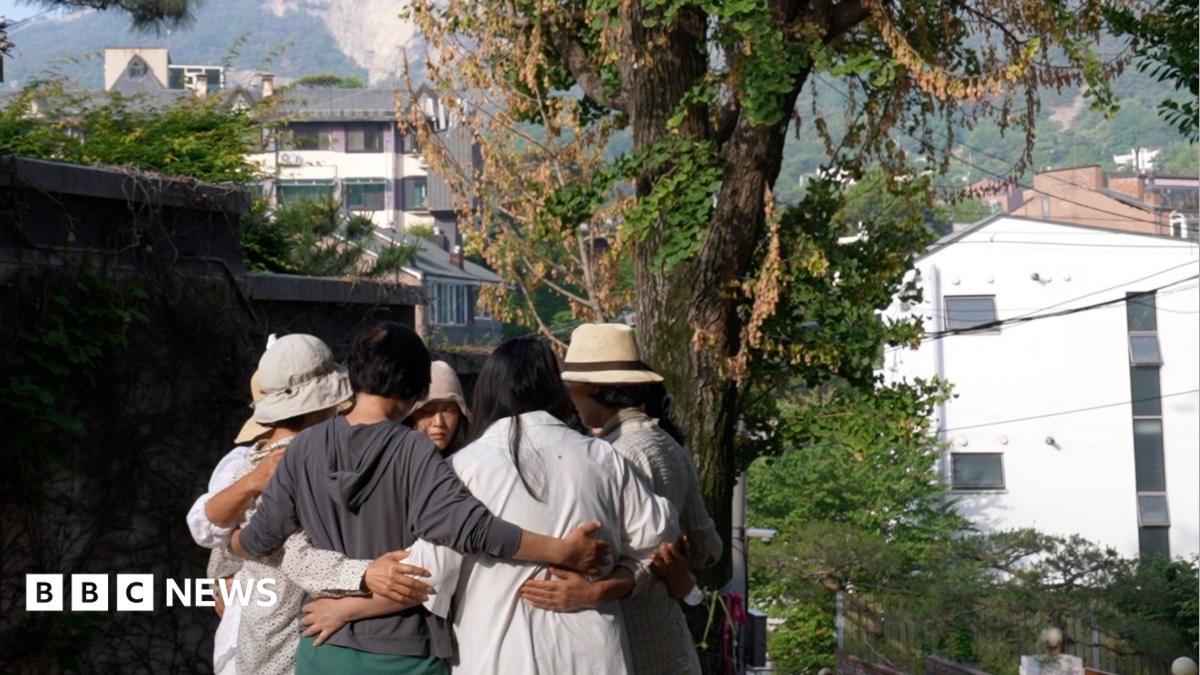
For weeks, around 20 residents regularly gathered in front of the tree to pray for its recovery. Some recited Whanki's essays, while a local shaman performed a "healing ritual".
Image source, Yujin Choi/BBCImage caption, Residents perform an "elm dance", which they believe promotes ecological healing
Notes of well wishes fluttered against the trunk as music rang out, and the group joined hands and swayed in unison for an "elm dance", which some nature lovers and activists believe helps trees heal.
"If someone had truly understood this tree was deeply loved, they probably would not have made the decision to inject herbicide," says Kim Min-joo, who has lived in Buam-dong for more than a decade.
Image source, Yujin Choi/BBCImage caption, Residents gathered regularly in front of the ginkgo tree to pray for its recovery
It recently occurred to Jung that all the days that she spent scrambling to save the ginkgo were the most active she had been since she fell ill last winter.
She had struggled to walk much and would often observe the tree from home. On better days, she strolled up to it, even hugging its jagged trunk and inhaling the earthy scent to lift her spirits.
"I felt so depressed and hopeless but those feelings disappeared. I entered a tree-like state."
She still can't walk very much, she adds, but "the tree helped bring me back out into life again. Ironically, it was because the tree became sick."
"Although it has been heartbreaking, there were also incredibly moving moments," Jung says, on reflection. "The neighbourhood came together, cared for one another, looked after each other."
As Seoul transforms into various shades of yellow with the arrival of autumn, the leaves on Buam-dong's once-prized ginkgo are a crispy brown.
Because they cannot imagine an autumn in which they don't pause to admire the ginkgo at its finest, swathed in a feathery coat of gold.
Image source, Yujin Choi/BBCRelated topicsSeoulSouth KoreaNatureMore on this storySycamore Gap tree: The story so far
Dating can be hard in South Korea - so the monks stepped in
Why I fell in love with a book called I Want to Die but I Want to Eat Tteokbokki