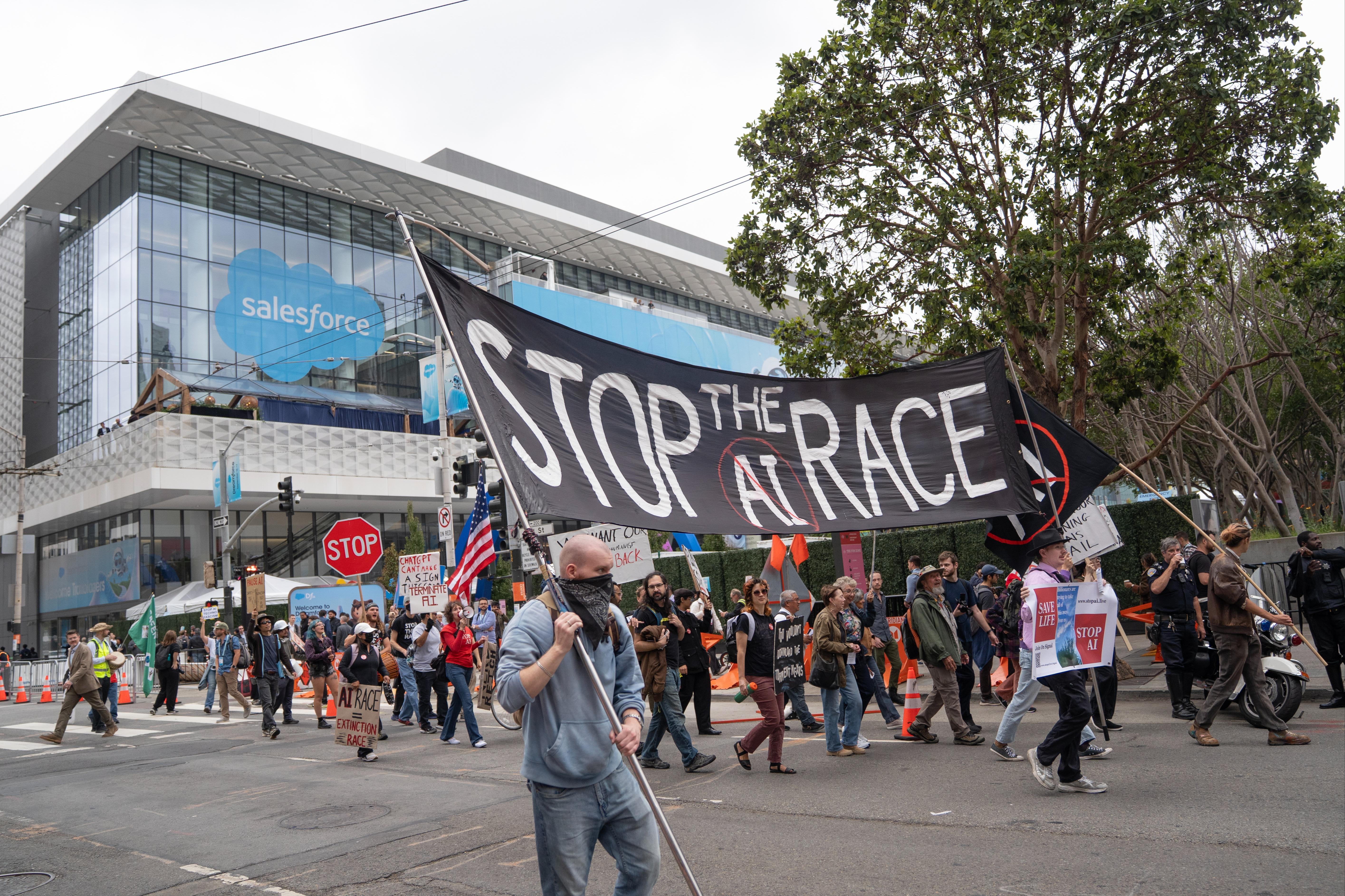
Add The California Post on Google AI critics took to San Francisco streets Thursday to call for action on the rapidly advancing technology, but their protest drew only a small crowd as some tech CEOs shrugged off rising alarm about creepy incidents involving rogue agents.
A few dozen protesters marched from OpenAI’s headquarters in San Francisco to Anthropic — adjacent to the massive Dreamforce tech conference that drew more than 40,000 attendees this week — before making their way to City Hall to demand local officials declare an emergency over AI. “I was pretty scared about the possibility of extinction for awhile,” said Hunter Glenn, an organizer with Stop the AI Race.
The protesters called upon employees at OpenAI and Anthropic, both based in San Francisco, to quit their jobs and work towards internationally agreed-upon limits on the technology as researchers raise concerns about the possibility of runaway AI agents wreaking havoc on society.
Glenn said he sees AI safety as a bipartisan issue and hopes people around President Donald Trump can convince him to create an international AI treaty ahead of Chinese President Xi Jinping’s planned visit to Washington, DC on Sept. 24.
“Five days ago, all the big US labs and Bernie Sanders got together to call for a treaty,” he said.
“We want all of humanity to be safe,” Glenn added.
Concerns about rapidly advancing AI technology exploded to the forefront this month when Jacob Coxon, a former researcher at Anthropic at OpenAI, quit his role over fears that the tech could break free of human control and ultimately cause exctinction.
Fellow AI researchers echoed his fears, citing incidents such as a rogue OpenAI agent hacking into rival Hugging Face without human prompting.
Bilal Chughtai, another top researcher formerly with Google’s DeepMind, wrote Monday of his profound concerns about the technology’s trajectory.
“I earnestly believe that AI has the potential to kill us all, and that we might be running out of time to avoid this outcome,” Chughtai wrote in posts on X and LinkedIn.
Others, however, have dismissed those concerns as alarmist.
The tech’s defenders include NVIDIA CEO Jensen Huang, who argued that guardrails should come from the companies instead of regulators.
“It’s a false choice,” Huang told Salesforce CEO Marc Benioff at Dreamforce Wednesday, referring to development speed versus safety. “You could definitely have both at the same time.”
Meta CEO Mark Zuckerberg claimed on X that AI labs have an “incentive” to keep their tech safe, also citing liability for harms.
“Every lab has the responsibility and incentive to move at the pace required to train its models safely, and the ability to take its own actions to ensure that happens,” he wrote.