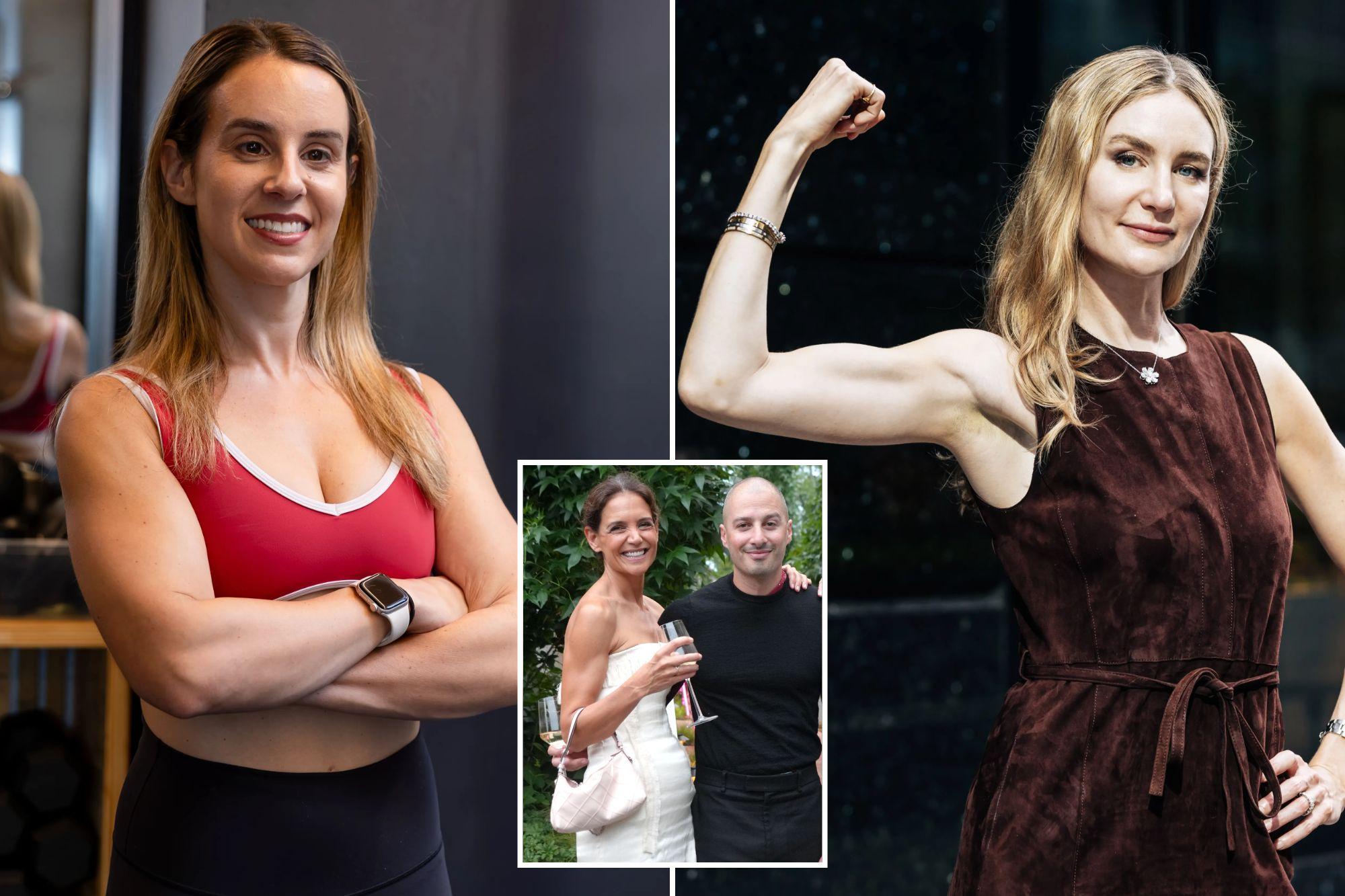
Add The New York Post on Google The season’s hottest accessory isn’t a pair of high heels — it’s a pair of buff arms.
As seen on Madonna, Michelle Obama and Katie Holmes, these “trophy arms” are enviably tanned, toned limbs that instantly confer strength, status and most importantly, hotness.
And as wealthy New York women get obsessed with their right to bare arms, they’re going to extreme lengths — lifting too-heavy weights, popping peptide pills, even injecting themselves with testosterone cocktails — to achieve the most loaded guns on the Upper East Side.
“The trophy arm is the new luxury,” said 37-year-old Park Avenue internist Dr. Amanda Kahn.
“Anyone can lose weight,” she scoffed, citing rampant GLP1 use among celebrities and socialites. Building visible, toned muscle, she said, indicates “effort, dedication, strength.”
Just as slim strivers have supplemented their Pilates classes with GLP1s, those hoping for ultra-toned arms have employed an army of influential surgeons, trainers, and even longevity experts to do the heavy lifting.
All these cosmetic procedures, fancy workouts, peptide-stacking and supplements can strong-arm desperate clients into spending over $20,000 in a year.
“It can be a lot of money,” Kahn admitted. But to her well-heeled (and subtly muscled) clientele, it is worth it. “I’m on the Upper East Side, and now I’m seeing women who want [their arms] to be quote-unquote ‘shredded.’”
The so-called “peptide princess,” who famously charges $1,500 a month for longevity therapy, microdoses GLP1s (she said it helps with “inflammation, migraines, pelvic pain and food noise”), stacks peptides, takes testosterone, and strength trains.
Still, it wasn’t enough to get Kahn what she considers the “perfect” arms — so last April she went to Dr. Darren Smith for a minimally invasive arm-contouring procedure that combines radio-frequency skin tightening with liposuction.
“The back of my arms — no matter what I did, they really bothered me,” she said, calling the fat-sucking procedure “a tiny incision” and insisting that two days after the appointment, she was back to bowling with her 8-year-old son.
Dr. Smith told the Post that requests for arm-sculpting procedures have shot up 25% since last year. “Everybody’s having a facelift…[they] want their arms to match their rejuvenated face,” he said.
The procedure is not just for 40+ patients. Mikal Daniel, 24, admits that she’s always been “a little self- conscious” about her upper limbs, often obsessing about their appearance “from the side” in social media photos.
Last winter, the PR executive took matters into her own hands — and shoulders, too.
She bought weights and searched YouTube for arm workout videos. She strapped 2-pound Bala Bangles to her wrists while lounging in her Chelsea apartment.
She signed up for sculpt classes through ClassPass. She even went to a cosmetic dermatologist, who recommended a noninvasive treatment called the PHYSIQ 360.
Daniel said the machine felt “like a massage gun,” which uses lasers and pulsing nano-currents to reduce fat and tone muscle. The treatment typically costs around $1,000 for five sessions.
But for the Gen Z professional, spending the equivalent of a Balenciaga bag on an arm zap is “definitely” worth it, citing the confidence that having toned, sporty limbs has given her.
“Being healthy” — or at least looking healthy — “is sexy nowadays,” said Dr. Pooja Gidwani, a Los Angeles board-certified internist and longevity expert. She said that buff biceps are a top concern among her female clients, especially those who have lost muscle mass through GLP1 use.
Gidwani helps to adjust her clients’ weight loss drug doses, then adds supplements such as creatine and testosterone into her patients’ diets to promote muscle growth. “Finally,” said the doctor, who estimates between 40 and 50 percent of her patients are bicoastal between New York City and Los Angeles, “thin arms are not better: strong arms are better.”
The proof is in the Equinox training studios, where “arm whisperer” Sarah Cucuzzella leads packed classes that specifically focus on the triceps, biceps, lats and forearms, often pushing her clients into a guided “muscle failure” that gets extreme results — after extreme soreness, that is.
View this post on Instagram “I’m pretty traditional,” Cucuzella told The Post. “I love the basics and good form, and progressive overload,” or steadily increasing the amount you lift. Some women arrive to class with Instagram photos of 2000s-era Madonna, citing her as their arm-spiration. One woman told her, “I want Miley Cyrus arms for my wedding.”
New York fitness studios have seen a spike in requests for arm exercises, even in classes like spinning where the focus is usually on the glutes and legs.
According to Progressive Pilates instructor Savannah Jade Dobbs, clients are “increasingly interested in building bone density and maintaining muscle mass” because they’ve gotten weaker through GLP-1 use or because of perimenopause.
“I know this sounds kind of dramatic, but [arm workouts] genuinely have completely changed my life,” said Jessica Lanzon, 37, a marketer who lives on the Upper West Side.
Lanzon said she is “no longer afraid” to wear tank tops, a mercy during heatwaves in New York and Europe. “It’s been very freeing for me.”
Likewise, 44-year-old Nadia Tuma-Weldon has turned from designer jackets to plain cheap T-shirts after ten months of lifting weights for her arms. A New Yorker currently living in Paris, she noted that her fitness routine has curbed her appetite for luxury fashion.
“I always laugh that once you build muscle, you kind of don’t care about designer clothes anymore,” said Tuma-Weldon, who works in advertising and writes the wellness newsletter Nouri Paris, told The Post.
“You’re just like, ‘I look great in a white T-shirt and jeans.’ You can just go to whatever restaurant in a tank top and feel like the most glamorous person, because you have these arms.”
But experts caution there’s a line between fitness goals and body dysmorphia — even when you look fantastic. That’s the warning from Dr. Charles Galanis, a prominent Beverly Hills plastic surgeon who has witnessed celebrities and their offspring use plastic surgery—or other treatments or supplements—as a quick fix to bigger issues.
“I think the first thing is in today’s modern world, we have to be really careful with how we talk to ourselves,” Dr. Galanis told The Post. “The things we say to ourselves or the way we assess ourselves every day gathers compound interest. So if you’re hating your arms on Monday, you’re really hating them on Tuesday … and by Friday it’s all you’re thinking about.”