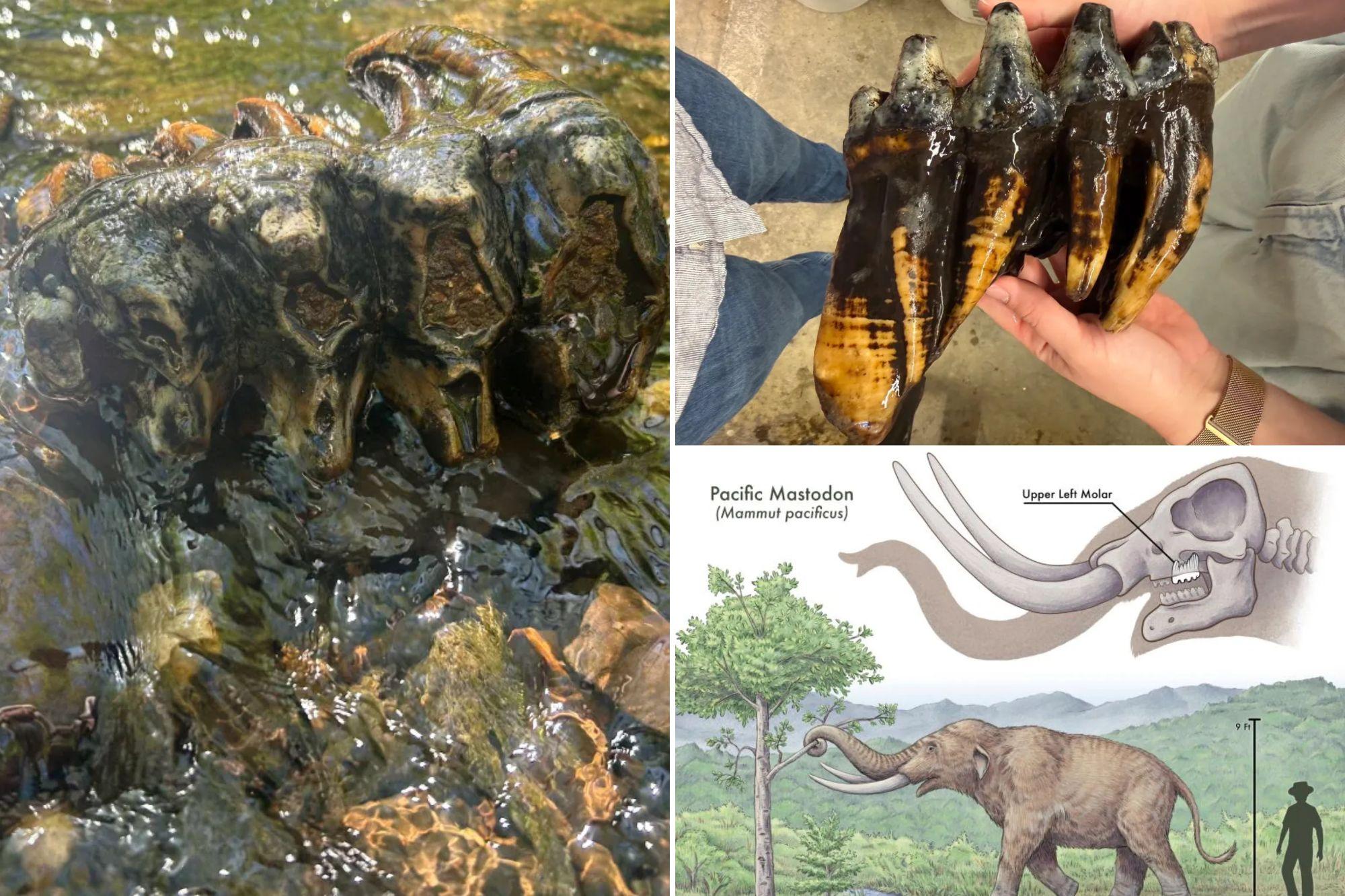
Add The California Post on Google A scientist accidentally discovered a jaw-dropping Ice Age fossil –– an ancient molar tooth –– while conducting field surveys in San Mateo County.
Brigid Lynch, a geomorphologist with Balance Hydrologics, was working on a project in a Midpeninsula Regional Open Space preserve to enhance the habitat for the threatened California red-legged frog when she stumbled upon an unusual rock in a creek bed.
“I was down in the creek bed surveying rocks when I came across it and thought — that one is very weirdly shaped,” Lynch said in a statement last week.
She took a photo of the rock and continued with her survey. A day later, when she was reviewing the photograph, Lynch learned that it was an exceptionally preserved upper left third molar belonging to an ancient Pacific mastodon estimated to be in its early 40s.
“As a geologist, I’ve gone out and seen stuff in the field, but definitely nothing as exciting as this,” she added.
The Pacific mastodon, once thought to be identical to the widespread American mastodon, is the newest species of mastodon to be recognized. Recent genetic and anatomical studies revealed that Pacific mastodons were distinct, with narrower teeth and thicker leg bones.
“The tooth itself is in immaculate condition. It’s the most complete mastodon molar from our area, and the most spectacular mastodon molar that I’ve ever seen,” said Wayne Thompson, paleontologist and owner of Pacific Paleontology.
The tooth has been donated to Stanford University’s Doerr School of Sustainability’s collection and will be made available to researchers who plan to use carbon dating to determine when the mastodon lived, its exact diet and the local climate conditions of its era.
“I had chills and shivers up and down my spine, so I was super happy to see this discovery because it can teach us a lot about the creatures themselves as a species and about this particular area. It’s another puzzle in the Ice Age saga that we can put into place,” Thompson added.
These giant Pleistocene herbivores roamed the region from 2.5 million years ago until their extinction roughly 11,700 years ago.
Unlike grass-eating mammoths, mastodons were browsers that used their powerful trunks to strip leaves, tender shoots and fruit from woody plants. Today, animals like deer, moose, elephants and giraffes carry on this same browsing habit.
“This find highlights for me that the presence of mastodons wasn’t that long ago, in geologic time. That mastodons were out here in the same landscape that I’m in today, 11,000 years ago roughly, really drives home how important the work we do is to keep species from winking out forever,” Matt Sharp Chaney, a biologist at Midpeninsula Regional Open Space District said.
California Post News: Facebook, Instagram, TikTok, X, YouTube, WhatsApp, LinkedInCalifornia Post Sports Facebook, Instagram, TikTok, YouTube, XCalifornia Post Opinion California Post Newsletters: Sign up here!California Post App: Download here!Home delivery: Sign up here!Page Six Hollywood: Sign up here!