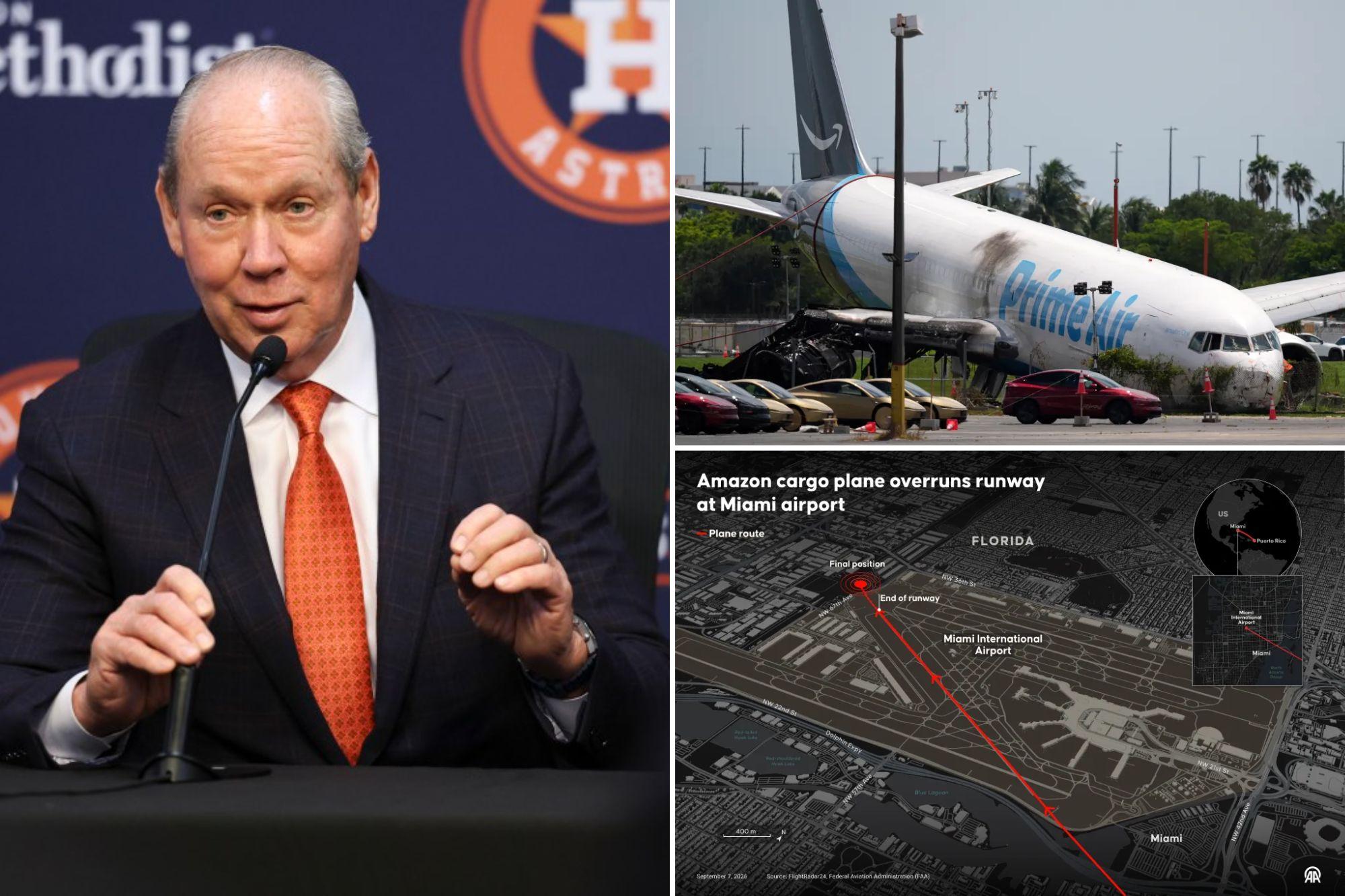
Add The New York Post on Google The operator of the Amazon Prime Air cargo plane that crashed in Miami and killed five people is controlled by Houston Astros owner Jim Crane.21 Air, a North Carolina-based all-cargo airline, is owned by Crane through an LLC, according to legal documents. He acquired the airline in 2021, according to a memo submitted to the Department of Transportation.“I own the controlling interest. I’ve got all the buttons. I don’t do deals where I don’t have control,” Crane bragged to Freight Waves in April.
The business mogul — who lives and works in Houston — is worth $2.5 billion, according to Forbes.
When he purchased the company it reportedly had four or five freighter aircraft, but Crane has grown its fleet to 16 planes, according to Freight Waves.
Yet his company was flagged for cutting corners and safety complaints by ex-employees before one of the Boeing 767 cargo planes operated by 21 Air ran off the runway Sunday and crashed into several vehicles.
Numerous senior staff members have filed complaints against 21 Air, with some saying they long feared a tragedy like Sunday’s deadly aviation crash at Miami International Airport.
“It’s something a lot of us ex-21 Air pilots have been anticipating for a while,” retired 21 Air pilot Tony Bless told CBS News, citing perennial concerns like ”maintenance safety issues, the pressure out of the chief pilot’s office, and the quality of pilots they would hire.”
The five people killed in the crash were part of a cleaning crew in a van struck by the plane when it overshot a runway, Miami-Dade County Sheriff Rosie Cordero-Stutz said.
21 Air did not reply to The Post’s request for comment, but its website shows a message from current CEO Keith Winters, who offered his “deepest condolences” to the families of the victims.
Capt. Joseph Carroll, 55, and First Officer Jaime Felipe Silva Molina, 37, have been identified as the pilots, who both survived but were hospitalized.“Was there fatigue involved? It could have been caused by pilot fatigue,” Robert Joslin, former FAA chief scientific and technical advisor, told The Post.
“It could be that it was an unstabilized approach. And obviously that would involve the pilots.”Joslin suggested a myriad of technical and human failures could be responsible for the tragedy.
“Braking systems and reverse thrusters could have failed. The pilots could have been off course, or at the wrong angle. The plane could have been too heavy. Or some combination of all of the above,” he added.
Normally such failures would be prevented or mitigated with redundancies — assuming the operator is following safety protocols, according to Joslin.But 21 Air executives were merely “paying lip service” to those protocols “then doing exactly nothing” when presented with concerns, wrote Bruce Joseph, a former fighter pilot reviewing safety policy for the company, in his resignation letter.
A former chief pilot for 21 Air, Joseph testified in his own Labor Department tribunal that he had “personal knowledge of people being discouraged” from recording safety concerns.
The Department of Transportation did not immediately reply to The Post’s request for comment.