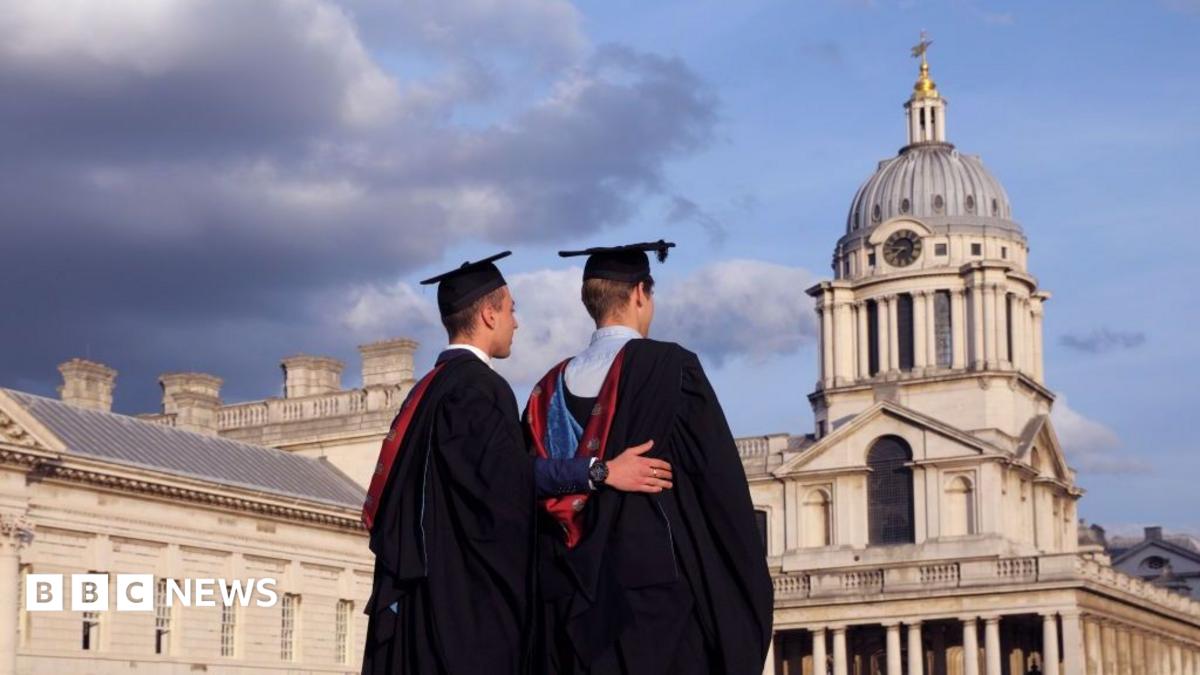
The universities of Kent and Greenwich have merged to form the UK's first "super-university" amid sector-wide financial pressures.
The new London and South East University Group (LASE) becomes the UK's third largest, with more than 50,000 students across four campuses in south-east London and Kent.
Leaders say the institutions are "much stronger" together as higher education providers face mounting economic strain, but the University and College Union previously raised concerns that the merger signalled a "broader problem for the sector".
The two universities, which legally merged last month, will still operate as distinct academic divisions within the group, retaining their current names.
Students will still apply to the institution they choose and degrees will be awarded in the name of Kent or Greenwich.
But the group will now be able to offer subjects that they could not before when they were separate entities, and students will be able to use libraries and access wellbeing services across the campuses in Greenwich, Medway and Canterbury.
Chief executive Prof Jane Harrington said the merger had made the universities financially stronger.
She said the combined group would also be better placed to help tackle regional youth unemployment.
"If I was to look through south-east London going out we've got areas of urban deprivation, then you go out into Medway and Kent you've got areas of rural deprivation and then we've got areas of coastal deprivation," she said.
"It's a real opportunity for us to address the very people that the government's worried about."
Image source, PA MediaImage caption, Prof Jane Harrington said the merged institution will better weather challenges
Harrington added: "Everyone probably now is starting to be familiar with the term Neets – basically people who are not in employment, education, or training (Neets) – and it's those very young people that we can now actually really start to look at what skills do they need."
There were an estimated 981,000 so-called Neets, aged 16 to 24, in April to June, a fall of 30,000 compared with the first quarter of the year.
The figure is still 30,000 higher than a year ago, according to the Office for National Statistics.
This is the first merger of its scale in the UK. Smaller mergers such as the amalgamation of three colleges within the University of the Highlands and Islands network have happened previously.
It comes as higher education providers in the UK have been facing increasing financial pressures, with MPs on the Education Committee warning earlier this year that there is a "real risk" a university in England could close due to insolvency for the first time.
The Office for Students, the higher education regulator in England, told the committee it feared 24 providers were at risk of becoming insolvent and closing in the 12 months from November last year, and warned 45% of higher education providers could be facing a deficit for 2025-26.
Harrington said challenges faced included additional barriers for high-fee international students, higher running costs and uncertainty in domestic student fee levels.
"So if you combine all of that, there isn't a university in this country that doesn't have to really look at their costs," she said.
LASE is writing up a lessons learned "blueprint" for the Department for Education to work as a "model" for a group structure which other universities would be able to use.
Harrington said the process was "not for the faint-hearted" but that it had been worth it.
In May, King's College London and Cranfield University, based in Bedford, announced plans to merge in August 2027.
Listen to the best of BBC Radio London on Sounds and follow BBC London on Facebook, external, X, external and Instagram, external. Send your story ideas to hello.bbclondon@bbc.co.uk, external
UK's first 'super-university' to be created as two merge from 2026
Universities merger to create 'global' institution
22,000 students told to pay back 'mis-sold' maintenance loans