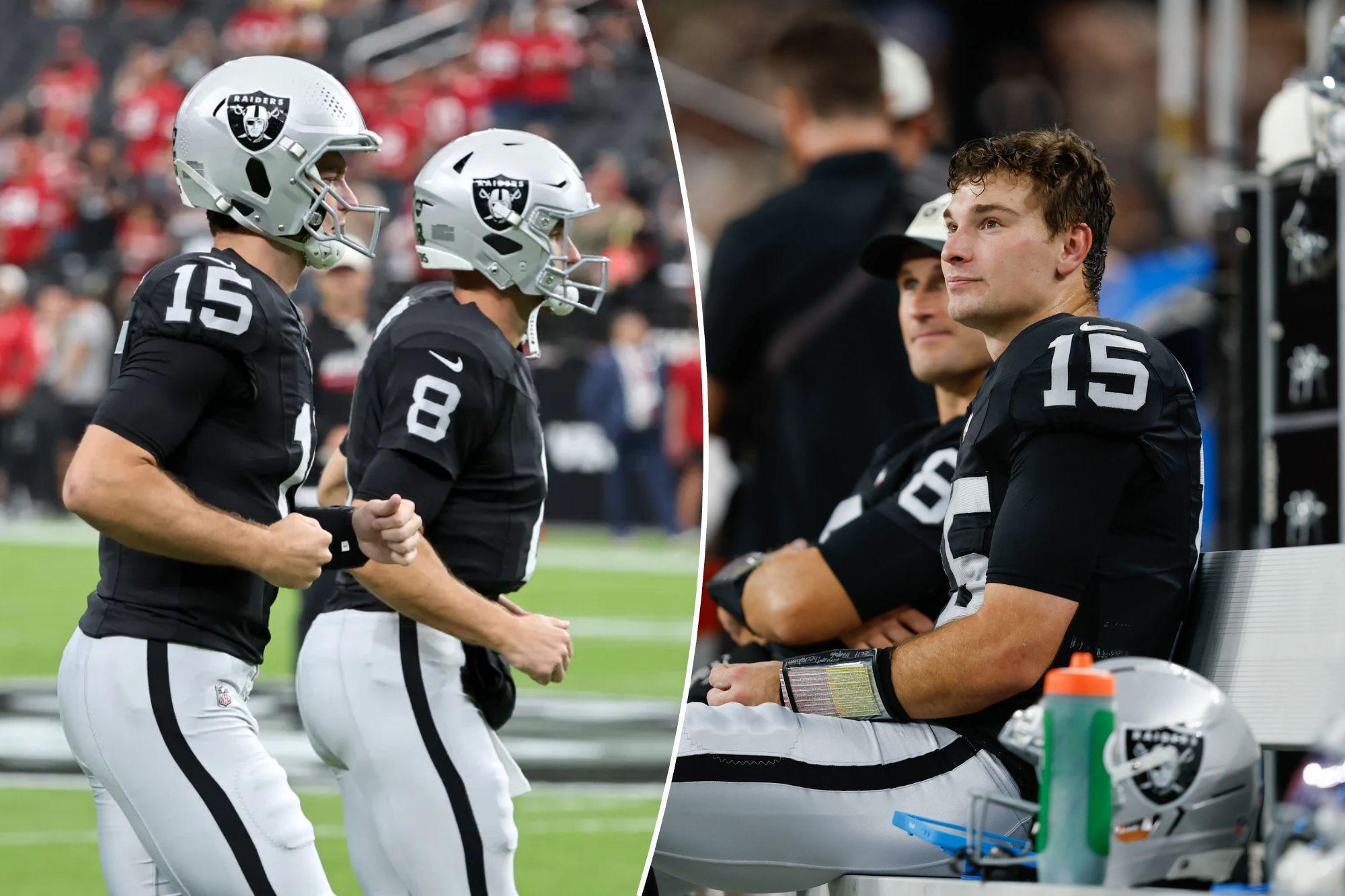
Add The California Post on Google Kirk Cousins starting the season at quarterback for the Raiders makes sense.
Cousins is a been-there veteran who understands Klint Kubiak’s offense and presently offers a steadier hand than Fernando Mendoza. He might no longer possess his peak physical ability, but he gives the Raiders their best chance to win immediately.
And if the 38-yer-old Cousins discovers some late-career magic, the offense comes together faster than expected, and the Raiders remain legitimately involved in the playoff race, keep starting him. They need to ride that wave as far as it will carry them.
But that is the only scenario in which Mendoza should spend his rookie season watching from the sideline.
The moment the playoffs become a pipe dream, Mendoza needs to play.
Not eventually. Not after another month of practice. Not when every possible excuse for keeping him on the bench has been exhausted.
But here is the thing. Not only didn’t Kubiak say Mendoza was QB2, he actually left open the possibility of Aidan O’Connell being Cousins back up, not Mendoza.
“We’ve got three guys that are ready to play.,” Kubiak recently said. “It’s going to be some hard decisions on who’s 1, who’s 2.”
Nothing against O’Connell, who has handled every situation professionally and shown he can enter an NFL huddle without being overwhelmed. But there is no world in which he should stand between Mendoza and meaningful playing time.
If Cousins gets hurt, Mendoza should replace him. If Cousins struggles while the Raiders tumble out of contention, the transition should happen then.
The Raiders used the first overall pick on Mendoza because they believe he can become their franchise quarterback. Once they made that decision, his development became the organization’s most important priority.
That does not mean handing him the job before he is ready. It means recognizing that readiness cannot be achieved exclusively in a meeting room or on a practice field or by watching from the sideline
Mendoza has to face an NFL pass rush, make protection calls, recover from an interception, and respond after a coverage fools him. He must learn how quickly throwing windows close and which chances will get his team beaten.
Those lessons are coming eventually. The Raiders gain nothing by unnecessarily postponing them until 2027.
I get it that Tom Brady, the Raiders’ de facto president of football operations, draws heavily on his own experience. Brady spent his rookie season developing before getting his opportunity.
It is not Fernando Mendoza’s – and NFL careers are not assembled from the same instruction manual.
Brady arrived in New England as a sixth-round lottery ticket behind Drew Bledsoe, an established quarterback who had led the Patriots to a Super Bowl. Nobody expected Brady to compete for the job as a rookie. New England had invested almost nothing in him.
That is two universes and an entire galaxy away from Mendoza’s situation.
The Raiders did not use the first overall pick on a developmental project. They selected Mendoza to become the centerpiece of the franchise and the player around whom their future will be constructed.
And you can miss me with the Patrick Mahomes, Aaron Rodgers and Jordan Love comparisons.
Mahomes sat behind Alex Smith as a rookie, but Kansas City was already a playoff team with an established quarterback and a succession plan. The Chiefs did not need Mahomes to rescue a rebuilding franchise.
Even then, are we certain waiting was right? Kansas City was bounced at home in the wild-card round with Mahomes watching from the sidelines.
Mahomes took over the next season and became league MVP. Can anyone dismiss the possibility that the Chiefs might have gone farther with him? Maybe sitting helped Mahomes. Maybe playing would have helped Kansas City.
Rodgers was the 24th pick and landed behind three-time MVP Brett Favre. Love was selected 26th by a Packers team coming off an NFC championship-game appearance with Rodgers playing at an MVP level.
Put some respect on those situations by respecting what they actually were. Mahomes, Rodgers, and Love were succession plans for successful teams with accomplished starters. Mendoza is the first overall pick of a rebuilding team that needs to learn whether he can become its foundation.
Context is not some minor detail that can be edited out to make the comparison work. Context is the entire argument.
The Raiders cannot use somebody else’s success story as an excuse to delay the beginning of their own.
And oh by the way, for all the fear surrounding the idea of playing a rookie quarterback, history is filled with high first-round picks who started immediately—or very early—and became enormously successful despite predictable growing pains.
Peyton Manning threw an NFL-record 28 interceptions as a rookie. Troy Aikman went 0-11 as a starter. John Elway completed fewer than half his passes and threw twice as many interceptions as touchdowns.
Matthew Stafford, Josh Allen, Joe Burrow, Justin Herbert, Andrew Luck, Cam Newton and C.J. Stroud were all forced to learn in real time. More recently, Caleb Williams, Jayden Daniels and Drake Maye were put on the field early rather than protected from adversity.
Some struggled more than others, but the struggles did not ruin them. They taught them. Playing young quarterbacks is not reckless when an organization supports them properly. Treating every mistake as potentially fatal – and using that fear to postpone their development – is.
By season’s end, the Raiders need to understand what Mendoza is and what he must become. Can he process quickly enough? Protect the football? Respond to pressure? Command an NFL huddle? Those questions cannot be answered while he holds a clipboard.
He also needs to grow with the Raiders’ young foundation: develop timing and trust with Brock Bowers, learn how Ashton Jeanty’s presence creates passing opportunities and operate behind this offensive line.
The goal cannot merely be surviving 2026. It must be using it to position the Raiders for a significant step in 2027 – learning which receivers complement Mendoza, whether the line can protect him and what the offense still lacks.
Most importantly, it means Mendoza enters 2027 with experience rather than mystery.
Sitting a young quarterback can help when an organization has an established starter, a competitive roster and a detailed plan. Sitting him because a veteran is the safer option in a season going nowhere is something else entirely.
That is organizational fear masquerading as patience.
The Raiders cannot be so afraid of Mendoza struggling that they prevent him from developing. They cannot spend the first overall pick on the most important position in sports and then treat every regular-season snap as too precious to invest in him.