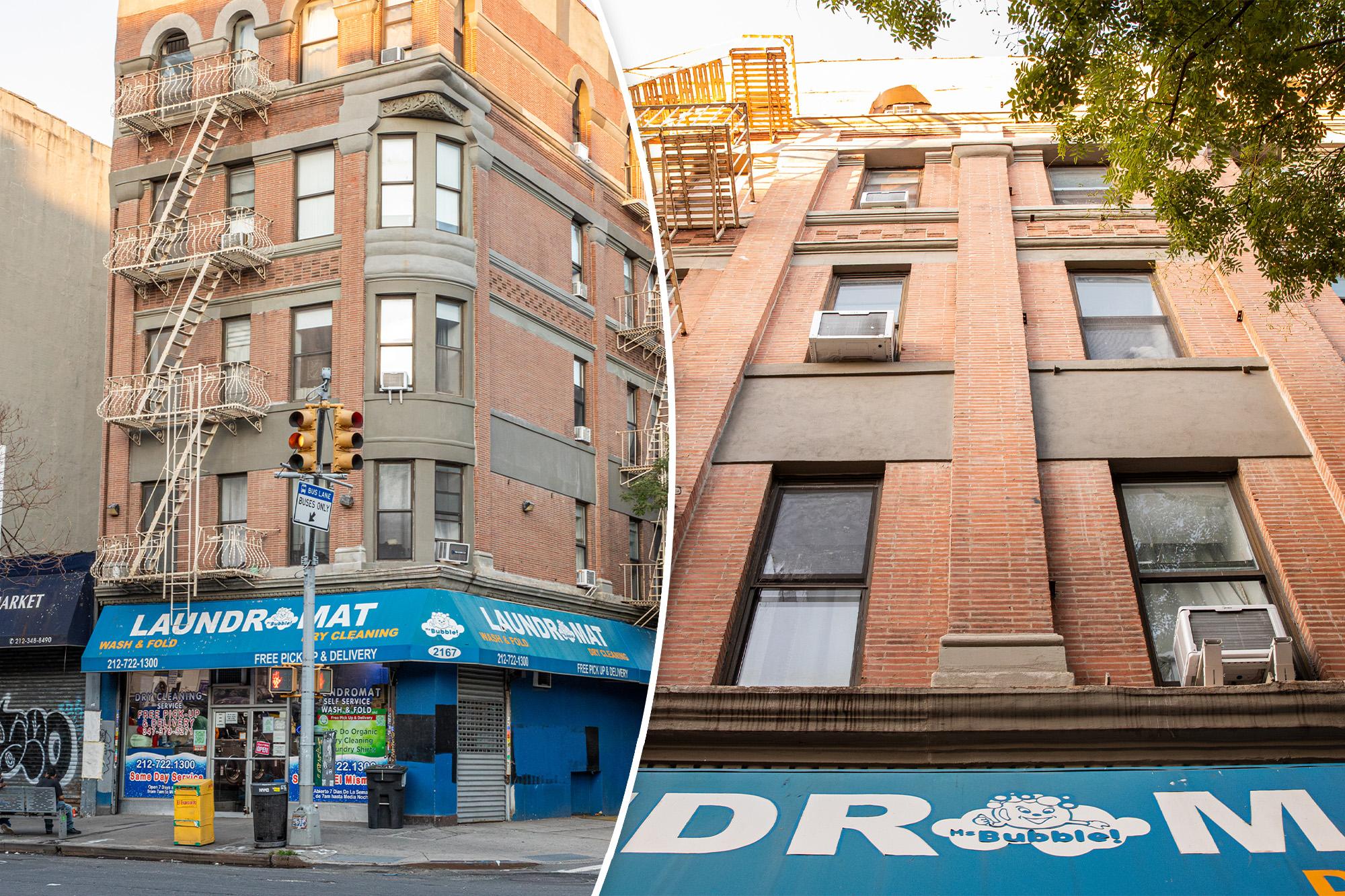
Add The New York Post on Google Last fall, when Dorian Solomon viewed the East Harlem studio apartment she now calls home, construction kept her from noticing the commotion from the Miss Bubble laundromat on the ground floor, directly below.
Since moving in, however, the disruption from the laundromat has been tormenting her with noise, vibration and fumes during all waking hours, while a boiler ticks noisily around the clock.
“I feel like a zombie,” Solomon told The Post. “In a small studio, there is nowhere to escape.”
The low-frequency vibration is a “heavy hum that resonates in your chest and penetrates right through earplugs and white noise,” said Solomon, 42, whose $2,550 monthly rent at the East 118th Street building is paid by a city housing assistance program.
“I walk outside for hours daily simply to escape,” she said. “I am exhausted, distressed and emotionally drained.”
Miss Bubble, sometimes labeled Ms. Bubble, has 32 branches in Manhattan and Brooklyn, with a website calling it “New York’s best laundry service,” stating that “all of our work is done on our premises — we don’t use off-site services. This way we can manage and oversee every aspect of our cleaning process ensuring best practices for you and for us all.”
Solomon wonders why commercial laundromats are even allowed inside residential buildings.
“Behind that business listing is a tenant living with constant vibration, combustion fumes and chronic health symptoms, and a city enforcement system where every agency treats the problem as someone else’s job,” she said.
Last spring, Solomon sued the landlord, Akari Equities, to obtain repairs. The landlord’s lawyer, Eric Kahan, wrote in court documents that the landlord “never failed or refused to correct any violations in the subject premises,” but is also “willing and ready” to correct any that do exist.
And if the city’s Department of Housing Preservation and Development did issue any violations, the landlord “does not concede or agree that any report or violations as written or issued by HPD are accurate or that same constitute violations of law,” Kahan wrote.
He also wrote that no other residents of the 20-unit building have complained, and that Solomon didn’t grant access “to inspect the alleged conditions.”
Solomon, who was unable to obtain legal aid, withdrew the lawsuit because the issues she broached are not generally enforced through housing court, which deals primarily with maintenance concerns such as leaks, lead paint and lack of heat.
Kahan didn’t return requests for comment, nor did a Miss Bubble representative.
Desperate for relief, Solomon then spent months scrutinizing city records and attempting to navigate an uncaring bureaucracy. She has contacted multiple city agencies and officials, the main result being inspections marked “resolved” that resolve nothing.
“My goal is a livable home,” she told The Post.
Records from the Department of Buildings show that the certificate of occupancy allows for a tenant laundry room, which doesn’t currently exist, plus an eating and drinking establishment on the ground floor.
But, according to a DOB spokesman, the property has a “letter of no objection” that allows for the space to be legally converted into a laundromat.
At one point, a building inspector did issue a violation for the laundromat, but “the summons issued by the inspectors was reviewed by DOB attorneys, who determined that it was issued in error,” the spokesman said.
Solomon complained to the DOB that “the laundromat is making the building shake,” but the DOB claims otherwise.
“We have inspected this property multiple times in response to the constituent’s complaints and have not observed the shaking or vibration of the building … nor issued any enforcement actions for alleged unpermitted or illegal occupancy,” the spokesman said.
Though the 2023 building code has certain sound transmission standards for structure-borne noise, including an “impact insulation rating” for dwelling units sharing a floor or ceiling with a mechanical equipment space, “these modern code requirements are not retroactive,” and existing buildings need not comply, the spokesman said.
Several other complaints about Miss Bubble were received before Solomon moved in. One neighbor complained about the laundromat ventilation “blowing toxic dust into my apartment … it is effecting [sic] my health.” Another complained of “air quality … so bad that it is affecting my love one causing asthma and other health issue.”
The fumes persist, said Solomon, who was frustrated by the Department of Environmental Protection’s response to her complaints about noise and air quality.
Last month, the DEP conducted an inspection, and “the complainant did not answer the door, so the inspector left a voicemail,” according to a DEP spokesman.
But nobody buzzed, Solomon said. “I got a call from an unknown number and missed it. They left a voicemail, but there was no number for me to call back.” The morning of the inspection was uncharacteristically quiet, she said, likely because management had been notified in advance.
“I came out of the shelter system through a city housing assistance program, and this apartment was supposed to be stable housing,” Solomon said. Her miserable situation shows “a systemic tenant protection failure.”
That’s true, said Andrew Scherer, a professor at New York Law School and an expert in landlord-tenant law. “The system is wholly inadequate,” he told The Post.
“We haven’t made decent, affordable housing a reality for everybody. If the building doesn’t violate any codes, the city agencies almost never do anything affirmative or proactive. There is no routine enforcement or inspections. It’s all complaint-driven.”
The housing-court approach — going to court with a common-law nuisance or warranty-of-habitability case — is tough for someone with few resources and the inability to pay a lawyer, Scherer said. Free legal services prioritize people facing eviction.
“It’s not so much that there’s nothing that can be done,” Scherer told The Post. “It’s that there aren’t the resources to actually do it. Potential solutions would take significant effort on the part of this tenant. The system doesn’t have any automatic resolution to things like this, which is very unfortunate.”
A person can keep complaining, but “nothing is a sure shot,” Scherer said. In some cases tenants join forces, but Solomon believes the neighbors are afraid to complain too vociferously.
“Mayor Mamdani says ‘government only works when it answers to the people it serves,’” Solomon said. “I spent months asking his agencies why their own records contradicted one another. I couldn’t get answers. So by the mayor’s own standard, who was government answering to?”
The mayor’s housing spokesman didn’t return requests for comment.
Solomon’s landlord has offered a penalty-free lease break, she said, and she would be glad to move, but it’s tough to find apartments that accept rental assistance and are in acceptable condition.
“I cannot resolve a health crisis by relocating into another one,” she said.