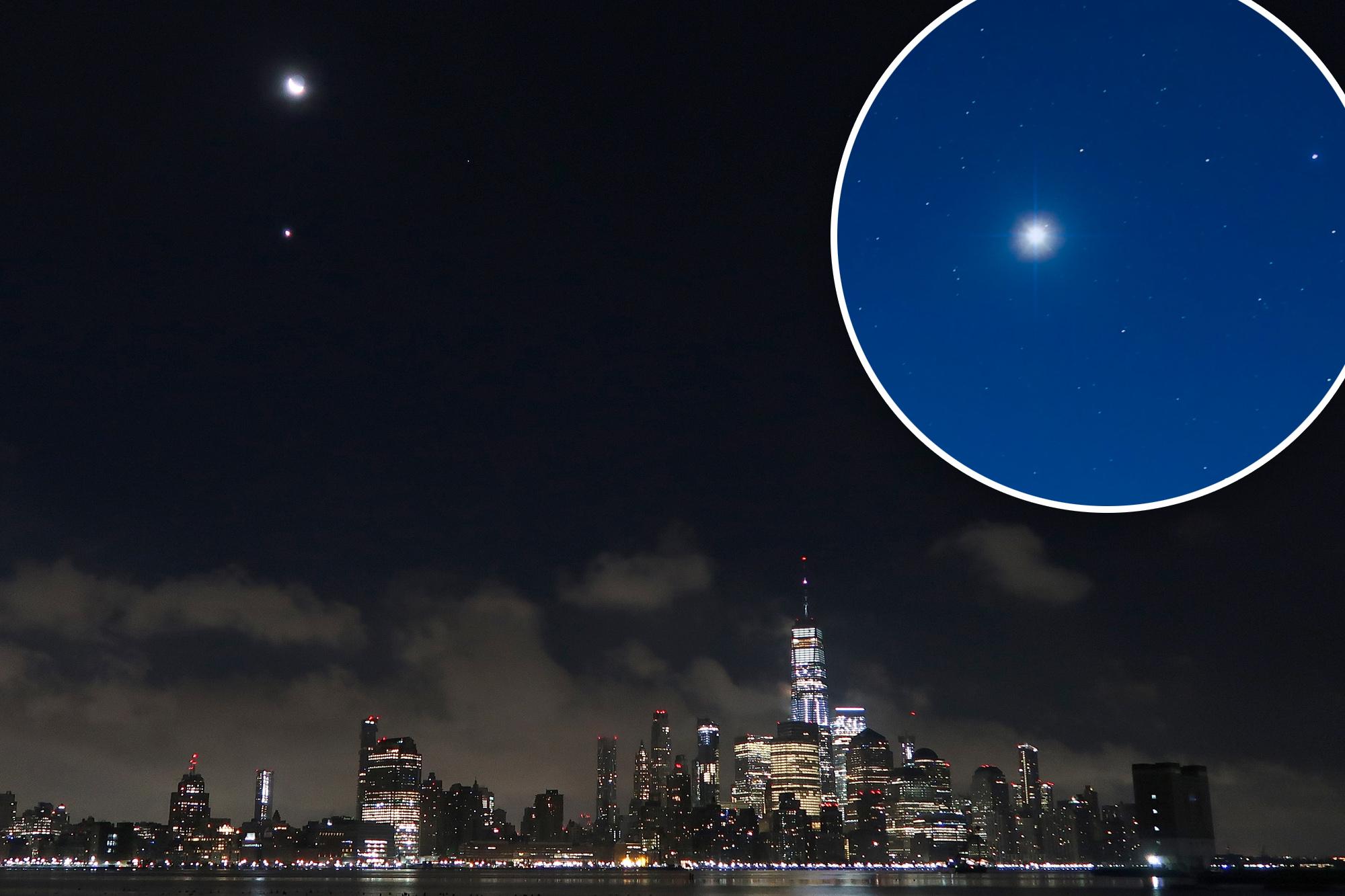
On September 1 and 2, Venus will share the sky with the bright star Spica for a cosmic two-fer that will be visible to the naked eye. wowinside - stock.adobe.com See more of our coverage in your search results.
Add The New York Post on Google Venus will be dancing with the star.
Stargazers need not mourn the end of summer just yet — the season is ending with a celestial doubleheader for the ages. September kicks off with Venus soaring past Spica, the Virgo constellation’s most luminous star, for a cosmic meet-cute that will be visible from Earth.
During the early part of the month, the second rock from the sun will appear just after sunset, according to earthsky.org.
It will be joined by Spica on September 1 and 2, with the two star-crossed lovers appearing “roughly 2 full-moon widths apart” during their hot, heavenly hookup, per the site.
Their interstellar fling will only last until the middle of the month, whereupon Venus will drift away from the luminous entity.
But that’s not the only cosmic rendezvous on the horizon this week.
Before dawn on Thursday, September 3, the waning gibbous moon will share the sky with Pleiades (also called the Seven Sisters) in the constellation Taurus, Forbes.com reported.
Our lunar satellite will then share the sky with Mars before dawn on Sunday, September 6.
On September 4th, meanwhile, the moon will attain its last quarter phase, making the sky dark enough to spot galaxies, nebulae and other phenomena.
In the interim, here’s how to catch Spica canoodling with the hottest planet in the galaxy.
The best window will be between September 1 and 2, when stargazers are urged to look to the western horizon during the deep twilight hours around 20-30 minutes after the sun sets, People.com reported.
For optimal viewing, sky watchers should choose a clear vantage point away from buildings, trees and other obstructions.
Watching from a balcony, beach or other unobstructed spot could allow gawkers to capture this spectacle more clearly.
Best of all, stargazers don’t need any fancy equipment to catch these celestial celebrities in the act. Venus and Spica will be visible to the naked eye with the world’s hottest planet appearing as a bright white pinprick of light.
Once the sky darkens, Spica will show up above it as a fainter blue-and-white speck.
That being said, it’s nonetheless best to view this spectacle through electronic eyes, according to Astronomy.com.
“With the planet so close to the star in the sky, you should be able to capture both easily in binoculars or a telescope’s field of view,” they write. “They will also make a lovely centerpiece for a nightscape photo — and the bright points of light should be easy to capture even with a cellphone.”