Add The California Post on Google California’s ambitious high-speed rail megaproject is facing a critical cash bottleneck and could run out of money by the end of 2027.
The California High-Speed Rail Authority’s Inspector General warned the project will run out of funding by as soon as the end of next year.
The estimated cost of the train project has ballooned to a staggering $231 billion, with completion now delayed until roughly 2039.
In an official letter sent to Governor Gavin Newsom and state legislative leaders reviewing the final 2026 Business Plan, Benjamin Belnap blasted that the agency that he said “has obscured basic facts about the project, hindering lawmakers’ ability to provide effective oversight”.
According to Inspector General Belnap’s report, the state agency faces a significant funding gap over the next five fiscal years. To keep ongoing construction on track for the initial Merced-to-Bakersfield segment, the project needs an immediate $2.2 billion in additional financing for fiscal year 2027–28 alone.
Beyond the cash flow bottleneck, the Authority has spent over $5.7 billion on delay and change-order fees, including $537 million paid to a single contractor in February.
David Tangipa, a Republican state assembly member representing the Fresno area, said that the project had begun when he was a child and there has been no significant progress ever since.
“Whenever anybody asks me what my position on high-speed rail is, I tell them I did not vote for high-speed rail because I was 12 years old when this project started,” Tangipa told KCRA.
Rep. Kevin Kiley (R-Roseville) called the California high-speed rail project “the worst public infrastructure failure in U.S. history.”
“Thankfully, we have now cut off all further federal funding,” Kiley told The Post.
High-Speed Rail Authority CEO Ian Choudri spoke at a Fresno rotary club last week and pinned blame on California’s byzantine building rules for out-of-control costs and delays.
He seemed to particularly emphasize laws requiring environmental reviews, specifically the California Environmental Quality Act, for causing delays.
““Back in the day, in the 1800s, we were able to build infrastructure like this in a very short amount of time. What happened after that, continuously we kept regulating ourselves more and more and more,” Choudri said.
The original voter-approved 2008 bond measure estimated $33.5 billion for the entire Phase 1 network (San Francisco to Los Angeles/Anaheim). Today, building just the 171-mile Central Valley segment (Merced to Bakersfield) is projected to cost up to $35.7–$36 billion, surpassing the original estimate for the whole state.
The estimates to connect San Francisco to Los Angeles now range up to $128 billion on paper, according to KCRA.
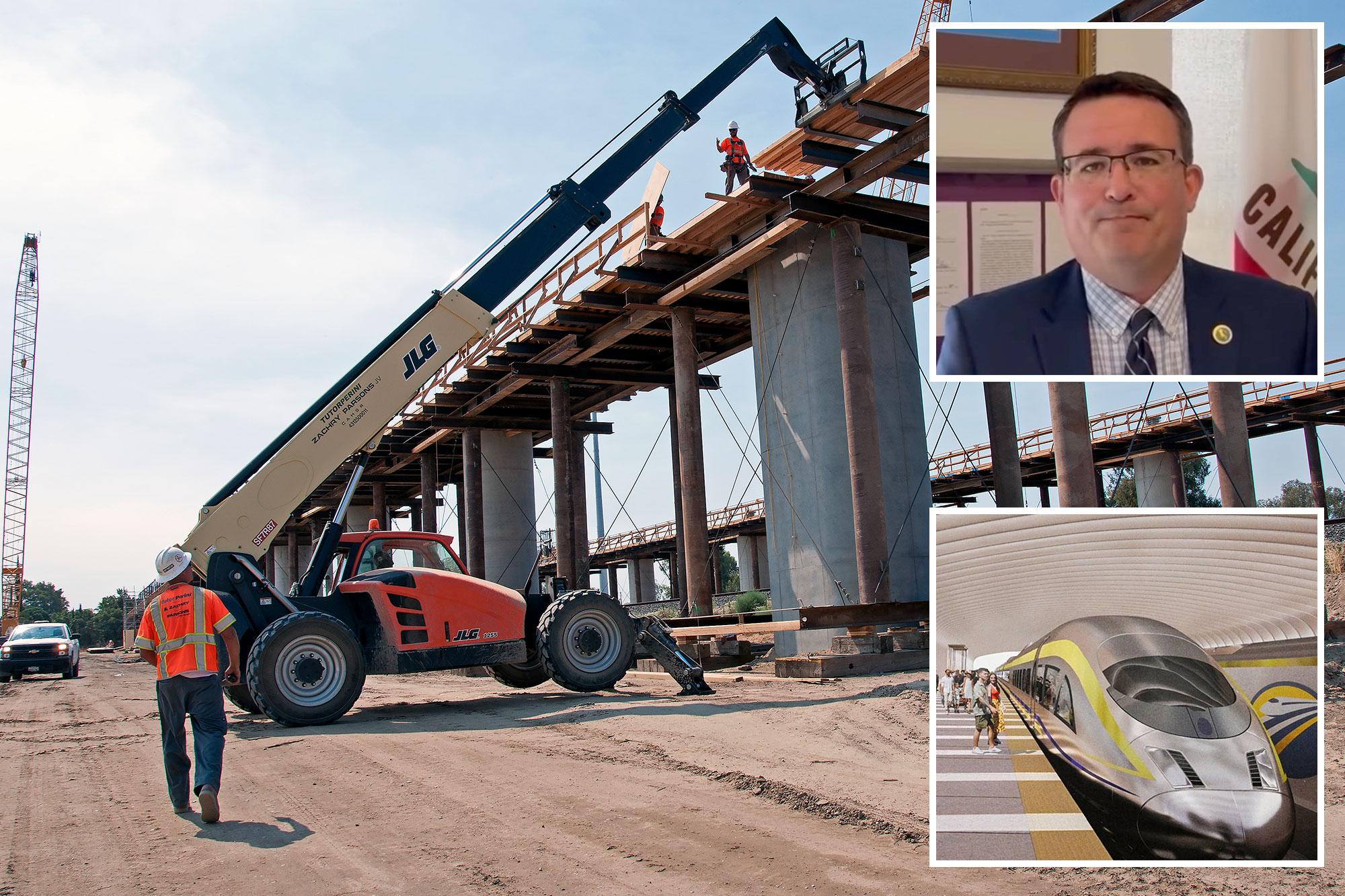
While nearly the entire 494-mile Phase 1 corridor between San Francisco and Anaheim has secured environmental clearance and is legally ready for building, active high-speed rail construction remains entirely confined to a 119-mile section within the Central Valley, according to the project overview.
Meanwhile, work on the outer ends of Phase 1 is limited to “bookend projects,” such as the completed Caltrain electrification in the Bay Area, which upgrade local transit networks to support future high-speed trains without actually building new high-speed lines there yet.
Phase 2, which covers the planned extensions to Sacramento and San Diego, remains completely unaffected by these developments, as no active construction, final design or environmental milestones are included for those routes.