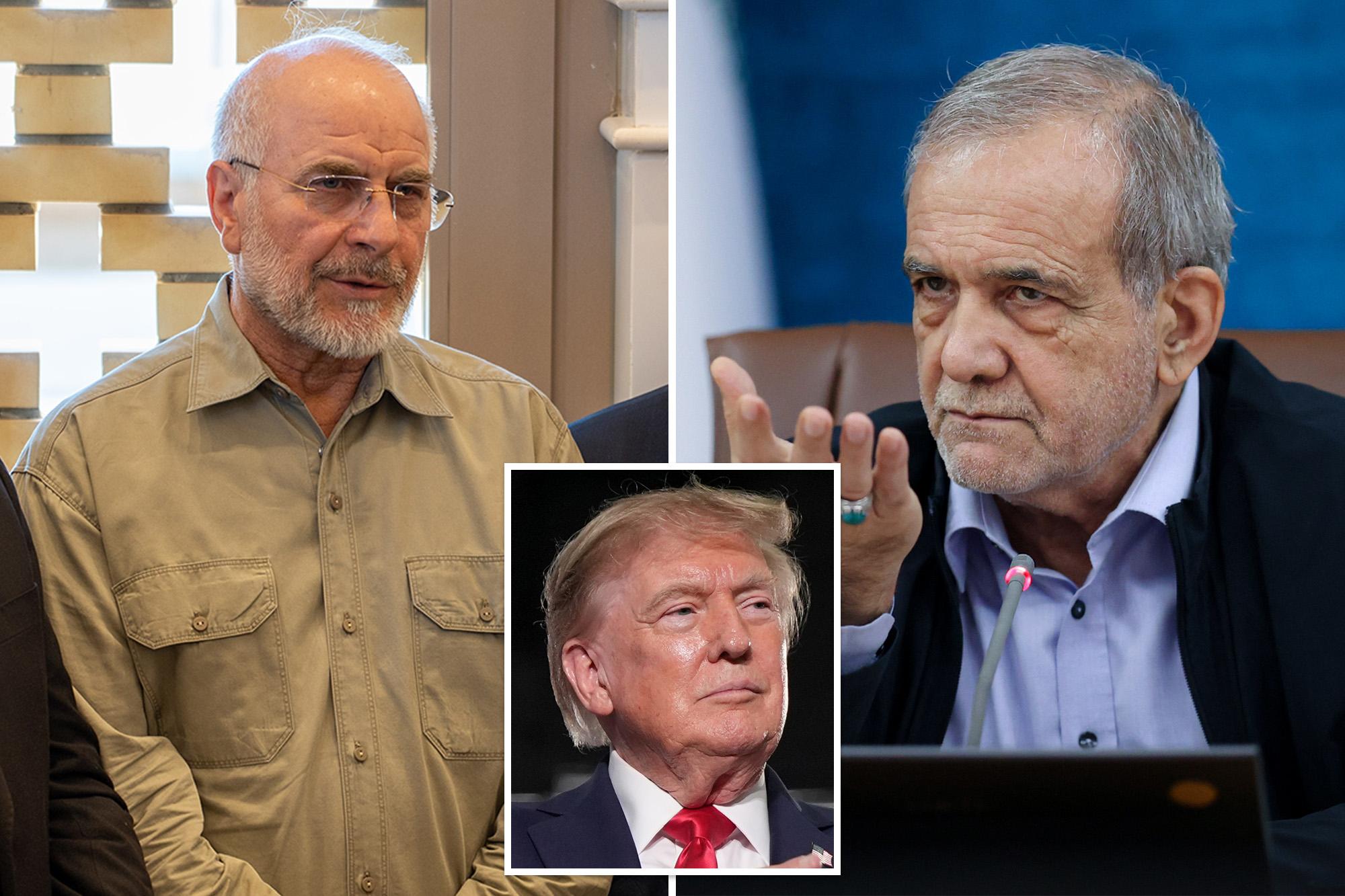
Add The New York Post on Google WASHINGTON — Iran’s president and parliamentary speaker are both publicly pushing for the country to end the war with the US as they grapple with hardliners who favor resistance.
Iranian President Masoud Pezeshkian warned that mounting economic pressure on Tehran is taking its toll, while cautioning against “humiliatingly” backing down “before the enemy.”
“The war must come to an end at some point,” Pezeshkian said in a speech Friday, per state media. “It is better that we demonstrate our strength and dignity today and tell the world that we have won and that we are ending the war.”
Since the memorandum of understanding collapsed, President Trump has maintained a blockade on Iran, cutting off the regime’s ability to sell oil, which had been its top source of revenue.
Treasury Secretary Scott Bessent is planning to unveil what Trump has dubbed “economic D-Day” measures on Tehran this week. Existing economic warfare on Iran has caused inflation, a deepening cost-of-living crisis, and more within Iran.
While it’s not entirely clear what those punitive measures will entail, Bessent has seemingly hinted that there will be secondary sanctions on countries that do business with Iran.
“I was in the presence of the Supreme Leader, and in his speeches as well, he openly stated that we must move beyond this state of ‘neither war nor peace,'” Pezeshkian claimed, per a translation referring to Ayatollah Mojtaba Khamenei, who hasn’t been seen publicly since the war in Iran began.
“We are not going to humiliatingly back down before the enemy or bow our heads. We can sit down with strength, but also with logic, and resolve our problems. This is possible, and we are also working to make it happen.”
Ironically, Khamenei recently elevated hardliners in Iran who lean towards resuming war over officials who favor trying to cut another deal with the US.
But similar to Pezeshkian, Iranian Parliament Speaker Mohammad Bagher Ghalibaf underscored the national security risks Iran faces if the theocratic regime continues to deal with a full-blown economic crisis.
“No matter how much military power we have, if our people are struggling and the country lacks financial circulation and economic growth, we will not achieve progress,” he said, per Iranian state media. “As someone who has experienced war, [I] understand the true value of peace.”
Throughout the prior negotiations with Iran, top Trump administration officials complained that they were getting conflicting responses from Iran. The MOU, which Trump signed in June, collapsed after Iran launched several attacks on vessels traversing the Strait of Hormuz.
Trump has long made clear that his primary goal is to ensure Iran never obtains a nuclear weapon. But he also wants the Strait of Hormuz to be fully reopened.
Already, the administration has claimed it is securing between 8 million and 9 million barrels of oil through the critical waterway daily. Before the war began, it was roughly 20 million barrels of oil a day.
“They would love to make a deal, but they’re not ready to make the right deal,” the president told reporters on Friday.