play Live Sign upShow navigation menuplay Live Click here to searchsearchSign upEXPLAINERNews|US-Israel war on IranCan Iran retaliate against countries that join US ‘economic war’?Mohsen Rezaei, secretary of Iran’s Supreme National Security Council, has warned of retaliation against countries joining the US ‘economic war.’
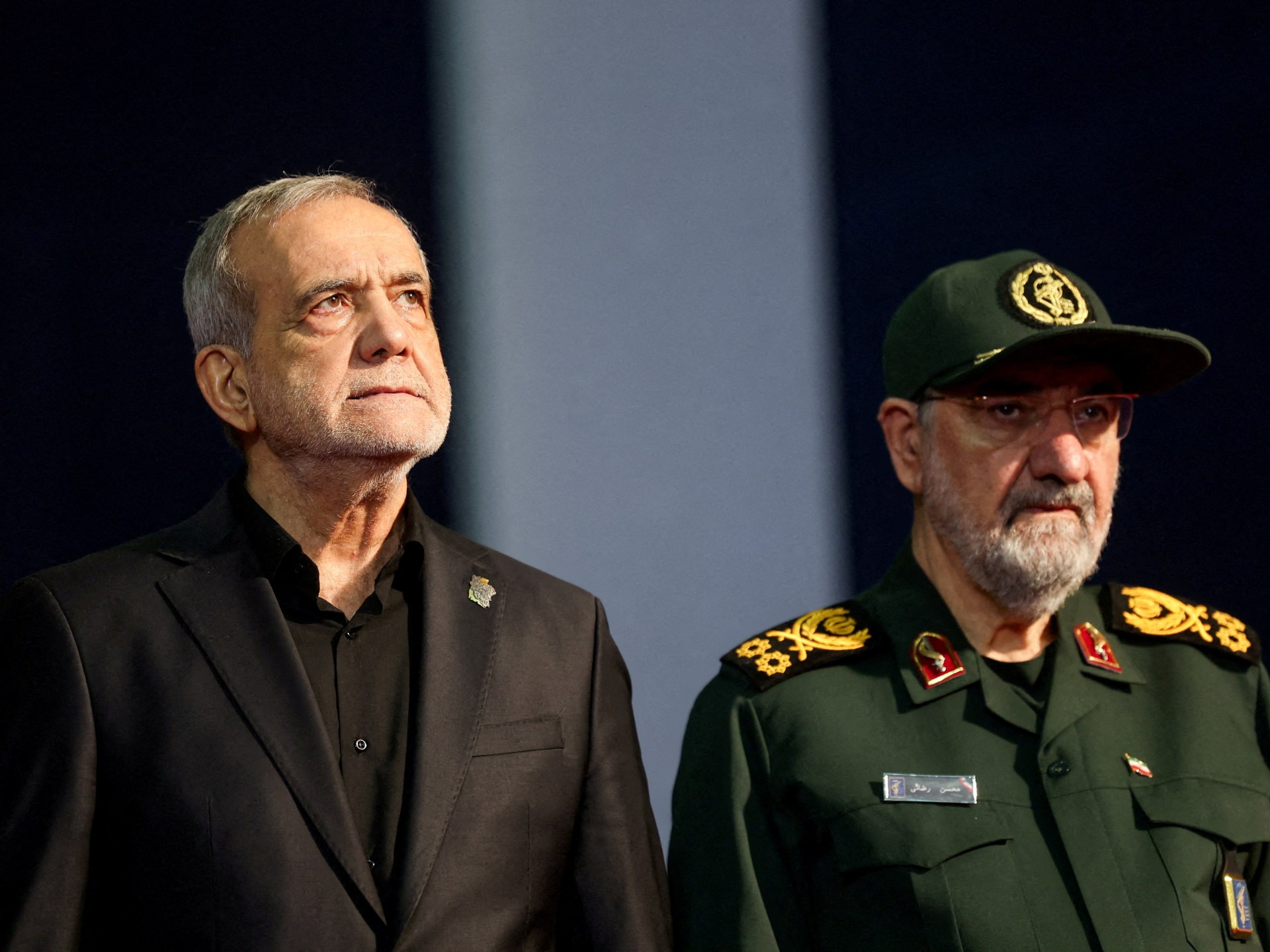
xwhatsapp-strokecopylinkgoogleAdd Al Jazeera on GoogleinfoPresident Masoud Pezeshkian and secretary of the Supreme National Security Council Mohsen Rezaei at a farewell ceremony for Iran's assassinated Supreme Leader Ayatollah Ali Khamenei [File: Mohammed Salem/Reuters]By Al Jazeera StaffPublished On 23 Aug 202623 Aug 2026Iran has threatened to retaliate against any country that joins the United States’ “economic war” against it, as diplomatic efforts to end the months-long war have stalled and shipping through the Strait of Hormuz has drastically decreased.
The warning from Iran’s top security official on Saturday came as the US plans to announce new sanctions on Monday that could further strain the struggling Iranian economy.
On Saturday, Mohsen Rezaei, secretary of Iran’s Supreme National Security Council, told the IRIB state broadcaster that Iran was appealing to all countries around the world, including its neighbours, not to join the US’s “economic war”.
“Any country that takes part in imposing economic restrictions on us will be regarded as an enemy,” he said, warning of “seismic” retaliation.
Rezaei also warned Iran’s neighbours that if they participated in Trump’s economic warfare, “not even a drop of oil” would leave the Gulf region, including by alternative export routes away from the Hormuz chokepoint through which a fifth of global oil and gas exports pass in peacetime.
Iran has attacked US military installations and civilian locations since the war began on February 28 , on the pretext that Tehran was on the verge of having nuclear bombs. That claim was debunked by the US intelligence agency, as well as the UN’s IAEA nuclear watchdog.
The US operates military facilities in more than a dozen locations across the Middle East and North Africa, including in Gulf nations, such as Bahrain, Kuwait, Qatar, Saudi Arabia and the UAE. Thousands of US soldiers are also stationed across the region, including in Jordan.
Rezaei’s remarks came days after US President Donald Trump announced that his government would undertake the “most crushing economic operation” yet against Iran. He also pledged “tremendous economic consequences” for any country that gives Iran “any type of lifeline”.
The US Treasury Secretary, Scott Bessent, echoed his threats the following day, saying, “You’re either with us or against us”. He also urged cooperation from China, which buys more than 80 percent of Iran’s oil shipments.
On Sunday, Iran’s President Masoud Pezeshkian said: Iran is “in a full-scale economic, military and security war” with the US. He said Washington falsely predicted before the war that it would fall amid US aggression and become like Venezuela.
“The enemy had assessed that if Iran falls, it will become Venezuela,” he said in a televised speech.
“Not only did it not happen, but it became a power that amazed the world with its resistance, solidarity and cohesion.”
Rezaei described Iran’s strategy as a three-stage sequence, starting with talks with countries cooperating with the US to de-escalate tensions.
“Of course, we will first negotiate with them. We will hold talks and tell them to step aside and distance themselves from the United States.”
“But if they do not act, we will strike. We will target that country’s interests,” he added.
Rezaei’s warning that alternative export routes outside Hormuz could be targeted, probably points to the Bab al-Mandeb Strait gateway to the Red Sea. Saudi Arabia has used it to export its oil following the blockade of Hormuz. Tehran imposed a blockade on Hormuz in response to the US war and has since used it as leverage in negotiations with Washington to end the war. The US has put Iranian ports under a naval blockade, impacting Tehran’s international trade.
Hamidreza Azizi, a researcher on Iran at the Clingendael Institute, said in a post on X on Saturday: “Tehran appears to be trying to establish deterrence at an earlier stage, by signalling that even preparations for an attack could trigger an Iranian response.”
Azizi said two elements in the new “offensive doctrine” are emerging: preemption, which is aimed at preventing a perceived threat from materialising; and disproportionate retaliation, which is aimed at raising the cost of any attack that does occur.
Iran’s warning to Gulf states joining Trump’s economic war is “essentially an ultimatum” to the Gulf states, he said, adding that Iran’s military-security establishment “is increasingly preparing for another round of escalation”.
Gulf countries, which are Iran’s neighbours and also US allies, have increasingly been finding themselves caught in the middle of the war. So it is unclear if they will join Washington in economically threatening Iran further.
Iran’s attacks on Gulf nations have impacted their economies, which use Hormuz for most of their exports, including oil and gas.
While Gulf nations have condemned Iranian attacks on their territories, analysts say Gulf states closely aligned with Washington recognise that a functioning political relationship with Iran is necessary due to its close proximity.
The UAE restored diplomatic relations with Iran in 2022 but imposed a trade embargo last week after accusing Tehran of a missile attack. Iran denies responsibility.
Saudi Arabia and Iran agreed to normalise ties in 2023 under a deal brokered by China, both likely a calculation that engagement with Iran was safer than permanent confrontation.
While the Iranian attacks on Gulf states have tested this idea, they have not necessarily shattered it.
“Ultimately, Gulf countries can’t change geography. They have to live and work alongside Iran,” Simon Mabon, a professor of international relations at Lancaster University told Al Jazeera in an interview last month. “They don’t want the instability that would come from the fall of the Islamic Republic. I think some Gulf states have pushed for harder strikes – not to precipitate its collapse, but to weaken the more hardline elements of the IRGC.”
Also last month, Trita Parsi, executive vice president of the Quincy Institute for Responsible Statecraft, told Al Jazeera that confidence in diplomacy to end the crisis remains low but, at the same time, no nation in the region “can afford another long war”.
As a result, that “will keep them away from a completely uncontrolled level of escalation”, and depleted global oil inventories will make a prolonged confrontation between the US and Iran unattractive.
“All inventories have not been able to be replenished” during the ceasefire, Parsi added. “We are at a much lower level globally.”
Since 1979, Iran has faced sanctions from the US and other nations in the West. The United Nations has also imposed sanctions on Tehran.
The US first imposed sanctions after the 1979 Islamic Revolution that toppled the pro-Western ruler Reza Shah Pahlavi. Washington said that was in response to Iranian students taking Americans hostage at the US embassy in Tehran.
Washington also halted oil imports from Iran and froze $12bn in Iranian assets following the revolution. Iranian products were banned from import into the US, apart from small gifts, informational material, foodstuffs and some carpets.
In 1995, President Bill Clinton issued executive orders preventing US companies from investing in Iranian oil and gas and trading with Iran. He banned US trade with Iran and investment. A year later, the US Congress passed a law requiring the US government to impose sanctions on foreign firms investing more than $20m a year in Iran’s energy sector.
Then in December 2006, the United Nations Security Council, whose members include China, Russia, the UK and France, imposed sanctions on Iran’s trade in nuclear-energy-related materials and technology and froze the assets of individuals and companies involved in related activities.
The sanctions were mainly an effort to curtail Iran’s growing nuclear capacity, but while programmes to enrich uranium were stopped in 2002, they restarted in late 2005. In subsequent years, the UN toughened the sanctions and imposed more. The European Union also followed suit.
In 2015, Iran signed a nuclear deal – the Joint Comprehensive Plan of Action (JCPOA) – with the US, EU, China, France, Germany, Russia and the United Kingdom. The deal put a cap on Iran’s nuclear programme in return for the complete lifting of sanctions.
However, in 2018, during his first term, Trump announced the US withdrawal from the nuclear treaty and reimposed all sanctions on Iran that were lifted under the treaty as part of his “maximum pressure” campaign against Tehran.
In 2019, the Trump administration designated Iran’s Islamic Revolutionary Guard Corps (IRGC) a ‘Foreign Terrorist Organisation’. Additionally, he imposed sanctions targeting petrochemicals, metals (steel, aluminium, copper) and senior Iranian officials.
During Trump’s first term, Qassem Soleimani, the head of the IRGC’s elite Quds Force, was assassinated in a drone strike in Baghdad in 2020. The US also imposed additional sanctions on Iran.
The Biden administration, in power from 2021 to 2025, kept in place most US sanctions.
Last September, UN sanctions were reimposed due to Iran’s nuclear programme when the UNSC voted against permanently lifting economic sanctions.