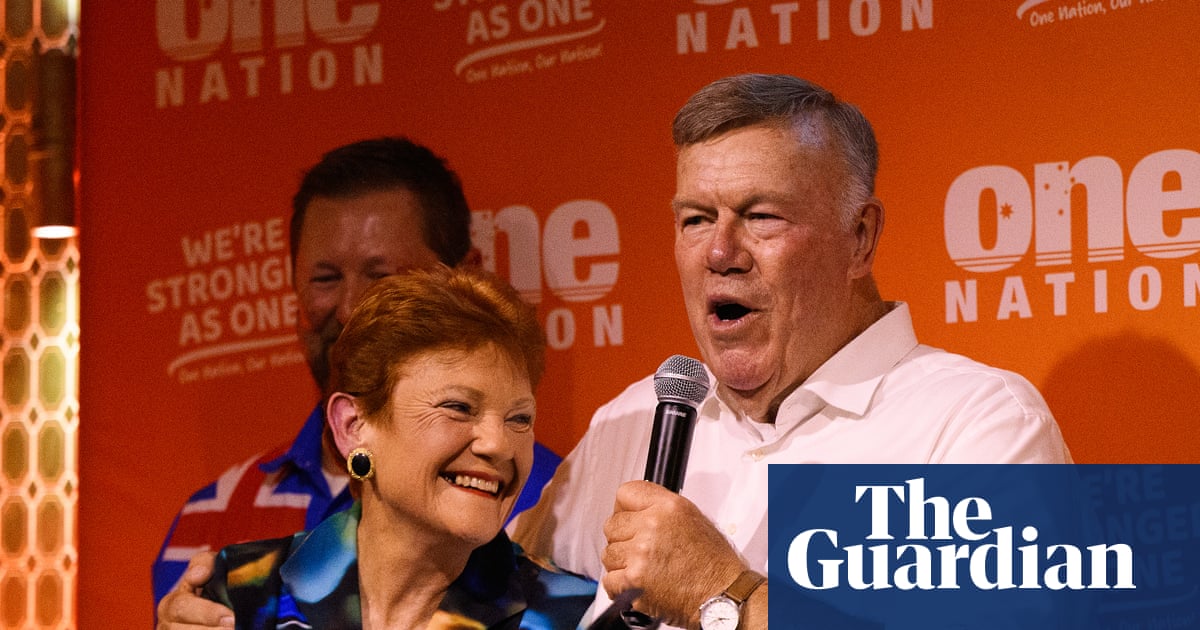
The One Nation leader Pauline Hanson previously counselled the member for Farrer David Farley over his comments about the party’s migration policy. Photograph: Bianca de Marchi/AAPView image in fullscreenThe One Nation leader Pauline Hanson previously counselled the member for Farrer David Farley over his comments about the party’s migration policy. Photograph: Bianca de Marchi/AAPOne Nation MP concedes party’s migration target ‘not too different’ from Labor’s once rural workforce includedDavid Farley says party wants 100,000 migrant rural workers in addition to the 130,000 migration target it considers the ‘true’ number
Follow our Australia news live blog for latest updates
Get our breaking news email, free app or daily news podcast
One Nation MP David Farley has conceded the minor party’s net migration target is “not too different” to Labor’s, echoing an earlier claim over which he was counselled by his party leader, Pauline Hanson.
Appearing on the ABC’s Insiders program on Sunday morning, Farley argued skilled workers and backpackers were critical to keeping Australia fed, and argued they should be considered as a separate category to migration “in its true form”.
The minor rightwing party, led by Hanson, has struggled to define its migration policy, with inconsistent messaging over whether its target figure represents net overseas migration (Nom) or permanent migration.
Read moreThe member for Farrer said One Nation’s Nom target remained 130,000. But he said that figure did not include skilled workers, backpackers and Pacific and Timor-Leste labour through the Pacific Australia Labour Mobility (Palm) scheme.
Farley said he expected there would be room for a “minimum” 100,000 additional people in the migration target to ensure critical industries had enough workers. Those included about 40,000 Palm workers and 70,000 skilled workers, including aged care nurses.
“A minimum of 100 [thousand additional migrant workers], but the 130,000 [target] is what we call the true Nom,” he told ABC’s Insiders on Sunday.
“I think the big difference is [that] we’re focusing on: what are the skills we need as a nation, where do we need these migrants to be.
“The raw number is not too different [to the government’s], but the reality is, where do we need them? We don’t need them in the great urban metroplex. We need them out to be productive, working in agriculture, engineering, mining.”
The Nom is calculated by the difference between the number of people entering and leaving the country – though it excludes short-term visitors such as tourists. It includes Australians moving abroad and returning, and is different to permanent migration, which measures longer-term visas offered for skilled workers and family members. For this financial year, there are 185,000 permanent places.
The Nom figure surged after the pandemic, during which it fell below zero, but has began to return to more typical levels in recent quarters.
10:29One Nation wants to restrict migration. A town in Barnaby Joyce’s electorate welcomes it – videoThe Nom was forecast to drop to 295,000 people last financial year but reached 301,000. The government forecasts it to drop to 245,000 in 2026-27 and 225,000 in 2027-28.
The Albanese government is preparing to announce changes to the migration system to achieve Nom targets. However, the home affairs minister, Tony Burke, cancelled a planned National Press Club appearance earlier this month over internal unrest on the final policy.
The Coalition has declined to provide an exact figure for its Nom target, but the opposition leader, Angus Taylor, has indicated it will be “well below 200,000”.
One Nation’s immigration policy is listed as offering a hard visa cap of 130,000 a year – a policy that would probably lead to a negative Nom. Barnaby Joyce, a former Nationals MP who defected to One Nation last December, has suggested the 130,000 number was instead a target for the Nom.
Farley’s electorate in south-western NSW relies on migrant workers for aged care and food processing. The Farrer MP said more than two-thirds of workers in his seat’s slaughterhouses and processing units were migrants.
“We need to have dexterity and flexibility in it. Managed properly, [the migration system] works well … we’re talking a system that’s critical to Australia. It’s critical to our food,” he said.
Read moreBefore being elected, Farley said Australia’s net overseas migration of 306,000 last year was “probably not” too many.
Hanson later said she had counselled him on the comments, while Joyce described them as a slip-up during the “pressure of a campaign”.
On Sunday Farley also said he was “impressed” by Anthony Albanese after the prime minister reassured him in person of a planned bailout for rice mills in his electorate.
Farley was also asked about Hanson’s decision to appeal to the high court against a finding that she racially discriminated against Greens senator Mehreen Faruqi, and whether discrimination laws should allow people to offend, insult or humiliate someone based on race.
He said: “Well, I’m not convinced that we need to go and change anything at the moment.”