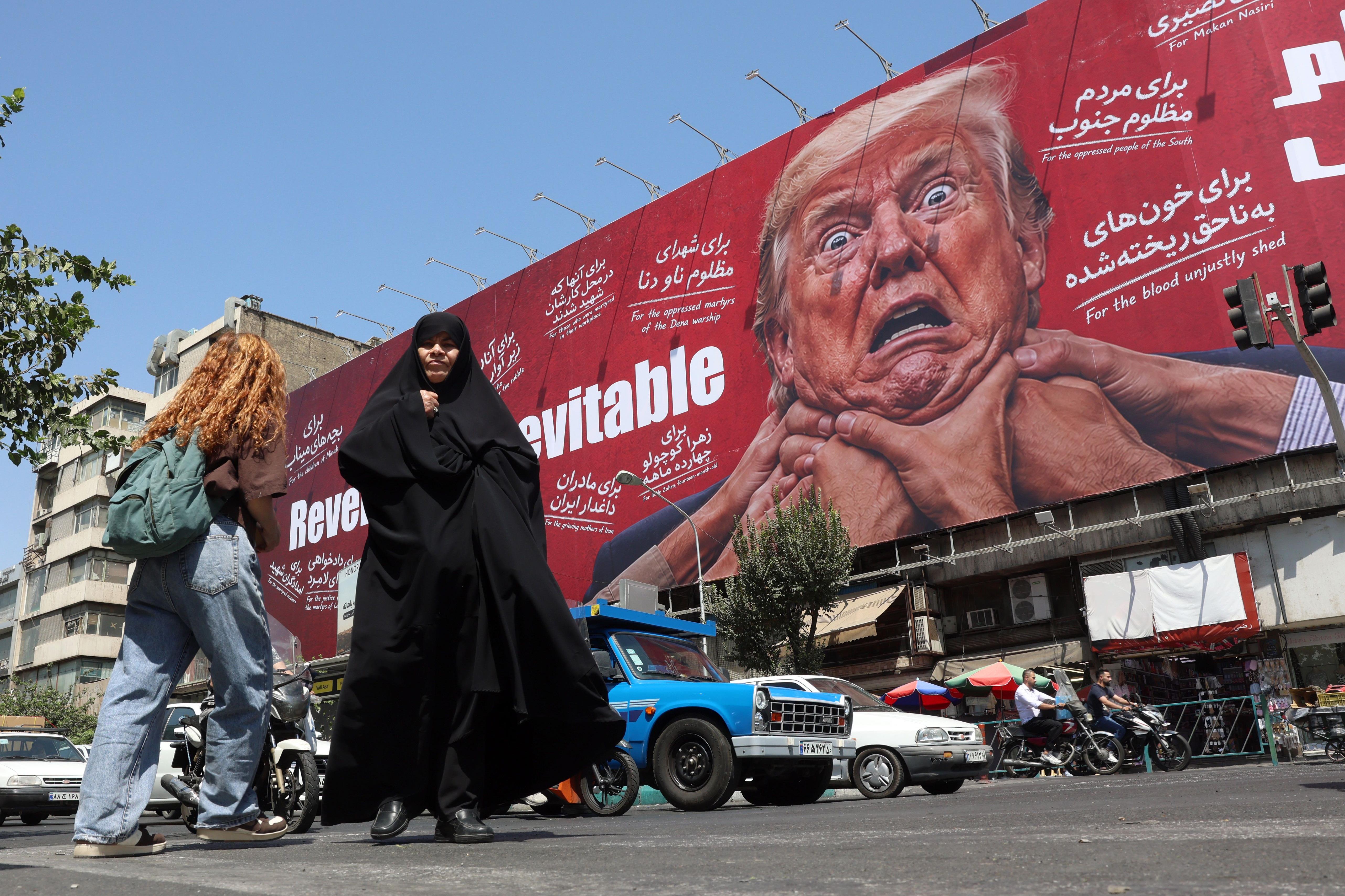
Iranians walking near an anti-America propaganda billboard in Tehran on Aug. 19, 2026. ABEDIN TAHERKENAREH/EPA/Shutterstock See more of our coverage in your search results.
Add The New York Post on Google The October surprise was born in Iran — and 46 years later, the Islamic Republic may be preparing to launch another one.
In 1980, the hostage crisis — 52 Americans seized at the US embassy in Tehran the year before during Iran’s Islamic Revolution — dominated the presidential race between incumbent Jimmy Carter and challenger Ronald Reagan.
Reagan’s campaign manager Bill Casey, assuming Iran would dread his hawkish boss’ victory, worried that Iran might release the hostages right before Election Day — and hand Carter a last-minute win.
Seeking to short-circuit what he dubbed an “October surprise,” Casey told the press of his concern, and the phrase stuck.
Today it’s used for any late-breaking event timed to swing an election.
But Casey was wrong: Iran’s Supreme Leader Ayatollah Ruhollah Khomeini had his own reasons to want Carter defeated.
Carter had admitted the hated Shah to the United States, making him the face of Washington’s decades-long support for the monarchy; Carter had frozen Iranian assets, imposed sanctions and broken diplomatic relations with Tehran.
In Khomeini’s eyes, humiliating Carter and denying him the political triumph of the hostages’ homecoming served the Islamic Revolution’s interests.
He held the hostages through Election Day and beyond, releasing them within minutes of Reagan’s inauguration on Jan. 20, 1981 — extraordinary timing that fueled allegations of a secret Reagan-Iran deal, which exhaustive congressional investigations eventually debunked.
We may soon face another Iranian ploy aimed at leveraging foreign elections to weaken the regime’s enemies.
Israel’s election is scheduled for Oct. 27; the US midterms are Nov. 3, exactly one week later.
That makes the end of October a potentially dangerous window for regime mischief.
Tehran could attack Israel directly or engineer a serious escalation through one of its terror proxies — calculating that Israeli Prime Minister Benjamin Netanyahu, days before an election, would have little choice but to respond forcefully.
Imagine a ballistic missile barrage, massive enough to overwhelm Israeli defenses, killing scores of civilians in Tel Aviv or Haifa.
Or an Iranian terrorist proxy carrying out a mass-casualty attack against an Israeli population center.
The precise scenario is unknowable, but the calculation is not: Inflict enough carnage that no Israeli prime minister could allow it to go unanswered.
A powerful Israeli retaliation could trigger a broader regional escalation, drive the Iran war to the top of the news, spike oil and gasoline prices, and create serious political and economic complications for President Donald Trump and Republicans fighting to retain the House and Senate just days later.
In the regime’s ideal scenario, Tehran would absorb the Israeli blow, play the victim, and wait to see if Republicans lose.
If they do, Iran gets exactly the narrative it wants: Israel helped cost Republicans Congress.
Tehran could then exploit the ensuing recriminations to deepen divisions between Washington and Jerusalem, counting on American critics of Israel, on both the right and the left, to hammer home that message.
That makes the days immediately preceding the Israeli election a particularly attractive window for an Iranian provocation.
We should be thinking about this now — because there’s little doubt Tehran is already doing so.
The Islamic Revolutionary Guard Corps knows our political system well; it studies our divisions and looks for opportunities to exploit them.
The Treasury Department sanctioned IRGC-linked entities in 2020 and again in 2024 for using disinformation and hacked material to interfere in US elections.
Countering an October surprise — whether this scenario or others — requires close US-Israel coordination over the next two months to war-game the possibilities.
American and Israeli political, military and intelligence officials should agree on potential responses before missiles are flying, emotions are high, oil prices are spiking, poll numbers are dropping and both governments are working at cross-purposes — straight into the Islamic Republic’s trap .
One option should at least be considered: Revenge may be a dish better served cold.
If Iran launches an attack deliberately designed to provoke Israel before the elections, Israel could defend itself, absorb what it can, establish Iranian responsibility, and wait — until after both elections — to retaliate at a time of its choosing.
But Trump would need to give Netanyahu the political cover necessary not to respond immediately, and a commitment that the IDF could act after the midterms.
Trump could also make clear publicly, well before October, that Washington is aware of the potential regime trick, saying that an election-season provocation will fail to divide the United States and Israel, and retaliation will inevitably follow.
Forty-six years ago, an ayatollah exploited an American election and helped hobble a sitting American president.
The current ayatollah should not be allowed to run the same playbook on this one.
Mark Dubowitz is chief executive of the Foundation for Defense of Democracies.