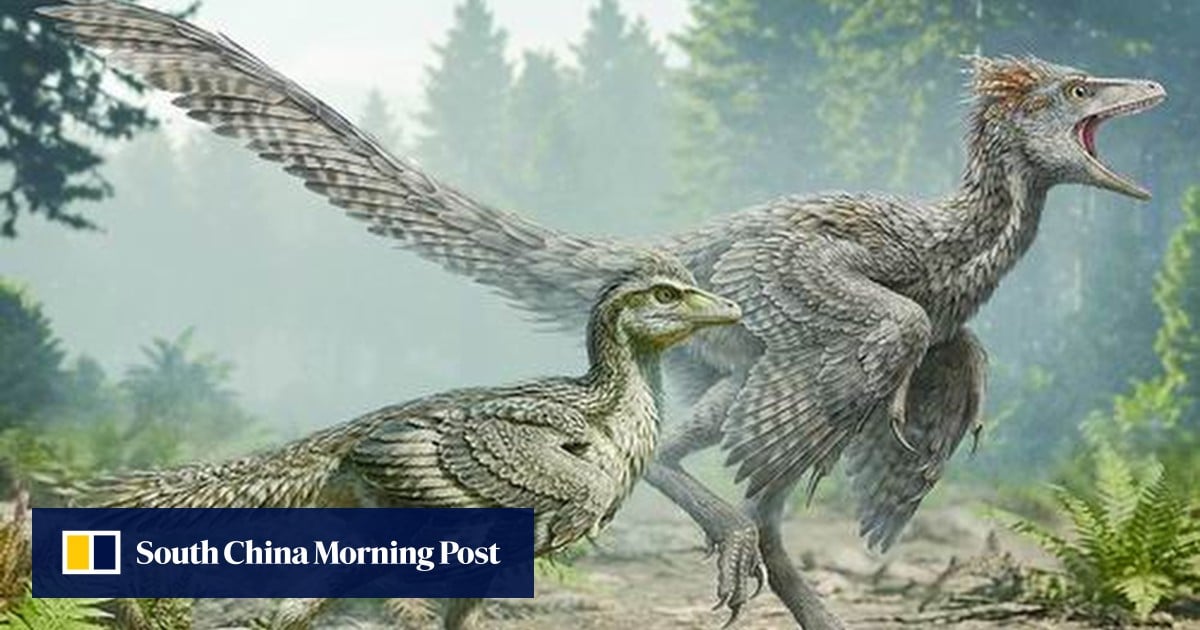
A Jurassic fossil dating back 150 million years fills in a vital part of the evolutionary puzzle of how birds took to the skies
3-MIN READ3-MINVictoria BelaPublished: 12:00pm, 18 Jul 2026A fossil found in China suggests modern birds shed the long, bony tails of their dinosaur ancestors through a step-by-step process, rather than a sudden evolutionary transition as previously believed.The transition to a short, feathered tail was one of the most important steps in the evolution and survival of birds, the only living group of dinosaurs to survive a mass extinction event 66 million years ago.“The evolutionary assembly of the flight-adapted bird body plan encompasses some of the most profound morphological changes in terrestrial vertebrate history,” a team of Chinese researchers said in their paper published in the peer-reviewed journal Science Advances on July 1.
Unlike most non-avian dinosaurs, modern birds have a pygostyle, which is a skeletal structure formed by the fusion of the final few caudal or tail vertebrae. This short tail structure acts as an anchor for tail feathers and muscles.
But studying the transformation to this more aerodynamically favourable structure has been difficult, due to the “exceeding rarity” of early-diverging birds and birdlike dinosaurs.