Make New York Post a Preferred Source Scientists hunting invisible “ghost particles” more than a mile underground have found surprising clues that could torch everything experts thought they knew about the depths of our planet.
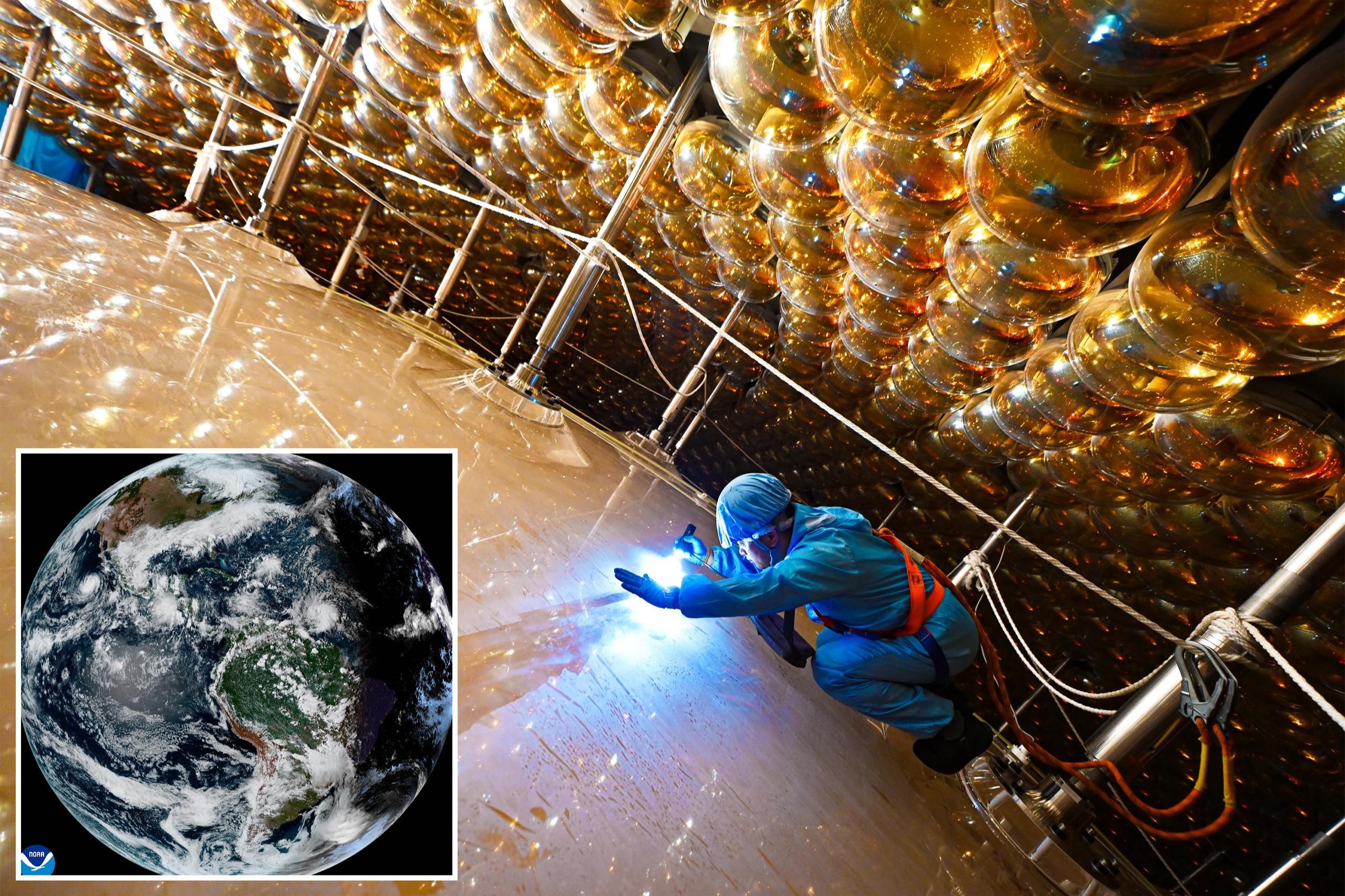
The tiny particles, which are let off during the process that keeps the planet’s insides hot and moving, were captured at a lab buried over a mile deep inside a mine in Canada, and suggest the Earth may be heating unevenly from the inside, according to Quanta Magazine.
If confirmed, this would mean that more of the planet’s radioactive matter is packed into some spots than others — a finding that could shatter one of geology’s most basic assumptions that the rock deep inside the Earth, which make up the mantle, is evenly mixed.
“It could be that that’s the first hint that the mantle is not uniform,” Mark Chen, a particle astrophysicist at Queen’s University told the science outlet.
“There may be deep Earth structures in the mantle that are not understood — it could be that [they] concentrate some kinds of elements,” Chen said.
For decades, most scientists agreed that the radioactive elements heating the planet were spread evenly throughout the mantle, since the slowly flowing rock should stir everything together like a giant pot of soup.
The mantle is the thick layer of hot, slowly churning rock between the Earth’s crust and its core. The earth’s misunderstood “structures” that Chen mentions are two mysterious, continent-size blobs buried deep near the core, one under Africa and the other under the Pacific.
The heat from that radioactive fuel makes the rock deep underground churn, keeping the planet alive and powering everything from earthquakes and volcanoes to the magnetic field that shields Earth from space radiation.
Ghost particles, known to scientists as neutrinos, are so tiny they zip through entire planets without slowing down as trillions pass through your body every second. The rare Earth-made particle is so hard to catch that only a few hundred have ever been detected.
However, the Canadian lab caught about 50 of them last November — the first ever in the western hemisphere — as the only other labs to pull it off are in Japan, which made the first-ever catch in 2005, and Italy, which followed in 2009.
All three recorded different readings, with a signal looking high in Italy, low in Japan, and “pretty in-between” in Canada, according to the report.
“If we take it at face value, we could say maybe the western hemisphere has a lot more radioactive material in it than the eastern hemisphere,” William McDonough, a geochemist at the Chinese Academy of Sciences, said.
McDonough, however, remains skeptical of anything certain, and added that there are reasons to be wary of these estimates.
“Are the Italians right? Are the Japanese right? Are they both right? Or is something wrong?” he said.
In China, a massive new detector expected to report results soon could help settle the question depending on its findings, according to the report.