
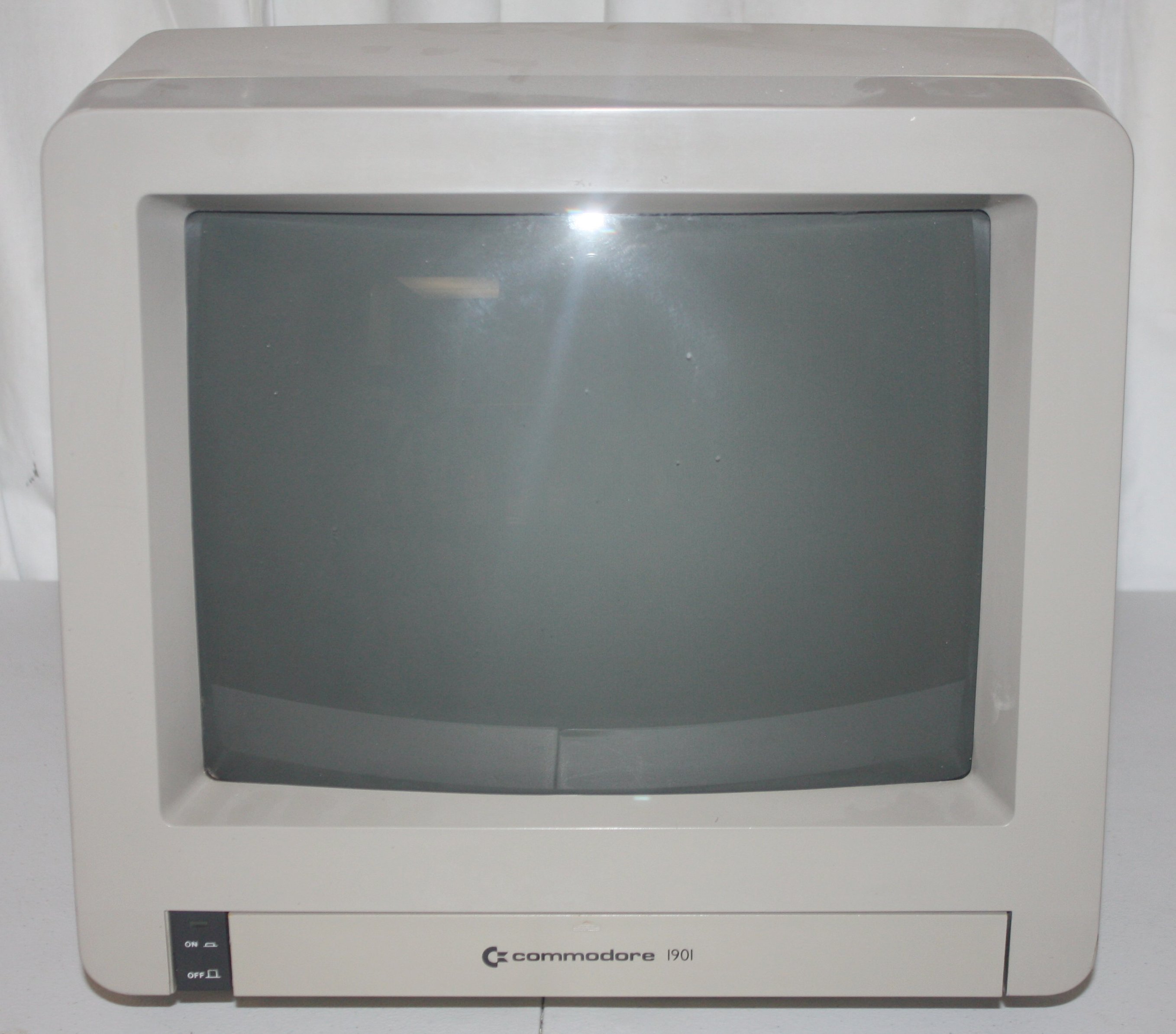
Commodore Monitors
Commodore never manufactured its own monitors. Throughout its history it bought them from outside makers, among them JVC, Philips, Daewoo, Thomson, Hyundai, GoldStar and Toshiba, and sold them under Commodore model numbers. The badge on the front therefore says little about what is inside, and anyone repairing one needs to identify the real manufacturer to find the right service manual and parts.
The first generation served the VIC-20 and Commodore 64. The 13-inch 1701 and 1702 accept both composite video and the separate luminance and chroma signals of the 64, which gives a much sharper picture than a television. Variants followed: the 1703 in charcoal grey for the C16 and Plus/4 family, the PAL 1801, the several versions of the 1802, and the 1803 for the Korean market. The C128's 80-column mode needed a digital RGBI input, provided by the 1902 and, in Europe, the Thomson-built 1901.
The Amiga brought analogue RGB. The 1080 offered composite, digital and analogue RGB inputs in one cabinet, and the 1081 served the German market. The 1084 and stereo 1084S, made by Philips and Daewoo in many variants, became one of Commodore's longest-lived monitor lines and work with almost every Commodore machine. The 2002 was another all-purpose model. For the later Amigas and Commodore's PCs came the 1930 VGA monitor and the 1950 and 1960 multiscan monitors, while the A2024 was a specialist greyscale display capable of 1024 by 1024 pixels in PAL form.
Collectors look for working tubes, intact front doors and the right cables. CRT monitors are heavy and costly to ship, and their high internal voltages make repair a job for the experienced.