
The story
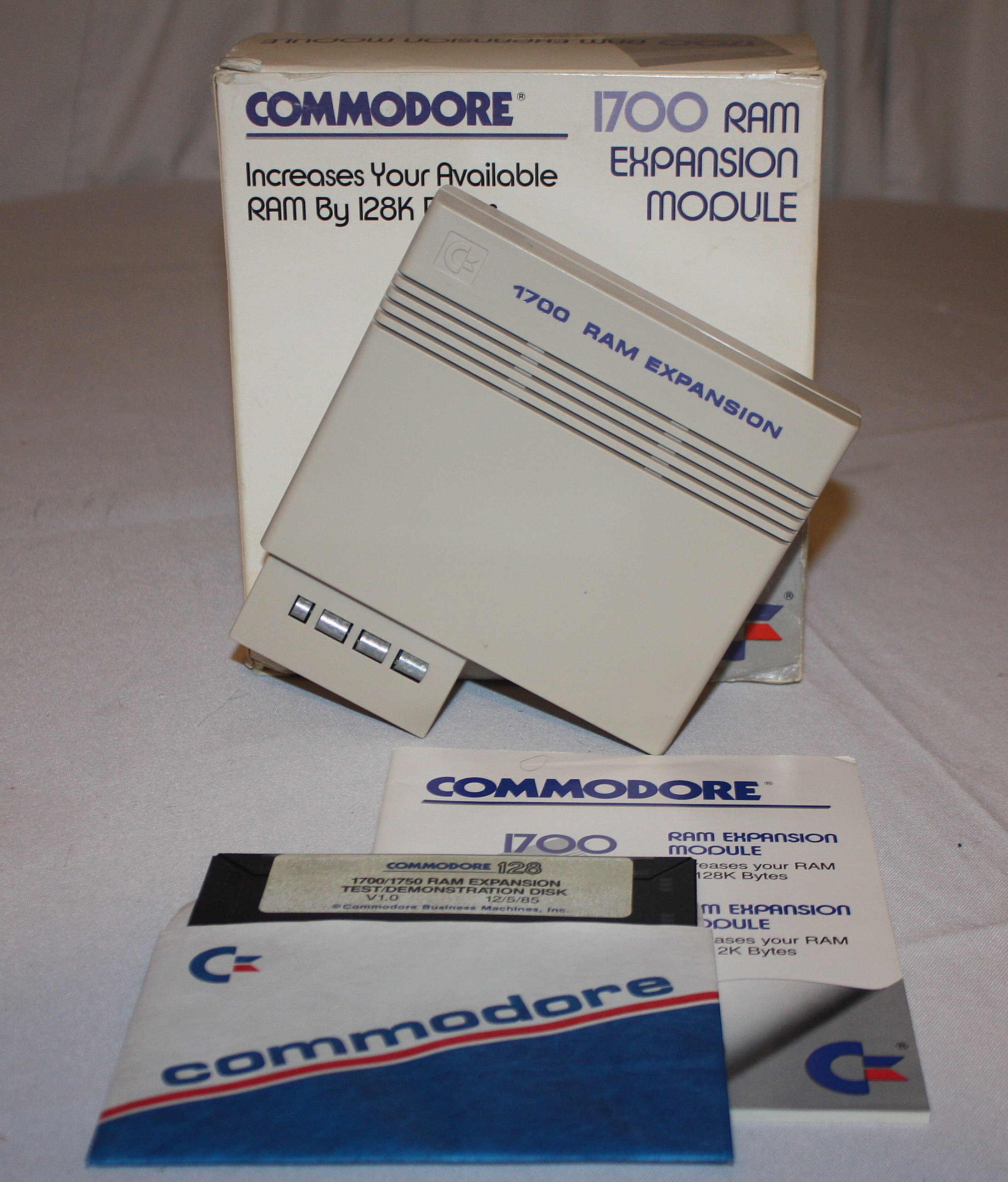
Commodore's RAM Expansion Units, usually just called REUs, were cartridges that added a large block of memory to the Commodore 64 and 128. There were three models: the 1700 with 128 KB, the 1764 with 256 KB and the 1750 with 512 KB. The 1700 and 1750 were announced alongside the C128 and intended for it, while the 1764 was positioned for the 64. Engineers showed the technology at the 1985 Consumer Electronics Show with a spinning globe animation, and the units were sold from 1986 until 1990.
The extra memory is not mapped directly into the processor's address space. Instead a custom chip, the MOS 8726 RAM Expansion Controller, copies blocks of data between the REU and the computer's own memory using direct memory access, far faster than the processor could manage. C128 BASIC 7.0 includes STASH, FETCH and SWAP commands for this, GEOS and the 128's CP/M can use an REU as a very fast RAM disk, and some copy programs used it for quick transfers.
Software support stayed limited because few people owned one, but the REU found a loyal following among bulletin board operators, whose programs used it to cut loading times. One practical snag was power: the original C64 supply struggled with the extra load, so the 1764 shipped with a stronger 2.5 A supply. The 1700 and 1750 share a circuit board, and a small timing resistor differs between the C64 and C128 versions.
During the DRAM shortage of the late 1980s the 1750 became scarce and expensive, and several companies upgraded smaller units to 512 KB. Hobbyists later pushed the design to 1 MB, 2 MB and beyond. Clones and related devices such as geoRAM kept the idea alive after Commodore stopped making them.