
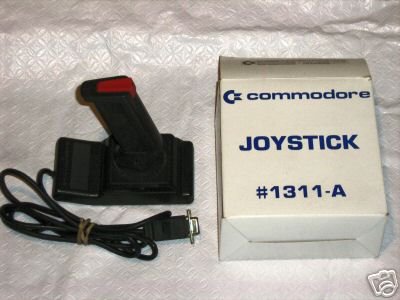
Commodore Joysticks and Paddles
Commodore adopted the controller standard first used on the Atari 2600: a 9-pin port carrying five switch lines for the four directions and fire, plus power and two analogue inputs. The VIC-20, Commodore 64, C128 and Amiga all use it, so a huge range of third-party joysticks works across them. The main exception is the C16 and Plus/4 family, which used a different connector of its own.
Commodore's first own-brand stick was the VIC-1311 for the VIC-20, a white unit closely modelled on the Atari design. A later 1311 took a rectangular body with a triangular stick. For the C16 and Plus/4 came the T-1341 and T-1342 with the 264-series plug, and a 1311-A variant offered the Plus/4 styling with the standard connector for the 64 and VIC-20. The CBM 1399 used microswitches and had auto-fire, while the VG-200 AQ pistol-grip stick and the similar VG-250 with auto-fire turned up in Europe.
Paddles were the other classic controller. The VIC-1312 pair, in white with black knobs, plugged into one port; a later version came in dark grey. Each paddle is a potentiometer, and the computer's sound chip measures its setting by timing how long a capacitor takes to charge, giving a value from 0 to 255. Two paddles share one port and the 64 can read four in all. Only a modest number of games used them, among them Kickman, Omega Race, Pinball Spectacular and versions of Breakout and Arkanoid.
Collectors look for original boxed sticks and matched paddle pairs, and should check for worn contacts and noisy potentiometers, which make paddles jitter.