Hirotaka Sato holds a cyborg Madagascar hissing cockroach while flanked by his team. NTU See more of our coverage in your search results.
Add The New York Post on Google As if roaches weren’t hard enough to kill already.
Scientists in Asia have devised 3D-printed scuba suits that allow cockroaches to breathe underwater for up to three hours, potentially enabling these waterbugs to scout disaster areas and even — gasp — venture into the cosmos, per a skin-crawling study in the journal Nature Communications.
“Our new insect diving suit works like the oxygen tank used by human divers,” said the study’s lead author, Professor Hirotaka Sato from NTU Singapore’s School of Mechanical and Aerospace Engineering, SMBTech reported.
Sato and his team had previously demonstrated that Madagascar hissing cockroaches could be remotely piloted by installing electrodes in their sensory organs, according to New Scientist. This level of control was so precise that they could make swarms of the robo-roaches coordinate, paving the way toward their ultimate goal of creating organic rescue “drones” that could scour disaster zones for survivors.
The one downside to these cybernetically-enhanced superbugs? The subjects didn’t take well in water, hindering their ability to navigate flooded areas.
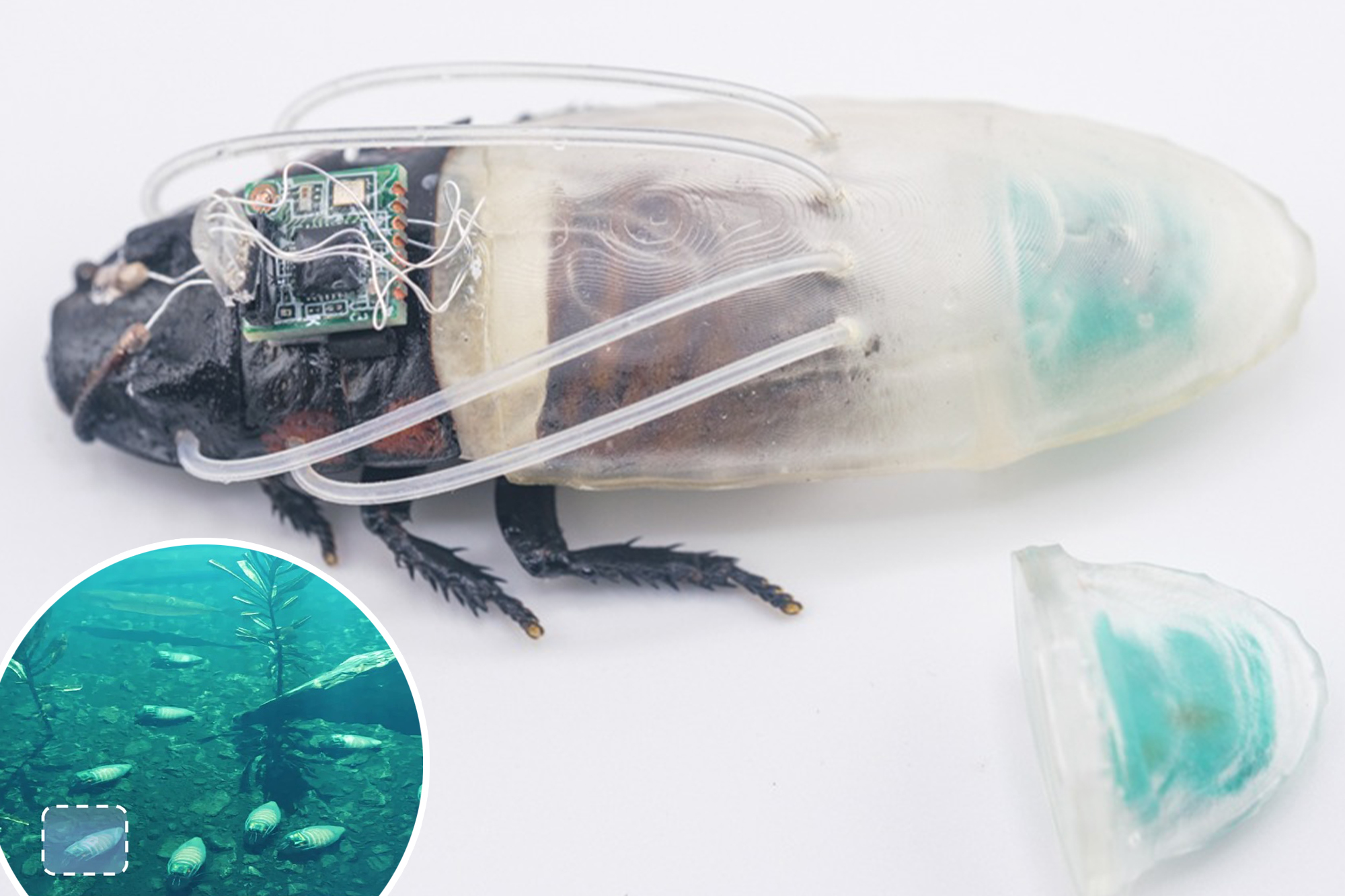
To circumvent this limitation, the scientists outfitted the cyborg bug with a 3D printed, watertight resin suit that generates oxygen and provides it to the critters’ spiracles — breathing holes — allowing them to operate both aquatically and on land.
Instead of outfitting the roaches with a human-style oxygen tank, the researchers supplied the suit with a cocktail of hydrogen peroxide and manganese dioxide that reacts to form absorbable O2.
Armed with the aquatic exoskeleton, cockroaches were able to excel during the amphibious rescue tests, which were conducted in plastic tubes that simulated flooded tunnels and other low-oxygen environments.
The hardy insects could scuttle for up to 3 hours at a time while nearly a foot underwater sans suffering any adverse effects. They also attained speeds of up to 78.4 millimeters per second — just 10mm slower than their average terrestrial velocity.
In other words, roaches can now survive a diving expedition in addition to a nuclear apocalypse.
Sato sees these suits as important “because real disaster sites can be challenging after heavy rain or flooding, blocking access routes in the rubble, drains and narrow gaps.”
“By expanding the operating parameters of our cyborg insects to include underwater travel, we believe that they can enhance search and rescue efforts,” he said.
And water’s not the limit for these tiny pantry pillagers, per Sato, who eventually wants to send them to where few roaches have gone before.
“The ultimate goal is to [take this technology to] space,” he declared. “It’s kind of one step, one big step, towards space suits for cyborg insects. Exploration over the Mars surface, for example.”
His team now plans to test the cockroach getups in various harsh environments to see how they handle the vacuum of deep space.
Of course, this begs the question of why the researchers wouldn’t just use a robot.
Per scientists, cockroaches are far more efficient because they can operate for long periods without recharging, instead replenishing their own energy stores by harvesting food from the wild.
What’s more, Sato has battle-tested bugs in the field before.
His cyborg insects notably assisted in search and rescue operations such as Operation Lionheart following the 7.7 magnitude earthquake that devastated Myanmar in Spring 2025.