America 250 US News America 250 These collectors have turned American history into an art form By Michael Kaplan Published June 29, 2026, 7:00 a.m. ET See more of our coverage in your search results.
Add The New York Post on Google As America reaches its 250th anniversary, it’s good to remember that the history of our country is told through words, deeds and artifacts. The latter, which shake out as illuminating Americana, rank among the most tangible links to our glorious timeline — going from the American Revolution to the freeing of slaves to women gaining the right to vote to all 45 presidents.
“Americana represents authentic history,” Louise Mirrer, president and CEO of the New York Historical, told The Post.
“Artifacts tell us what people were thinking about or saying or doing. People took the time to preserve these materials over the last 250 or more years, and they tell us about our past that binds us together. That’s a really important message for today.”
These collectors help tell America’s story with flags, documents, militaria and presidential memorabilia.
When David Rubenstein began collecting documents, he did not start small. His quest launched in 2007, when he bought a stamped Magna Carta at Sotheby’s for $21.3 million.
“It was the one copy in private hands,” Rubenstein told The Post of the 1297 English charter of rights. “I thought it would be good to keep the document that inspired the Declaration of Independence and our Constitution in the United States. I bought it and put it on permanent display at the National Archives.”
From there, Rubenstein was hooked. He snagged nine of the rare 1823 facsimilies of the Declaration of Independence (the original, in the National Archives, is faded beyond readability), two Lincoln-signed copies of the Emancipation Proclamation and a 1789 broadside printing of the Bill of Rights.
And he shares: Much of the collection — 7,000 paper-works strong — is in museums and archives and even baseball stadiums. The idea is for as many people as possible to view the documents that made America great.
Having earned his fortune as a co-founder of the Carlyle Group, Rubenstein, who owns the Baltimore Orioles, acknowledges that “when you own something that was signed by Abraham Lincoln or George Washington, it ‘s a nice thrill.”
He also loves to share the stories behind the docs — like how Abraham Lincoln needed to wait two hours to sign the Emancipation Proclamation because he was numb from shaking hands all day and did not want the signature to look tentative.
For all that, Rubenstein — who donated some $18.5 million to the recently opened museum under the Lincoln Memorial in Washington, DC — admits that he has a white whale.
“There are five copies of the Gettysburg Address,” he said. “One is at Cornell University, one is at the White House, one is at the Lincoln Library and two are at the Library of Congress. They’re never going to be sold. But there are lots of places to look at them. And that is the important thing.”
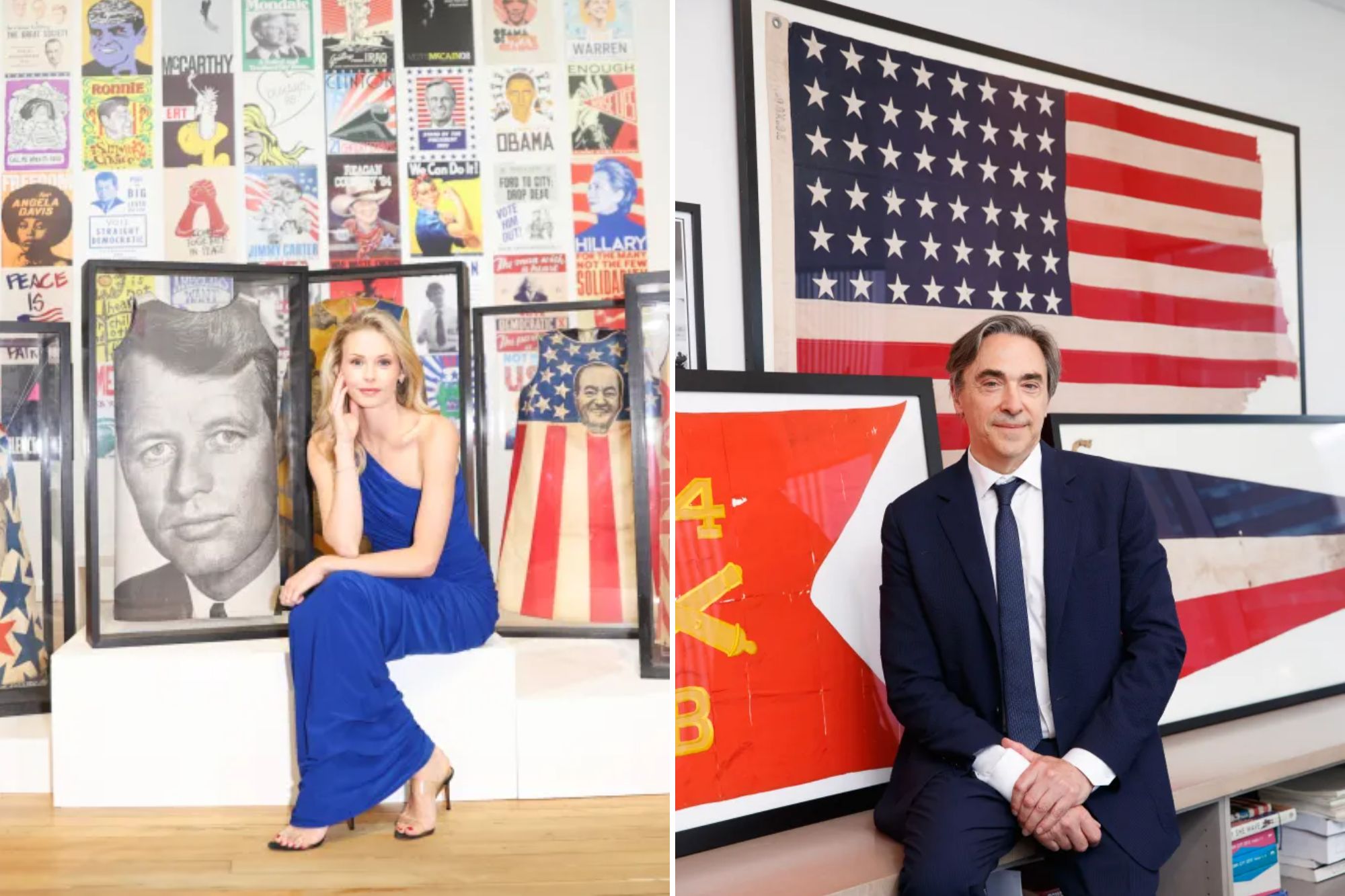
Walk into the Midtown Manhattan office of John Monsky, a partner with the investment firm Oak Hill Capital, and you are immediately wowed by two flags in frames: one with the edges frayed, the other with holes ripped through it.
“I’ve been told by the conservators that the holes are from shrapnel,” Monsky told The Post. “This flag was on a landing craft at Omaha Beach on D-Day. The beach became a shooting gallery.”
As for the frayed edges, also a remnant from a craft en route to the famous World War II battle, Monsky added, “The wind flapped really hard and tore the ends.”
Those flags are among 80 or so in his collection. “I’m very focused on quality, not quantity,” said Monsky who started scoring them as a kid in Florida. “I’m only trying to acquire flags that have a story to them.”
Some memorialize black militias during World War II or platoons that fought in the Vietnam War. He has swatches from the American flag that the Apollo XI astronauts planted on the moon. (The bulk of it remains on the lunar surface, albeit mostly bleached out.)
He also has a banner that Martha Washington had made for her husband, George. “It was 1775, and they had to come up with a flag,” said Monsky. “Nobody knew what to do” — so the printer put forth potential designs.
“There’s a flag of 13 stripes, don’t tread upon me, a pine tree and a pinwheel with 13 legs,” said Monsky, of the oldest and rarest item in his collection. “They’re trying. Then, later, with 13 stars — which was Washington’s personal banner — and 13 stripes, you see the man meeting the country through a flag.”
In 1968, when Robert F. Kennedy was running for the Democratic Party’s presidential nomination, a 10-year-old kid named Jordan Wright visited the senator’s New York headquarters and scored a campaign button. That set him off on a mission.
“His whole collection literally started with a button,” Jordan’s daughter-in-law, Madison Wright, told The Post (Jordan died, at age 50, in 2008). “He got bitten by the bug and, over the next 40 years, grew the collection to 1.3 million objects.”
Items range from the brass and copper buttons given out at the first 1789 inauguration of George Washington to 1917 ballots related to giving women the right to vote in New York to a toothpaste-smeared robe that Richard M. Nixon wore while padding around the White House in 1974, the year that he resigned.
The Museum of Democracy’s collection, pieces of which are currently on display at the Southampton Arts Center through July 18, includes an entire category of election-campaign swag.
There are paper minidresses that hype-women wore to fire up rally crowds for Nixon, Robert Kennedy, Nelson Rockefeller and Hubert Humphrey, as well as lanterns given out by John Adams.
Some memorabilia is shocking: Tiny coffins were meant to remind voters that William Jennings Bryan was so boring he could talk them to death, while dolls represented an African-American child that William McKinley allegedly had out of wedlock. “Nobody likes the fat man” buttons were a dis to William Taft.
“The personal attacks were brutal,” said Wright, who oversees the collection with her mother-in-law Pamala Wright. “You found something you didn’t like about your competitor and used it to swing the vote.”
Wright sees her family as “stewards of political history. We’ve all read about history in text books, but seeing this memorabilia brings it to life.”
Don Troiani’s collection has seen its share of action.
From the American Revolutionary War through World War II, it includes weapons, muskets, helmets and uniforms — many of which tell tragic tales. Like the paratrooper jacket worn at Operation Market Garden, a famous World War II maneuver that inspired the 1977 movie “A Bridge Too Far.”
“I think the owner of the jacket was injured at Market Garden,” Troiani told The Post, referring to the operation that landed Allied troops behind German lines to capture strategic bridges. “The jacket has two names on it. So, somebody got the jacket after Market Garden and took over wearing it.”
A Revolutionary War musket, likely used in the Whittemore Incident in 1775, has a remarkable story. “A guy in his 80s was fighting off a large force of the British all by himself. He was bayoneted and had his head bashed in” — but survived, Troiani said.
“Britain’s 47th regiment was attacking him. This is one of the guns from the regiment, which was later taken by the Americans and used against the British. It’s branded ‘United States’ while ’47th regiment’ is engraved on the barrel.”
While some collectors of Americana like to make their purchases at auction, Troiani, who also paints historical battle scenes, does not mind getting his hands dirty, even bringing a metal detector to construction sites at former military camps.
He came across a key find — a regimental coat from the American Revolution — after being invited to go through a stranger’s closet. “Only four or five of them exist,” he said, adding that his is on loan to the US Army National Museum. “I was looking for World War II stuff from the brother of the woman who had it … They had the coat hanging with kids’ winter jackets.”