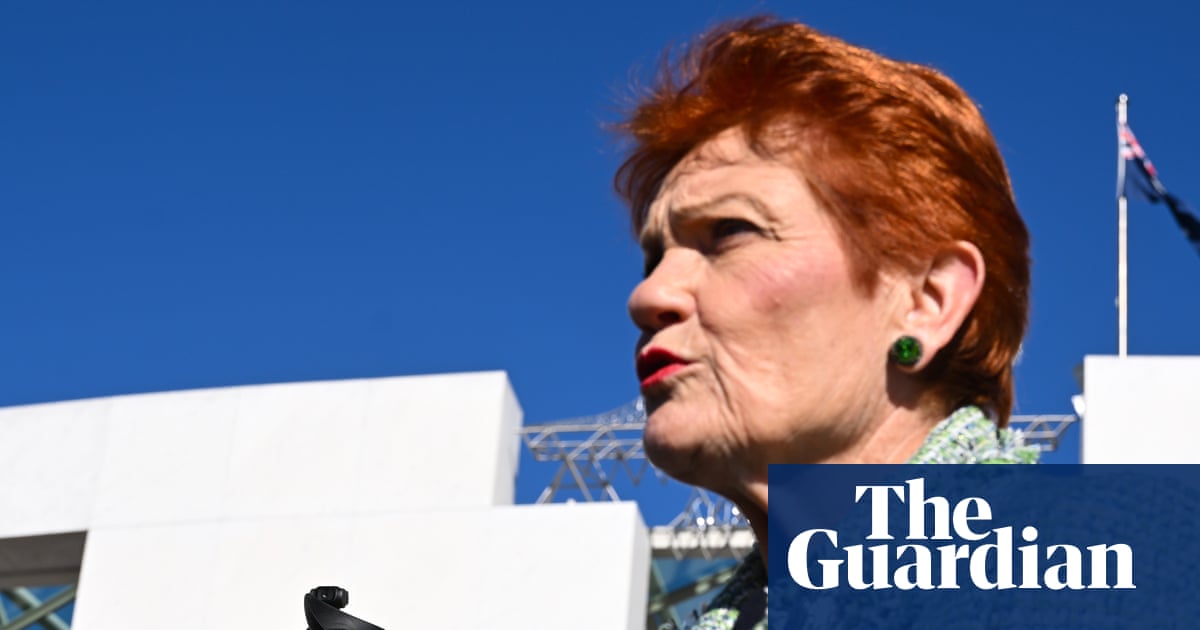
An SBS cameraman films Pauline Hanson outside Parliament House. One Nation claims for taxpayer funds after the last election are being reviewed for potential breaches. Photograph: Lukas Coch/AAPView image in fullscreenAn SBS cameraman films Pauline Hanson outside Parliament House. One Nation claims for taxpayer funds after the last election are being reviewed for potential breaches. Photograph: Lukas Coch/AAPPauline Hanson’s One Nation withdrew more than $800,000 of election spending claims after AEC inquiriesThe Australian Electoral Commission is examining if party breached laws in its $6m public funding claim after the last election, documents show
Get our breaking news email, free app or daily news podcast
The Australian Electoral Commission questioned Pauline Hanson’s One Nation party over more than $800,000 of claimed electoral expenditure for the last election, Guardian Australia can reveal.
Documents obtained under freedom of information laws show that the inquiries prompted the party to withdraw more than 140 items as it sought to provide additional information to justify almost 15% of the party’s $6.01m public funding claim.
The documents also reveal that the commission is now examining whether the party breached electoral funding laws for payments made to certain suppliers that were reimbursed in the claim.
Read moreAs the party continues to rake in millions of dollars from supporters, and freshly banks more than $7m after its success at the South Australian election, the party’s claim to taxpayer funds is being reviewed by the regulator for potential breaches.
Hanson, as the party’s registered agent, would face criminal penalties if she submitted an “incomplete, false, or misleading claim” to a commonwealth entity, according to the declaration signed by the party leader that accompanied the claim.
One Nation has previously been found to have wrongly claimed public funding for electoral expenses and the party has twice been forced to pay back election funding – once after the 2019 election and again after the 2022 election.
In 2021 the AEC subjected Hanson to an enforceable undertaking, finding that as the party’s registered agent, she had claimed about $165,000 in expenses that either was “not electoral expenditure” or was for spending “that had not been incurred”.
The NSW Electoral Commission has also denied funding claims made by One Nation, finding in 2021 that it incorrectly claimed $118,000 in taxpayer funds for the purchase of electoral material, including merchandising.
The Guardian sought multiple documents One Nation lodged with the Australian Electoral Commission to justify the taxpayer funds it received under public funding arrangements after the 2025 federal election, and correspondence between the party and the regulator about its claim.
Based on the 6.4% national vote the party received at the last election and its Senate performance, One Nation received more than $6m in public funding from the AEC.
The released documents show that following the party’s lodgement for just over $6m in July last year the commission queried information provided for 143 of One Nation’s claimed expense items.
A senior compliance officer from the AEC raised questions with the party about its claim in late October, advising that more information was needed to justify and process the claim.
“Information can include further descriptions of the goods and services provided and what the dominant purpose of the expenditure was for,” the compliance officer wrote in an October email to the party’s operation manager, Alex Jones.
The best public interest journalism relies on first-hand accounts from people in the know.
If you have something to share on this subject, you can contact us confidentially using the following methods.
Secure Messaging in the Guardian app
The Guardian app has a tool to send tips about stories. Messages are end to end encrypted and concealed within the routine activity that every Guardian mobile app performs. This prevents an observer from knowing that you are communicating with us at all, let alone what is being said.
If you don't already have the Guardian app, download it (iOS/Android) and go to the menu. Select ‘Secure Messaging’.
SecureDrop, instant messengers, email, telephone and post
If you can safely use the Tor network without being observed or monitored, you can send messages and documents to the Guardian via our SecureDrop platform.
Finally, our guide at theguardian.com/tips lists several ways to contact us securely, and discusses the pros and cons of each.
Illustration: Guardian Design / Rich CousinsThe officer requested the document be returned in the same week “so that we may continue processing the claim”.
After a phone call about the queries, Jones, who is based at the party’s Brisbane headquarters, advised that the party would “voluntarily withdraw” the items.
In an email, Jones said: “I wish to voluntarily withdraw the 143 items which have been queried totalling $809,648.11 from the party’s interim claim, to allow us more time to assess the queries and provide appropriate responses for each in the party’s final claim.”
In November, the party submitted its final claim, however details of this, including its response to the 143 queried items, have been redacted under freedom of information laws.
The decision to refuse the release of certain documents to the Guardian, including two key documents that detail the party’s funding claim, is based on the AEC’s compliance review of the payments made to One Nation. The AEC also examines funding claims made by other political parties as a matter of routine.
The AEC is refusing access to the documents that list items of electoral expenditure that comprise the election funding claim, saying the release “may influence or jeopardise the compliance review process”.
It also said that it did not want to release supplier information as it may compromise an ongoing investigation into the party’s financial compliance.
“[The documents] relate to an ongoing investigation into the accuracy of PHON’s election funding claim, which includes the assessment of evidence provided by PHON in support of its claim for election funding,” the AEC said in its decision letter.
“The two documents in question identify suppliers associated with PHON’s electoral expenditure and form part of the evidentiary basis for the current investigation. Disclosure would therefore reveal aspects of the scope and evidentiary focus of the investigation.
“I consider that release of the documents could reasonably be expected to forewarn third parties of the direction of the investigation, including the nature of the evidence being examined, and in doing so put the investigation in jeopardy.”
The AEC said it was “reasonably expected” that it would need to seek further information or evidence from certain suppliers identified in these documents.
“Disclosing the identities of these suppliers could prejudice the conduct of the investigation and the proper administration of the law in this course of the investigation.
“I am satisfied that the risk identified is real and arises directly from the content of the documents and the circumstances of the investigation.”
Guardian Australia has previously reported concerns among former candidates that the party is operating as a “money making scheme”, with information provided to the commission showing candidates reported spending just $872,116 for the 2025 election despite the claim of more than $6m.
Last month, the Guardian obtained financial records lodged by the Queensland division of the party with the Office of Fair Trading in Queensland, which revealed the party had not lodged any financial reports since 2022.
The reports were criticised by a leading financial expert as “sloppy and unprofessional”, showing missing and worthless assets of more than $1m.
One Nation did not respond to questions from the Guardian about the AEC review.
Do you know more? Email sarah.martin@theguardian.com