Add The California Post on Google It’s not often that architecture becomes a major talking point in a race for mayor. But former candidate Spencer Pratt keeps talking about it, firing off a thread on social media on the appeal of Art Deco buildings.
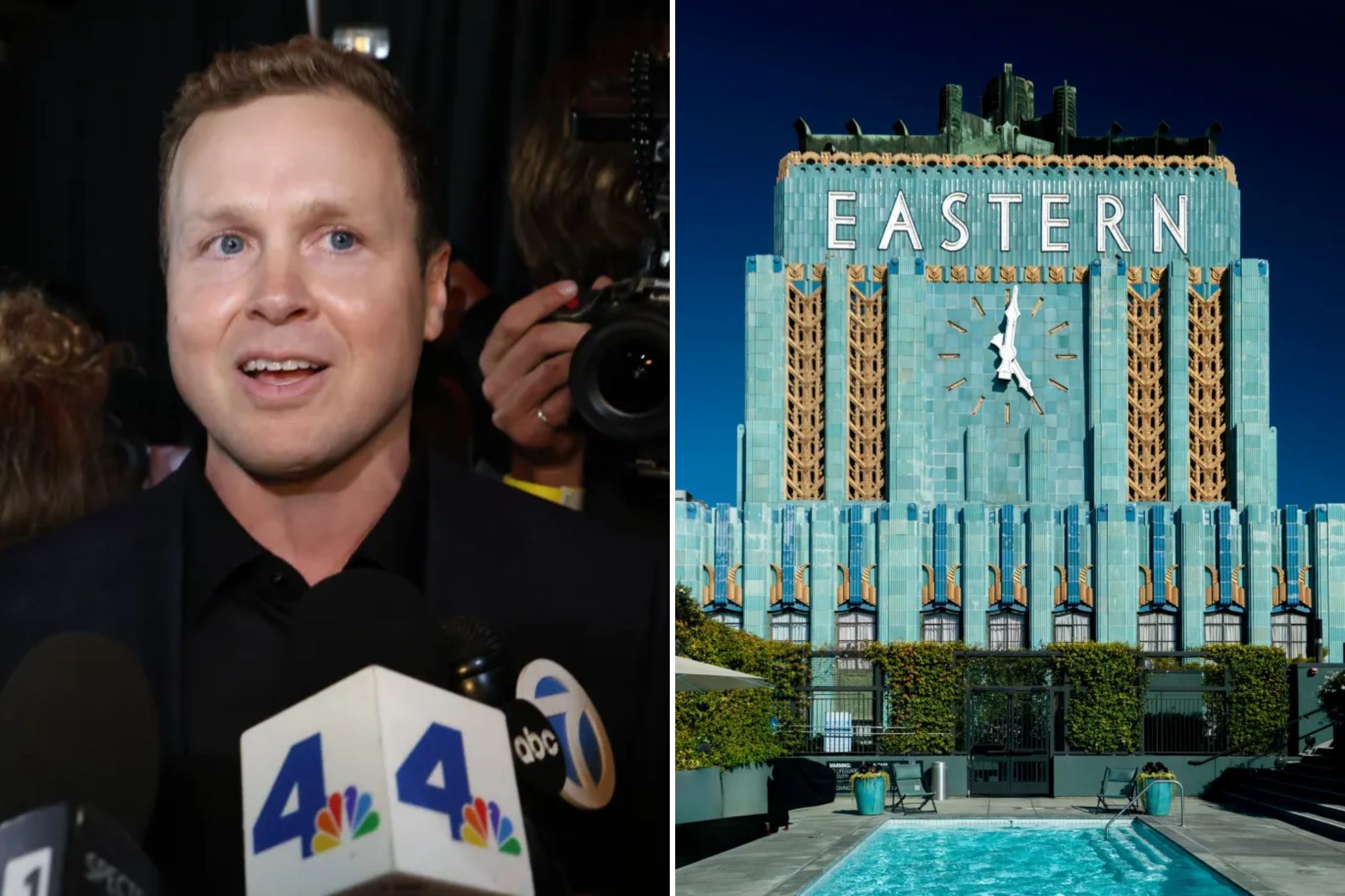
“One of the hallmarks of communism is the exaltation of ugliness,” Pratt began, in a post that included a photo of the 1930 Eastern Columbia building on Broadway, perhaps LA’s best-known Deco landmark, alongside one of a hulking concrete tower by Eric Owen Moss Architects, known as the (W)rapper, that was completed three years ago on Jefferson Boulevard.
“Contrast our gorgeous Depression-era LA architecture with the commie brutalist slop vomited upon us today,” Pratt declared. “I’ll support any candidate who vows to throw this architect in prison for crimes against beauty.”
Even as some architecture critics have joined Pratt in slamming the (W)rapper — Oliver Wainwright, in The Guardian, called the building “a menacing thing” — it seems unlikely that Pratt’s former rivals, Mayor Karen Bass or City Councilwoman Nithya Raman, would endorse tossing Moss in the slammer.
Still, the thread revived a question that’s been bouncing around LA architectural and political circles for several weeks: Why does Spencer Pratt like Art Deco so much?
That obsession first emerged in May, during interviews with David Friedberg of the All-In podcast, and the writer Meghan Daum. “We’re going to have LA so beautiful,” Pratt told Friedberg. “No more of these high-density, SB 79, prison-like structures. We need to bring Art Deco back.”
The SB 79 reference was to a state housing bill, set to take effect July 1, that allows denser apartment construction in neighborhoods near transit lines. It is deeply unpopular with many of Pratt’s neighbors in Pacific Palisades, who have feared that houses lost in January’s firestorm might be replaced with condo blocks.
The mention of housing law in the same breath as Art Deco might have been jarring for listeners. In truth, it was consistent with the nostalgia of Pratt’s campaign as a whole, whose unspoken slogan from the start was essentially, “Make Los Angeles Great Again.”
Of course, there’s more to LA than Art Deco.
The great strength of LA architecture is its extreme eclecticism; though some fans of Spanish Colonial might disagree, the city has never had a house style.
Just in terms of publicly accessible landmarks, you can see early modernism at the Schindler House in West Hollywood, built with ingeniously quick-to-build tilt-up concrete walls.
Near Pratt’s neighborhood in Pacific Palisades, there’s still the mid-century variety of modernism at the eucalyptus-shaded Eames House and Studio just off Chautauqua Boulevard. (It survived the fire.)
Frank Lloyd Wright’s rather vain neo-Maya experiment, the Hollyhock House, is owned by the city and regularly open for tours.
Downtown, Grand Avenue has a murderer’s row of cultural and religious buildings by winners of the Pritzker Prize, the leading honor in architecture, including Frank Gehry’s shimmering Walt Disney Concert Hall, Arata Isozaki’s reserved Museum of Contemporary Art and Rafael Moneo’s imposing Cathedral of Our Lady of the Angels.
So there’s much more to LA than one particular style.
But for Pratt, Art Deco also served a political purpose. In many campaign appearances, Pratt contrasted what he saw as the dystopian hellscape of present-day LA with a sepia-toned picture of the city he grew up in.
And Art Deco isn’t a bad choice as an aesthetic avatar for an LA looking to recapture past glory. Along with its many variants, including Streamline Moderne, it’s the historic style most directly responsible for shaping the civic character of the city.
Many of our most recognizable civic landmarks, including City Hall, Union Station and the Central Library, fall under Deco’s wide umbrella.
The style is known among historians for having occupied, as it rose in popularity a century ago, a middle ground between the nostalgia of revivalist architecture, like the Spanish Colonial, and the austerity of modernist buildings, with their flat roofs and wholesale rejection of ornament. Along those lines, it might have appealed to Pratt as a symbol of unity — and even compromise.
But there’s a darker sensibility beneath the starburst ornament and glimmering surfaces of Art Deco, too, and it seemed to match the bleaker tone of much of the campaign’s rhetoric.
Art Deco hit its stride not in the Roaring Twenties, but as the Great Depression took hold. The first serious effort among architects to revive the style emerged in the late 1960s and early 1970s, another period of angst, uncertainty and political violence.
There seems to be something in Art Deco that doesn’t merely reflect but is nourished by periods of strife and division. Like Pratt’s ill-fated campaign, it casts itself as a ready savior, poised to rescue the city from tipping further into ugliness and despair.
Christopher Hawthorne, former architecture critic for the Los Angeles Times and chief design officer for the city of Los Angeles, teaches at the Yale School of Architecture and writes the weekly Punch List newsletter.