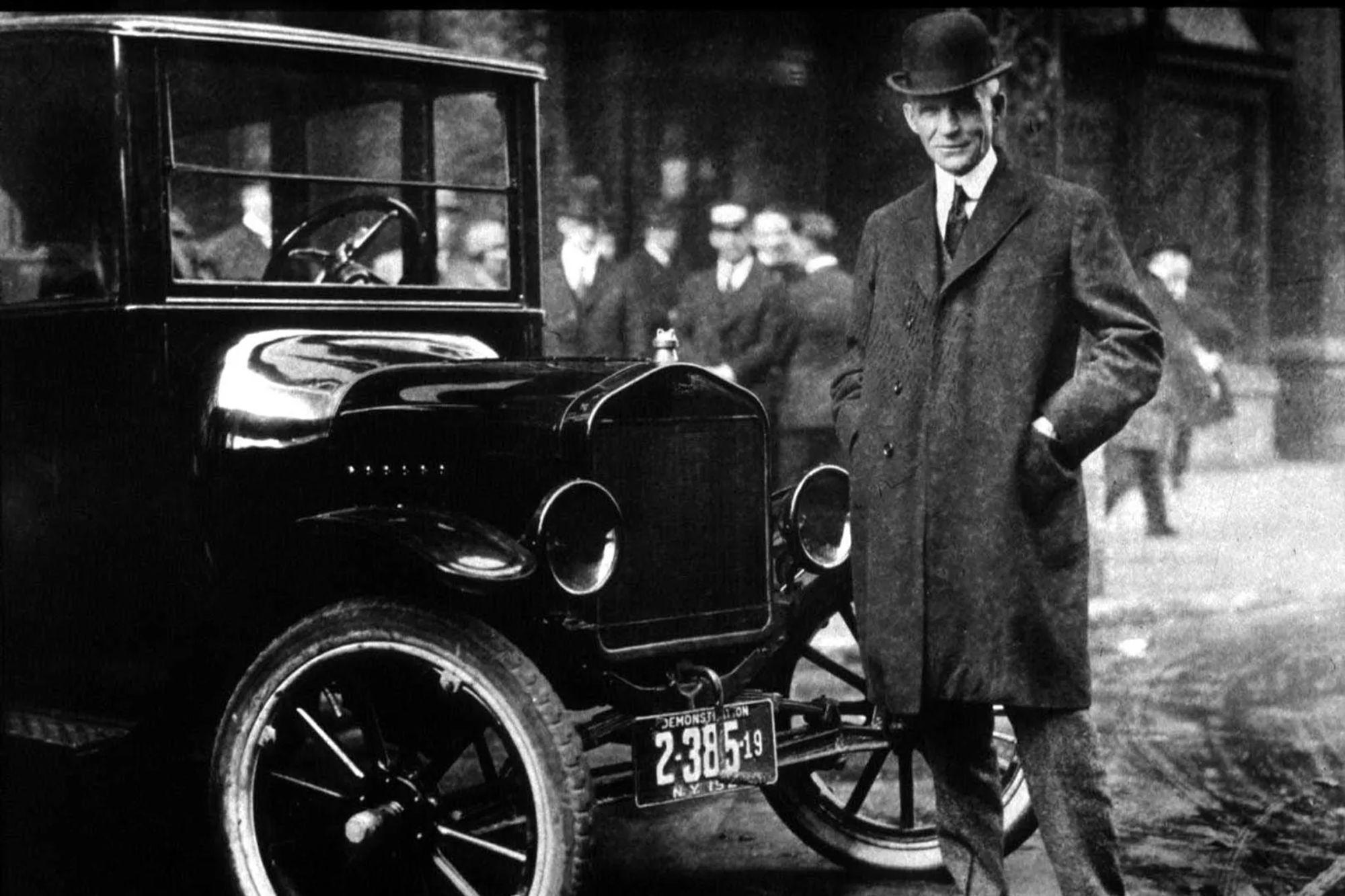
Add The New York Post on Google The ferry broke down at exactly the wrong moment for everyone except Henry Ford.
On June 8, 1909, two stripped-down Ford Model Ts rolled onto a little wooden ferry at Glasgow, Mo., and crossed the Missouri River. The cars were filthy, the men inside them were running on fumes, and a Boston-built Shawmut was closing fast behind them in a cross-country race.
Then the ferry quit. The boat that’d just carried the Fords to the western bank suddenly couldn’t return for the Shawmut or the Acme, another trailing car. The official explanation was mechanical failure, but the timing looked almost theatrical.
“It’s such an uncanny moment,” Eric Moskowitz, author of the new book “The Hardest, Longest Race: Henry Ford and the Cross-Country Contest That Changed America” (St. Martins Press), out now, tells The Post. “People sit up whenever I tell them about it.”
The Shawmut crew, stranded on the wrong side of the river, had a choice. They could lose hours searching for another crossing. Or they could aim the car toward the railroad bridge looming above the water, a half-mile of ties, gaps and terror, with no guarantee a train wouldn’t come roaring through. They chose the bridge.
That white-knuckle decision is one of the wildest episodes in Moskowitz’s book, which tells the story of the 1909 Ocean-to-Ocean Race for the Guggenheim Cup, a 4,100-mile contest from New York City to Seattle that helped sell America on the automobile and gave Henry Ford the origin myth every empire needs.
It also raised a century-old question: Did Ford win because the Model T was that good, or because his organization was that ruthless?
Moskowitz believes the answer is clearly, “Both.”
The contest was promoted as the first true coast-to-coast automobile race in America, even though earlier long-distance runs blurred that claim. It began on June 1, 1909, in front of New York’s City Hall, where thousands gathered to watch Mayor George B. McClellan Jr. fire a gold-plated revolver.
The timing was tied to Seattle’s Alaska-Yukon-Pacific Exposition, a World’s Fair meant to show off the city and the Pacific Northwest. President William Howard Taft pressed a ceremonial telegraph key in Washington, sending a signal that opened the exposition in Seattle and also launched the race in New York.
The contest was supposed to demonstrate the promise of the automobile. It also showed how little of America was ready for one.
The route called for thirty checkpoints, including stops in Poughkeepsie, Buffalo, Chicago, St. Louis, Denver, Boise and North Yakima. In the East, racers had mandatory rest periods. West of the Mississippi, it was a free-for-all across mud, mountains, wagon trails and whatever passed for roads when the country still mostly belonged to horses, trains and weather.
Only five cars made the start: two Model Ts, an Acme, a Shawmut and an Itala. Beside the larger, more expensive cars, the Fords looked almost comic. Their exhaust systems and mufflers had been removed. Their bodies had been stripped down to little more than chassis and seats. The Model Tcost $850, while its bigger rivals cost thousands.
“Spectators sizing up the pack dismissed the runty Fords,” Moskowitz writes.
Ford, who’d founded his eponymous auto company six years earlier, loved that. At that point, he was 45 years old and successful but not yet immortal.
“One thing that struck me was just how often the newspapers got his first name wrong, especially outside of Detroit,” Moskowitz said. “In 1909, this was a living, breathing person who wasn’t yet a household name, and it was far from clear what the future would hold for him.”
Ford had money, a new house, a son in private school and control of his company. He also faced a dangerous patent lawsuit, massive ambitions and a market full of competitors. “If things don’tbreak a certain way,” Moskowitz said, “he’d fade into history at this point as an affluent guy who was moderately well known in Detroit for a few years.”
The race was his chance to make sure things went his way.
His secret weapon wasn’t only the Model T. It was the Ford network. Across the country, Ford branch managers, dealers and local guides were waiting like a human telegraph line, ready to steer the Model Ts through roads that were barely marked and often barely roads.
The Shawmut had no such machine behind it. The car came from Stoneham, Mass., where its factory had burned down the previous November. The race was a Hail Mary, a way to make enough noise that investors might notice before the company disappeared.
In the Shawmut was Earle Chapin, a young mechanic who sometimes took the wheel and wrote constantly to his wife Caroline, whom he called “Anita.” Every letter had to be scratched out between breakdowns, wrong turns and punishing miles, from a car that was carrying him farther from home than he’d ever meant to go.
Finding those letters, Moskowitz says, changed everything for him. “It was electrifying, and I knew right away it would be the heart of the book,” he said. “What are the odds that these letters would be from someone in the Shawmut car, and that he’d be writing so frequently and with so much energy and emotion to his 24-year-old sweetheart back home?”
Chapin was missing their first wedding anniversary for “this crazy adventure,” Moskowitz said, while “the fate of Shawmut” was on the line.
Soon enough, romance gave way to road horror. In Kansas, rain turned the land into what one motorist called “mud, water and glue,” swallowing wheels and forcing the crews to push, dig and drive through the night in clothes stiff with cold and sweat. By the time the Fords reached Goodland, Kan., they were so caked in filth that reporters described the drivers as some strange new species.
In Fort Steele, Wyo., the Shawmut hit another Ford-engineered wall. Its crew reached a Union Pacific railroad bridge over the North Platte River and found Charlie Hendy, Ford’s Denver branch manager, waiting with an armed guard. Hendy insisted nobody could drive across without permission from Omaha, even though local practice had allowed cars over the bridge. The Fords had permission, but the Shawmut did not.
Chapin later called it “a damned crooked deal.”
Moskowitz sees the episode as part of a larger Ford pattern. The company had built a brilliant coast-to-coast support system that gave Ford’s men countless chances to tilt the race without leaving fingerprints.
The Ford team ultimately got caught “not because of what happens at Glasgow, which can’t be proven, or Fort Steele, which they freely own up to,” Moskowitz said, but because of something more concrete. “They secretly change the engine on the ‘winning’ Model T,” leaving behind “a paper trail in the form of a shipping record.”
That happened after the No. 2 Ford broke down in Cokeville, Wyoming. The engine trouble should’ve been disastrous. Under the rules, major parts had been stamped before the race. Replacing an engine meant the car could continue, but it couldn’t legally win.
The Ford crew swapped in another engine, repaired the original stamped engine, shipped it ahead and quietly swapped it back before the finish-line inspection.
The final stretch was brutal. Chapin became so ill in Baker City, Ore., that a doctor diagnosed him with “auto intoxication,” a period term for the punishment of endless motoring. The Shawmut had to go on without him.
The Ford, meanwhile, crossed Washington’s Snoqualmie Pass through mud, snow, and stumps. Henry Ford and his 15-year-old son Edsel took a train west and then drove into the Cascades to meet it. The No. 2 Ford reached Seattle first on June 23, greeted by cheers, flashbulbs and a story that seemed too perfect to resist.
The Model T had beaten the big cars. Ford had conquered the continent. America had seen its automotive future. Then, Shawmut protested.
The initial hearing in Seattle went Ford’s way. But the Automobile Club of America later reviewed the evidence and disqualified the No. 2 Ford for the engine swap. The Shawmut was declared the official winner, but it hardly mattered at that point.
“The news landed with a whisper,” Moskowitz writes. Ford dealers kept advertising the Model T as the winner of the New York-to-Seattle race. In 1909, Shawmut went out of business.
It was a cruel irony. Shawmut won the cup, but Ford won the country.
The contest exposed an America trapped between eras, a nation of railroads and mud about to be remade by speed. Moskowitz said people in 1909 knew they were living through “the onrush of modernity,” when technology was “making life ever better, at least for the consumer class.”
But the race also proved something harsher. The future didn’t arrive cleanly. It came through gumbo mud, broken bridges, missing ferries, backroom pressure, clever advertising and a tiny car that was a rolling myth factory.
Ford believed he’d built “a different kind of car, a more democratic car,” Moskowitz said, “but he wasn’t going to leave the outcome to chance.”