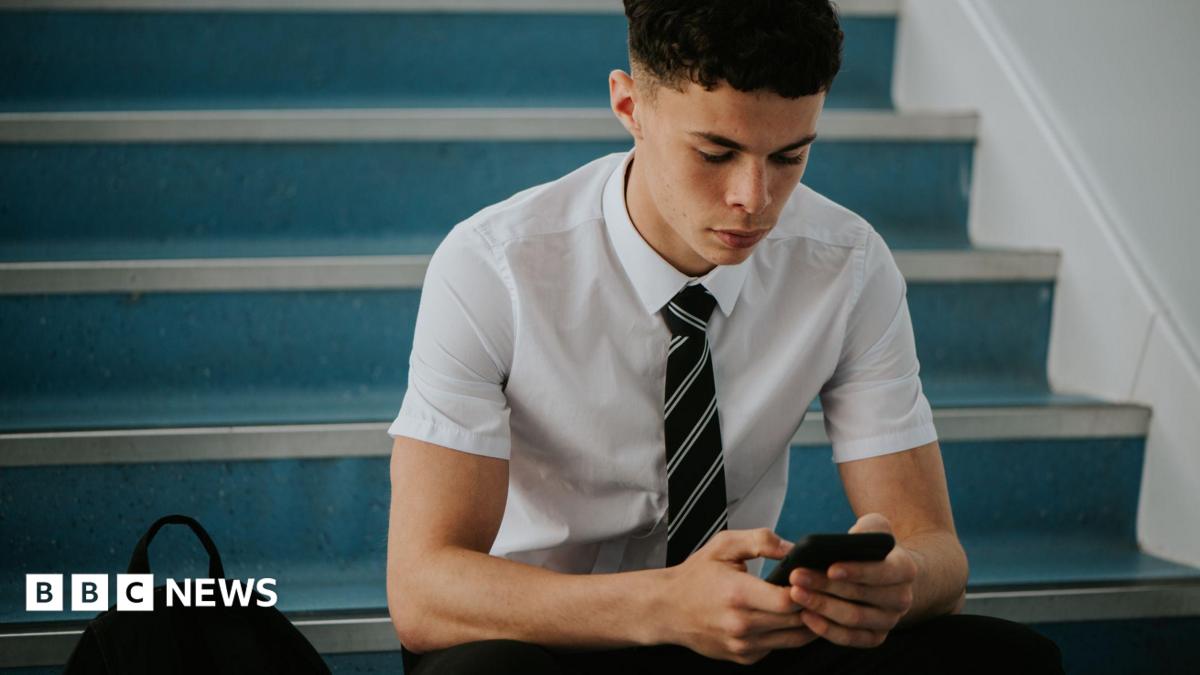
Image source, GettyByHayley ClarkeEducation reporterPublished1 minute agoA ban on smartphones in schools in England comes into force on Monday, 29 June, making individual schools and trusts legally responsible for being phone-free throughout the day.
It is separate from the recently announced ban on social media for under-16s, and the government said the move would give "legal force to what schools are already doing in practice".
But what is changing? And what does it mean for pupils, parents and teachers?
This will depend on your school's rules - but in most cases, probably.
Lots of schools let students bring their phones in, as long as they're not used, seen or heard.
Earlier this year, Education Secretary Bridget Phillipson wrote to head teachers to encourage them to follow guidance which says "all schools should be smartphone-free environments by default".
This is now going to be law as part of the Children's Wellbeing and Schools Act, which passed in April.
It means head teachers are legally required to follow that guidance, external.
Image caption, Some schools give students pouches for their phones
Almost all schools already have some sort of phone ban in place - but policies vary.
Some have special lockers for phones, others have sealed pouches.
At one school in Hampshire, "brick" or "dumb" phones are the only devices allowed, which can only be used to call or text and have very limited internet access.
In Essex, another school has just invested in magnetically locked pouches, to replace its previous out-of-sight policy. Children who need access to their phones during the day for medical reasons, such as to control an insulin pump, will instead use Velcro-sealed pouches.
These types of pouches have already made a "phenomenal difference" at a school in Hull, the staff and pupils say.
Some schools have "no see, no hear" policies, where phones can remain with students as long as the devices remain stored away.
The government says head teachers know their schools and pupils best, so can choose a way of delivering a phone ban that works for them.
But some unions want the government to go further.
Pepe Di'Iasio, general secretary of the Association of School and College Leaders, has called for more funding to support bans beyond "no see, no hear", to help pay for things like lockers, secure storage areas or phone pouches.
Politicians have been debating this issue for a few years now.
The Conservatives had been campaigning for an outright ban, while the Liberal Democrats claimed they had been "dragging the government" towards introducing a ban before it was announced in April.
The Labour government had previously said that a statutory ban wasn't necessary, as schools were following the guidance already.
Image caption, Maths teacher Bill Morris thinks banning phones at his school encourages more conversation between pupils
At one school in Barnsley, phones are collected during morning form time and returned at the end of the day.
Maths teacher Bill Morris, 26, thinks it's "really positive", giving students the opportunity to have conversations and learn real-world communication skills.
He also thinks it's a good way for them to think for themselves, form their own opinions - and not overly-rely on Google.
And he says the lockers they use help to create a better environment than his own experience when he was a pupil, when phones were out at break and lunchtime.
The teacher is also on board with the government's plans to ban social media for under-16s outside of school because of the effects of doomscrolling and short-form, snappy videos.
He added that one of his pupils had arrived at school "very tired" recently, having been on TikTok until 03:00.
There are also some rules for teachers in the government's guidance.
It says that school staff should not use their own phones for personal reasons in front of pupils throughout the school day.
This is to "empower staff" to better challenge pupils to meet the school expectations.
It also sets out when it might be appropriate for teachers to use a mobile phone in school, such as to issue homework, rewards and sanctions, or to log in to secure accounts using two-step verification.
Because education is devolved, the approach to phones in schools varies across the UK.
The Scottish government brought in guidance allowing head teachers to implement phone bans in schools in 2024.
Phones will be banned in all state secondary schools in Edinburgh after the summer holidays, following a consultation there.
In Wales, there is no national ban, but heads have the power to ban or restrict the use of devices in their own schools.
Welsh education minister Anna Brychan has promised to set "clear national expectations on how mobile phones are used in schools".
And in Northern Ireland, a phone-free pilot scheme in nine schools ended earlier this year, with a report due to be published soon.
Phones to be banned in schools by law in England under government plans
Make sure pupils don't ever use phones at school, Phillipson tells teachers