Add The New York Post on Google A burn with no return.
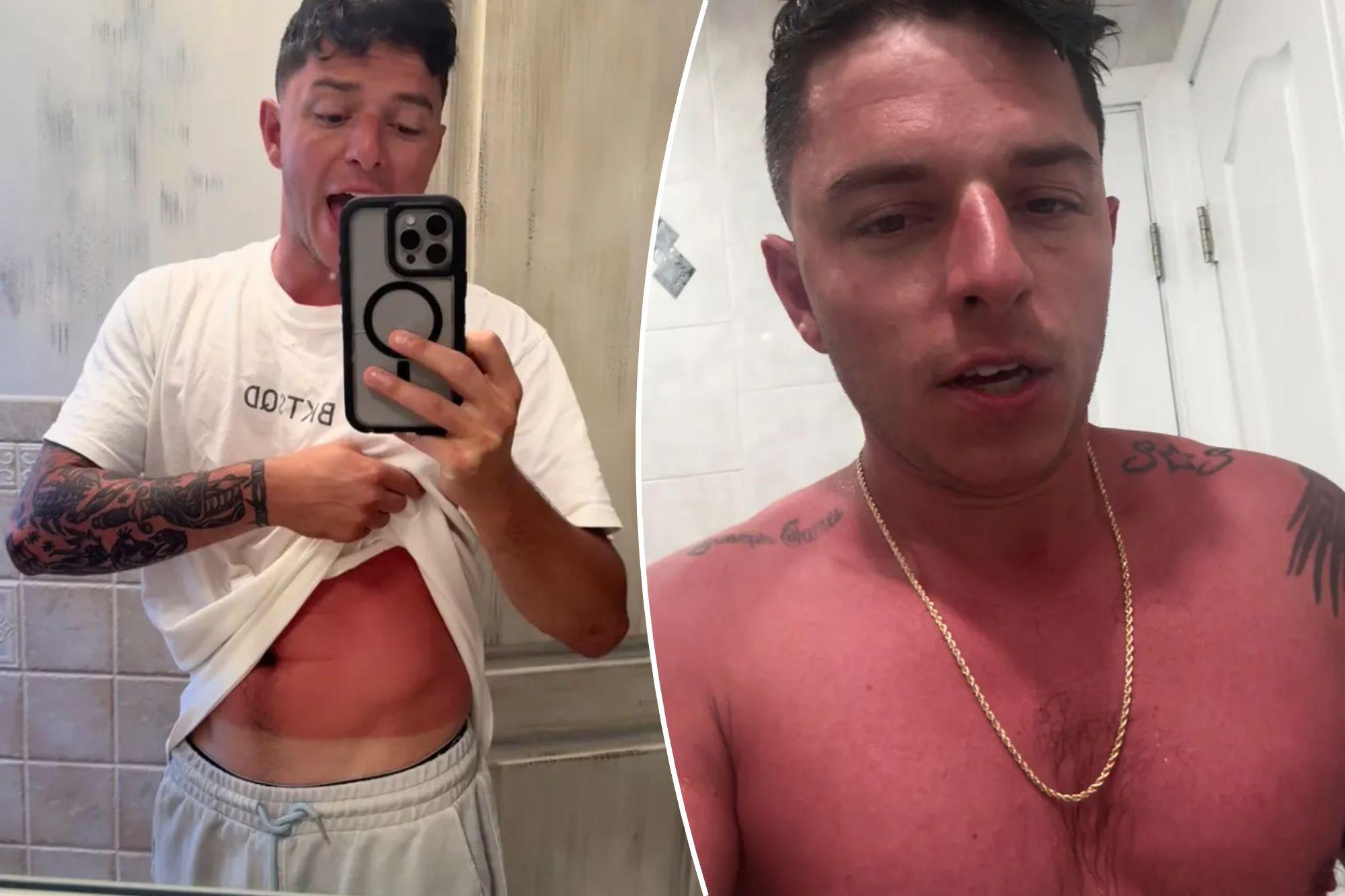
Last week, The Circle season 7 start Jojo Scarlotta went viral for his “horrendous” sunburn, which was painful, bright red and blistering after he failed to properly reapply sunscreen.
“I just showered. I can’t breathe. I think I’d rather stick thumbtacks in my nutsack than deal with this again,” he said. “They said the UV was a f—ing three … I look like Larry the f—ing lobster.”
Viewers were certainly stunned, warning him that he’d sustained a “life-changing sunburn” and should seek medical care.
“Life-changing sunburn” isn’t an official medical term — but the idea behind it is “very real,” dermatologist Dr. Michelle Henry of Skin & Aesthetic Surgery of Manhattan told The Post.
“A severe, blistering sunburn can permanently increase your risk of developing skin cancer because ultraviolet (UV) radiation damages the DNA inside your skin cells,” she explained.
“While your body can repair some of that damage, it doesn’t repair all of it. The DNA mutations that remain can accumulate over your lifetime.”
In fact, severe sunburns double your risk of melanoma, the deadliest form of skin cancer — so Henry says that if you do get burnt to a crisp, it should shake you out of your SPF-skipping slip-ups.
“I like to think of a severe sunburn as a wake-up call, not a life sentence. The good news is that the choices you make after that burn still matter,” said the doc, who is also a Melanoma Research Foundation Board Member.
“Every intense sunburn adds to your skin’s lifetime DNA damage,” said Henry.
“We don’t have one exact threshold where researchers can say, ‘This one burn changed everything,’ but we do know the risk increases with both the severity and number of burns.”
Have 10 or more severe sunburns in your life? You’ve got about 240% the risk of developing melanoma.
When in your life you got a bad sunburn may matter, too. Henry points to a Norweigan study that suggests that getting repeatedly sunburned as a child increases risk even if you’re careful later in life.
Five or more blistering sunburns as a teen puts you at a 80% higher risk of melanoma.
While most people worry about skin cancer, Henry says, there are more immediate concerns: A burn means the skin barrier is disrupted.
“If enough skin is affected, people can become quite sick because damaged skin loses fluid and can’t regulate temperature as effectively,” Henry said. “Large blisters also create an opening for bacteria, increasing the risk of infection.”
A burn could cause permanent pigment changes or scarring. UV also speeds up skin aging by breaking down collagen and elastin, contributing to wrinkles, discoloration, and loss of firmness early, Henry said.
You might also get a fever, chills, headache, nausea and vomiting.
“I don’t want people to panic if they’ve had one terrible sunburn. I do want them to take it seriously,” she said. “It’s never too late to change your relationship with the sun, and those changes can meaningfully reduce your future risk.”
Is it worse to have just a few really bad burns — or just tan a lot without SPF over time? They’re both bad, and both increase risk of cancer, Henry said.
Intense UV exposure, like blistering on a beach vacation, is more associated with melanoma and basal cell carcinoma. Chronic, everyday sun exposure — even if you never burn — drives squamous cell carcinoma and contributes to melanoma on exposed areas, like the face, scalp and neck.
“One of the biggest misconceptions I hear is, ‘I don’t burn, I just tan,'” said Henry. “A tan is not a sign that your skin is protected. A tan is actually your skin responding to DNA damage.”
The sun’s ultraviolet rays penetrate the skin cells, which only produce excess melanin as a reaction to that damage. And that damage accumulates over time.
“Your skin remembers every exposure, even if you don’t,” she said.
Scarlotta, fortunately, seems unlikely to put himself in this position again.
“I learned that applying sunscreen every two hours is a f— lot easier than spending a week cosplaying as a f—ing tomato,” he said. “I learned the sun and I are not friends. I cannot get away with idiotic s—. Even though something’s 90 million miles away, it can still kick your ass.
“I learned that there’s an SPF 100 sunscreen now, and I think that’s gonna be my best friend moving forward, along with a new linen shirt and a possible umbrella stand.
“A severe blistering burn can increase your lifetime risk of skin cancer, but it doesn’t determine your future,” Dr. Henry said. “Your skin health is shaped by what you do next.”
“I’m peelin’. It itches everywhere. If I had to compare myself to anything right now, I feel like Jorah Mormont when he acquired the greyscale,” Scarlotta said, referencing the exiled knight from “Game of Thrones.” He said he was using aloe vera and “popping Tylenol like Tic Tacs.”
If this sounds like you, don’t panic. Henry says most sunburns can be treated at home. She recommends:
That said, seek emergency care if you’re blistering across large areas of the body, if it covers your face, hands, feet, genitals, or large joints, and if your pain is severe.
If you develop a high fever, get severely dehydrated, dizzy, confused, can’t keep fluids down, or faint, go to the ER. Young kids with blistering sunburns should get help earlier because they get dehydrated quicker.
A classic staple that provides reliable, high-level protection. The lightweight formula absorbs instantly.
EltaMD is recommended by dermatologists for sensitive skin. The dual chemical-and-mineral formula blends easily.
Providing ultimate face and body protection, this premium sunscreen has a fast-absorbing texture, making wearing SPF 100 feel totally effortless.
COSRO is a K-beauty brand that’s taken over the internet. It layers much more luxuriously than the price would suggest.
More than 4,000 shoppers picked up this ISDIN face SPF in the past month for its subtle tint and anti-aging formula.