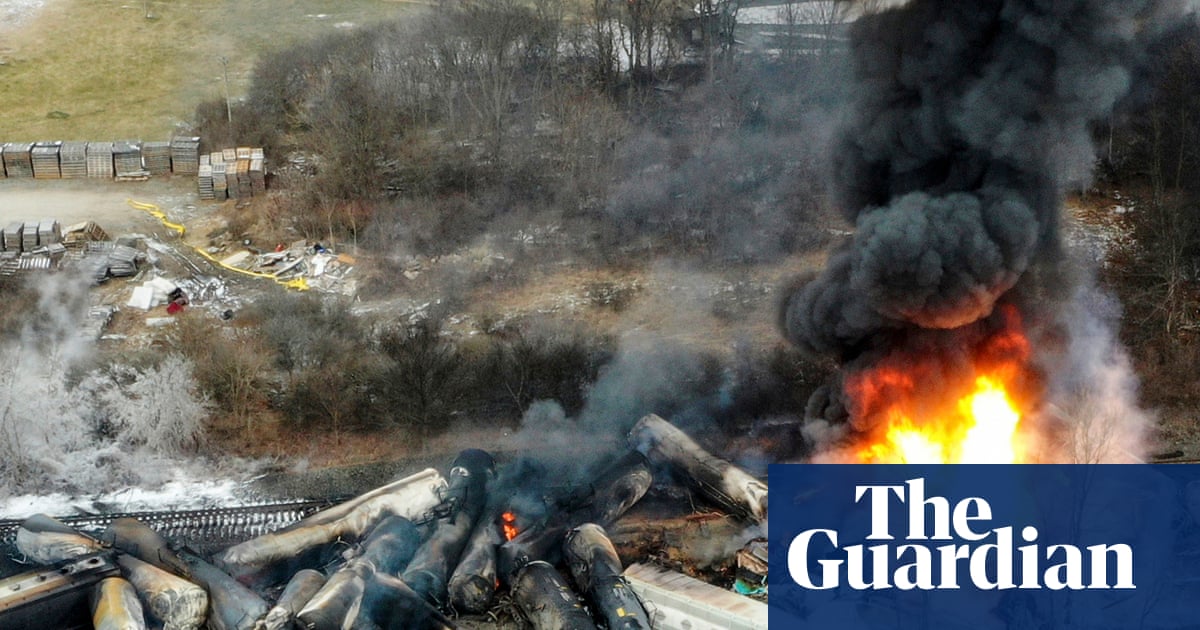
Portions of a Norfolk Southern freight train that derailed in East Palestine, Ohio. Photograph: Gene J Puskar/APView image in fullscreenPortions of a Norfolk Southern freight train that derailed in East Palestine, Ohio. Photograph: Gene J Puskar/APNew study suggests health damage from exposure to Ohio toxic train spillResearch finds immune systems still ‘responding to toxic chemical exposures’ related to East Palestine derailment
In the weeks after the East Palestine train wreck culminated in a towering fireball and chemical release in the small Ohio town, Jessica Boersma was seriously exposed to the stew of compounds emitted from the derailment site.
Boersma lives less than a quarter mile away, and, as a city council member, she had to spend significant time at the site coordinating with first responders.
Now the first long-term research carried out on East Palestine residents exposed to the disaster suggests how it may have affected her – blood drawn six months after the accident showed signs of chronic inflammation and altered cell counts suggesting the chemical exposure had damaged her body.
More broadly, the new peer-reviewed pilot study that checked blood samples suggests that some East Palestine residents’ immune systems were still “responding to toxic chemical exposures” by fighting off an attack, or repairing their bodies. The research did not look for particular diseases.
Compared with a control group, East Palestine residents showed higher numbers of red blood cells, higher hemoglobin levels, inflammation and an increase in the number of cells the body dispatches to attack and “eat” chemicals in order to remove them from the body.
The East Palestine residents also showed higher levels of proteins that work to repair tissue damage, and lower numbers of cells that fight infection, which suggests a response to a chemical exposure.
“This pilot shows evidence that the bodies of those who lived in close proximity to the site were still fighting and repairing from a toxic exposure,” said Erin Haynes, a University of Kentucky study co-author.
The researchers will next check a larger group of residents and first responders for the same issues. The studies are part of a broader University of Kentucky-led effort to track long-term health problems in East Palestine residents.
Dozens of cars on the Norfolk Southern train derailed and burned in February 2023 in the town of 4,700 at the edge of the Appalachian hills. The fire burned near tankers carrying vinyl chloride, and, two days later, fearing a “major explosion”, officials conducted a controlled burn of the chemical as a prevention measure.
In the immediate vicinity and in pockets throughout the city, a potent chemical odor hung in the air for weeks. The levels of dioxin were as much as 14 times higher than what US Environmental Protection Agency scientists had found to be safe, while volatile organic compounds (VOCs) and other toxic substances were also emitted.
Some residents have since reported a range of health issues, like headaches, rashes, respiratory problems and hormonal disruptions. Boersma, a chiropractor, has at times had gall bladder pain, irregular menstrual cycles, elevated cortisol levels, and suffered from an itchy throat and nose that felt like an allergic reaction during the six months after the wreck.
Boersma told the Guardian that some of her patients had reported similar issues, but she is eager to learn more from the studies.
“I feel pretty normal now, but I’m interested in getting involved because I want proof – clinical, and black-and-white data – that show health markers that I could follow,” Boersma said. “We have a starting point with this.”
When regulators lifted the evacuation order in February 2023, they claimed air monitoring showed no risks from VOCs, and allowed residents to return home. However, public health advocates warned that the monitors may not have been able to detect all the chemicals and byproducts that pose a risk in such a complicated setting.
Long-term exposure to VOCs, such as vinyl chloride spilled at the site, have been linked to increased inflammation and other immune changes that East Palestine residents’ blood tests revealed. The study notes that prolonged air exposure to VOCs triggers the production of proteins that repair damaged tissue. Boersma said her blood showed elevated levels of the proteins that repair tissue.
Haynes said VOCs and toxicants can attack every organ in the human body, but there is a dearth of research on how our bodies fight against – and repair from – chemical exposures. The immune response is “suggestive” of that fight, which is why researchers first zeroed in on that, Haynes said.
“We really wanted to look at the body’s ability to fight a toxicant or foreign substance,” Haynes added. “It looks like their bodies were fighting an infection, but it was probably the exposure.”
Meanwhile, stress is strongly linked to immune dysregulation and found to alter immune responsiveness. East Palestine residents reported severe anxiety in the wreck’s wake, Haynes said.
While the patterns point to an immune response to the toxic cocktail at the site, “the findings do not prove that the train derailment caused the observed changes or that any individual has an illness or will develop future health problems,” the study’s authors stressed.
And not everyone who partook in the study showed health issues. Ron and Peggy Caratelli live about eight-tenths of a mile from the wreck site. They evacuated as soon as the orders to leave were issued, and stayed away for about a month. Their blood shows a different story – they have no markers of immune system impacts, Peggy told the Guardian.
“There was an overwhelming smell and we could taste it, it made our eyes burn, and we could feel it in our lungs,” Peggy said. Ron has suffered from COPD, but Peggy said it was unclear whether it stems from the wreck, or 35 years of smoking. She said he had also not eaten particularly well.
Peggy said she does not want to blame their problems on the wreck, but they are hopeful that the studies can help shed some light on the effects on the broader community.