Skip to main content Close Ukraine Mideast conflict France France 24 live See all shows Latest Newscast Closed-captioned Newscast TV guide Headings
Iranian Supreme Leader Ayatollah Ali Khamenei has been killed in a joint Israeli–US strike on Iran, a development that plunges the future of the Islamic Republic into uncertainty and heightens fears of wider regional instability. FRANCE 24 spoke with former NATO vice chief-of-staff Michel Yakovleff about what that could mean for the country's future.
By: Alison SARGENT Video by: Alison SARGENT To display this content from YouTube, you must enable advertisement tracking and audience measurement.
One of your browser extensions seems to be blocking the video player from loading. To watch this content, you may need to disable it on this site.
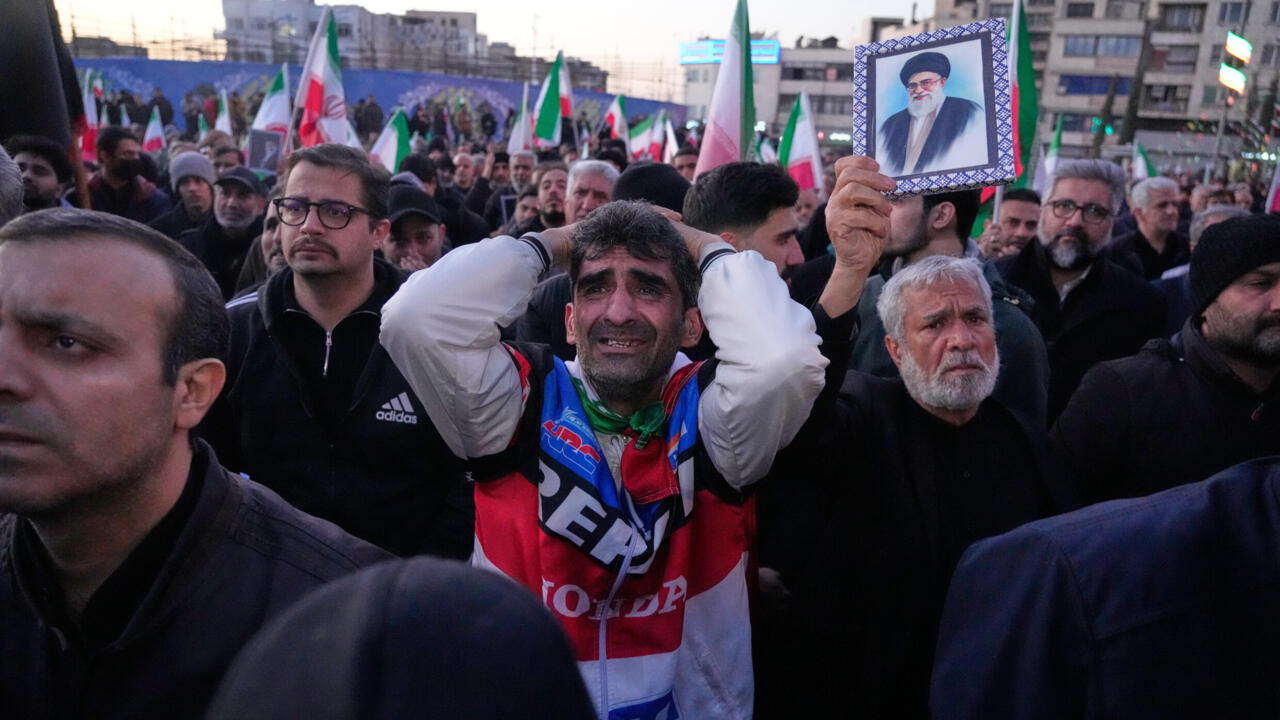
Government supporters mourn during a gathering after state TV officially announced the death of Iranian Supreme Leader Ayatollah Ali Khamenei, in Tehran, Iran, Sunday, March 1, 2026. © Vahid Salemi, AP 05:02 The revelation that Iran's Supreme Leader Ayatollah Ali Khamenei was killed in a wave of US-Israeli air strikes on Saturday has thrown the Islamic Republic's future into doubt, with US President Donald Trump saying the leader's death gave Iranians their "greatest chance" to "take back" their country.
FRANCE 24 spoke with former NATO vice chief-of-staff Michel Yakovleff about whether or not the Iranian government would be able to weather the latest US-Israeli bombardments – and what the Islamic Republic's survival would mean for the limits of Washington's unparalleled military might.
Read moreLive: Israeli army says has begun striking targets in 'heart of Tehran'
FRANCE 24: What do you foresee as possible scenarios for Iran in the coming days?
I think we're going to go into more days of strikes, and strikes from the Iranians. My concern is that the American strategy is much more short-lived than the Iranian strategy. The regime’s theory of victory is that we just outlast the storm. So when the Americans and/or the Israelis get fed up, we send a last salvo to show them that we're still alive and kicking.
The armada that Trump talks about is a large armada by any measure, but historically it's not that large. In reality, it's a few days’ worth of massive strikes. After that, it will have to go into a lower tempo of operations, much lower. Significantly, visibly lower.
And I also wonder for how long the Israelis can keep up with hundreds of missions every day over Iran. My concern is, if by the time they've expended their first oomph and first serious salvos, the Israelis and the Americans actually run out of ammunition and/or run out of targets, and the regime is still there – well, what next?
Read moreIran supreme leader Ayatollah Khamenei dies, killed in joint US–Israeli attack
FRANCE 24: Both Israel and the United States have been urging the Iranian people to somehow rise up, saying, “We've weakened the government – this is this is your chance.” Is that a totally unrealistic expectation? We have seen celebrations, but we’ve also seen pictures of huge crowds mourning the former ayatollah.
I don't know enough of Iranian society to say if it's unrealistic or not. But it's a bit preposterous from the American president to believe he can say, let's say in two or three days, “I've done my part of the job, now it's yours to take over.” That's the easy way out.
Trump has a tradition of betraying all his allies, the last ones being the Ukrainians, and before that, it's been the Afghans. I doubt that there is that degree of faith in the Iranian public.
In reality, it's a really open question. Everyone knows that Trump wants this to be a few days. Regime change has never been achieved that way in history. Now, this could be a first – and personally, I'd welcome it. I'd be very glad to be proved mistaken. But I can understand that the Iranian public – it’s very easy to say, “Just do your revolution and finish the job.” That's very easy from an American president at a distance.
To display this content from YouTube, you must enable advertisement tracking and audience measurement.
One of your browser extensions seems to be blocking the video player from loading. To watch this content, you may need to disable it on this site.
© France 24 05:17 FRANCE 24: So if short-term, this is a military success but long-term, the US and Israel lose their steam, and the Iranian regime rises back, even if it's weak – does that mean that, long-term, this will have been for nothing?
If that is what unfolds, then it will be worse than "it will have been for nothing". It will have demonstrated the limits of American and Israeli power.
Now, we're not there yet – there's a real string of tactical successes. And it may be, and I hope, that the regime is far closer to crumbling than it itself believes, and that this would be the last nudge that would, in effect, actually achieve a strategic objective. That's the positive way of looking at things, the hopeful way of looking at things.
If it doesn't work out that way, and the regime outlasts the current storm, then it's very bad news for the free world. Because it will have demonstrated the limits of American power.
Page not found The content you requested does not exist or is not available anymore.