play Live Sign upShow navigation menuplay Live Click here to searchsearchSign upSport|World Cup 2026In New York’s Astoria neighbourhood, Arab nations unite in World Cup joyHistoric World Cup match wins for Egypt, Morocco and Algeria brings together fans from the Middle Eastern diaspora.
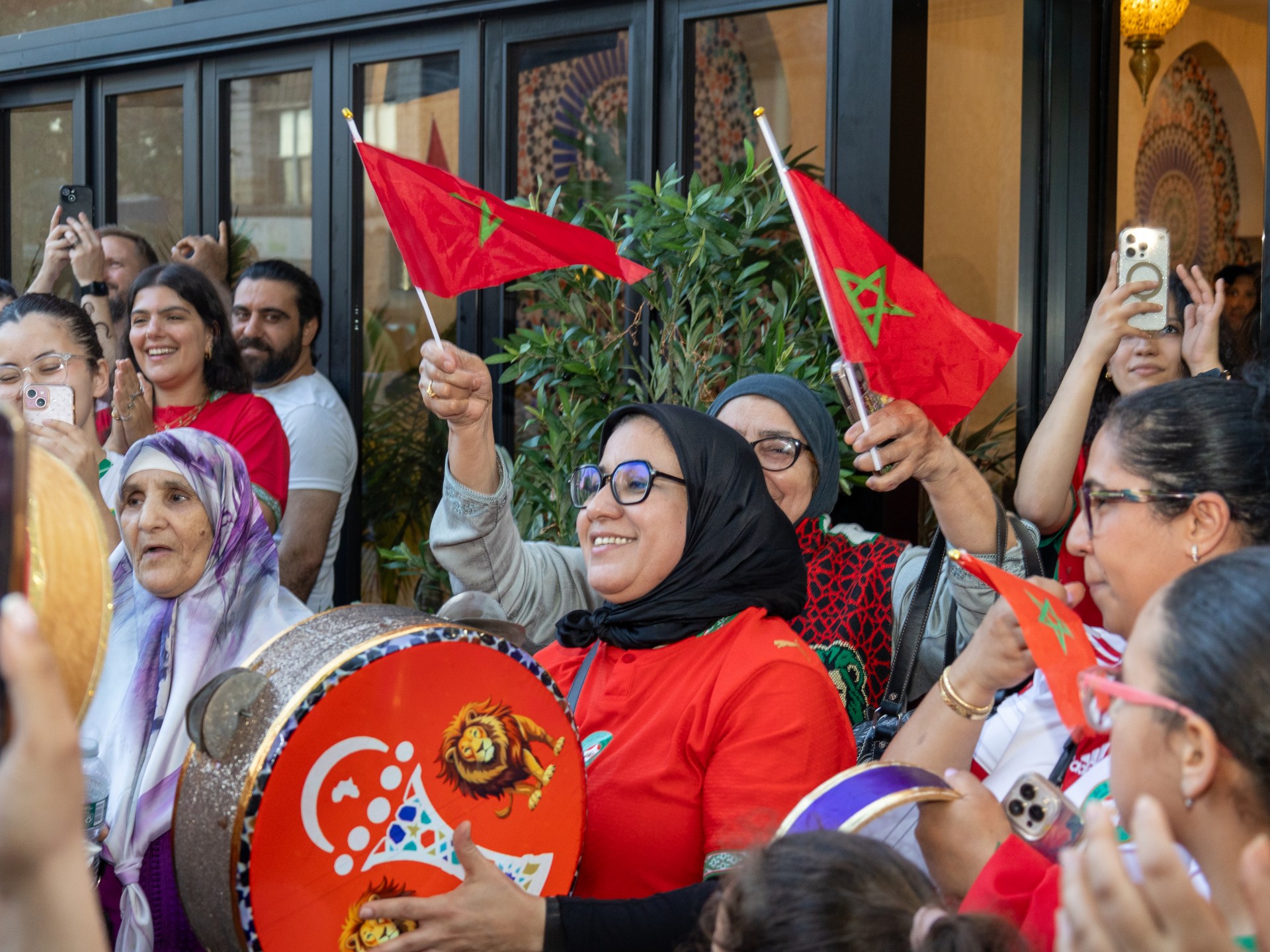
xwhatsapp-strokecopylinkgoogleAdd Al Jazeera on GoogleinfoMorocco fans celebrated on the streets in New York after their team beat Haiti to secure their place in the Round of 32 at the FIFA World Cup Fans [Daleelah Saleh/Al Jazeera]By Sonia BhagatPublished On 25 Jun 202625 Jun 2026New York – As the sun began to set on a warm Wednesday evening in New York, the Moroccan darija chant of “Sir! Sir! Sir!” – “Go! Go! Go!” – blared out of cafes and onto the streets in Astoria, a diverse ethnic hub in the Queens borough of the city. Astoria has long been a major hub for one of the most established Arab communities in New York City.
Shortly after 8pm local time (00:00 GMT), celebrations erupted as fans carrying Morocco’s flag took over the iconic Steinway Street after the North African country defeated Haiti 4-2 to enter the knockout stage of the World Cup for the second successive edition.
Two days earlier, it was Egypt who secured their first-ever win in the World Cup as they overcame New Zealand 3-1, transforming the heart of Queens’ Arab-American enclave into a sea of fans draped in Egyptian flags, chanting “Masr! Masr! Masr!” – the Arabic word for Egypt.
And on Monday, sandwiched between the two African wins, was an all-Arab affair as Algeria took on tournament debutants Jordan in Group J.
Fans of both countries packed cafes and pavements to follow the action together.
It was the Algerian fans who had a reason to celebrate, as their team sealed a dramatic 2-1 comeback win against Jordan, adding their flavour to a weekend-long celebration of Arab football across Astoria.
For some locals of the community, it was an apt nod to the New York borough, which is home to a large North African diaspora.
“I watched the Qatar 2022 World Cup in Morocco, and it’s just insane how the vibes are so similar [here],” Mouaouia, who is an undergraduate student at Barnard College, reminisced.
“Everyone is in their jersey and raising the Moroccan flag. It’s not just Moroccans but people from other Arab and African countries.”
Generations of Arab-American New Yorkers have lived around Steinway Street, a bustling 4km (2.4 miles) strip known for its cafes, bakeries, shops and hookah lounges adorned with flags from Algeria, Morocco, Egypt, Jordan and Palestine.
On a typical summer day, Steinway Street is abuzz with the sound of passing cars and families weaving between storefronts and late-night eateries.
During the World Cup, car horns blare after every goal, and crowds celebrate long after midnight, singing and clapping as fireworks light up the sky.
Inside Midnight Astoria, a local hookah lounge, Algeria fans watched the match through plumes of smoke that fogged the large screens.
With the sounds of the crowd inside the venue mixing with the on-field action, the lounge transformed into a mini stadium where fans supporting opposing teams were united by a shared pan-Arab identity and culture.
It was a sense of solidarity that extended beyond national allegiances.
In the middle of post-match celebrations, a jubilant fan, chanting alongside Algerian supporters, described a broader feeling of unity across the Arab diaspora.
“I’m from Iraq, my team lost [last Tuesday] to France, but I’m going to support every Arabic team, okay?” he said with a joyful smile.
In Astoria, watching the World Cup is an expression of national pride – a way for Arab fans to stay connected to their home nations while living in a country that has increasingly tightened its borders and cracked down on immigration.
While the travel and visa policies of United States President Donald Trump’s administration have restricted and denied entry to players, support staff, match referees and fans, local communities have come together to create an avenue for representation.
Kareem, an Egypt fan, set up a TV in front of his parents’ shop for fans to watch from the pavement. He said seeing Egyptians celebrating on Steinway reminds him of his home country.
“You feel like you’re home already in Egypt, especially with the World Cup. You’re in the stadium, you’re in the middle of Cairo in the middle of Alexandria, that’s New York City.”
“It’s been a lot of happiness, joy”, said Ahmed, a local fan who sported a large Egyptian flag from his sports car.
“You see people happy about their culture, about their nation.”
Ahmed said legendary forward Mohamed Salah has made him more confident about his Egyptian identity. “He made me want to dress with Egypt [colours], show Egypt off.”
Arab communities in New York and across the US have long faced suspicion and demonisation since the September 11 attacks.
Years of heightened surveillance, anti-Muslim rhetoric and political debates around immigration and national security have shaped these fears.
For many immigrant communities, the World Cup has served not just as moments of national pride, but has brought a sense of belonging and identity.
While Queens has been the hub of celebrations, World Cup fever has caught on in other boroughs of New York.
In the Brooklyn neighbourhood of Bay Ridge, Zahid Zakaria and Leyla Hadi watched the Morocco-Haiti match at a restaurant and hookah bar.
Revelling in the “party” atmosphere, Zahid said: “The best moment I think was the fourth goal, obviously… It was just amazing to be here with people who have a connection to the homeland.”
Bay Ridge has a notable Arab-American population, but Zahid is Mauritian and Leyla Pakistani, and both recognise the significance of the moment.
“The most incredible part is that people, who have been told they don’t belong, are embracing oneness,” Hadi said.
Back in Queens, Rayhana believes the World Cup has offered a rare moment of unity.
“The biggest takeaway is that football has always been a sport that unites people, and it is fulfilling its purpose right now,” she said as crowds waved the Moroccan flag around her.
“There has been so much division within the Arab diaspora but it’s so beautiful to see that we’re still able to gather to celebrate this win.”