play Live Sign upShow navigation menuplay Live Click here to searchsearchSign upSport|World Cup 2026Mexico win 3–0 to eliminate Czechia and win all three World Cup matchesListenListen (2 mins)Save
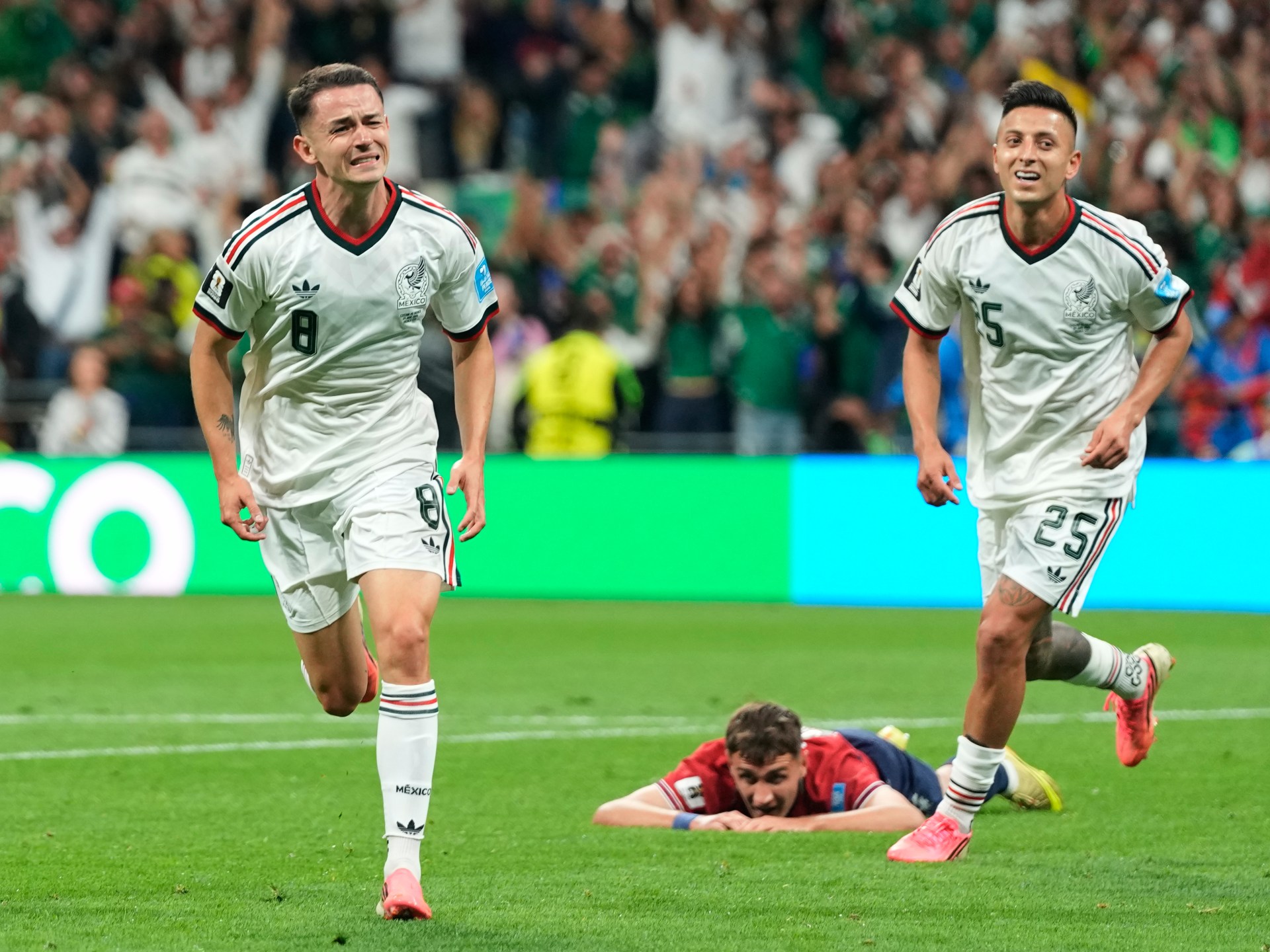
xwhatsapp-strokecopylinkgoogleAdd Al Jazeera on GoogleinfoMexico's Alvaro Fidalgo (8) celebrates scoring his side's third goal against Czechia during a World Cup Group A soccer match in Mexico City, Wednesday, June 24, 2026. [Silvia Izquierdo/AP]By APPublished On 25 Jun 202625 Jun 2026Mateo Chavez and Julian Quinones scored goals in a six-minute span early in the second half, and Mexico beat Czechia 3-0 to win all three of its World Cup group-stage matches for the first time.
The 22-year-old Chavez, in his first World Cup, opened the scoring in the 55th minute, and Quinones scored his second goal of the tournament in the 61st. Alvaro Fidalgo added a goal in second-half stoppage time on Wednesday night.
Mexico’s previous best group-stage performance was two wins and one draw, achieved in 1986 and 2002, both featuring Javier Aguirre, the first as a midfielder and the second as El Tri’s coach.
Already the winner of Group A, Mexico will play again at Azteca Stadium on Tuesday in a round-of-32 match against an opponent to be determined.
Czechia were eliminated, finishing with one point in three games.
The match included nods to Mexico’s past and future. Gilberto Mora became the youngest Mexico player to start in a World Cup at age 17.
And 40-year-old goalkeeper Guillermo “Memo” Ochoa entered in the 77th minute, joining Argentina’s Lionel Messi and Portugal’s Cristiano Ronaldo as the only players to appear in six World Cups.
Fans at the game chanted a slur that has previously led to fines and other sanctions against the country’s football federation.
The slur, which literally means male prostitute in Spanish, could be heard at the Azteca Stadium towards the end of the first half when Czech goalkeeper Matej Kovar took a goal kick, the Associated Press confirmed.
The chant has cost Mexico hundreds of thousands of dollars in fines levied by FIFA. It rose to popularity roughly 25 years ago and is used to intimidate goalkeepers when they take goal kicks.
It went viral in the 2014 World Cup in Brazil and was heard again in Russia during the 2018 World Cup and four years later in Qatar. It has persisted despite attempts by the Mexican football federation to stop it.