Image source, Getty ImagesImage caption, Players can now be sent off when covering their mouths, with Paraguay's Miguel Almiron receiving a one-match ban
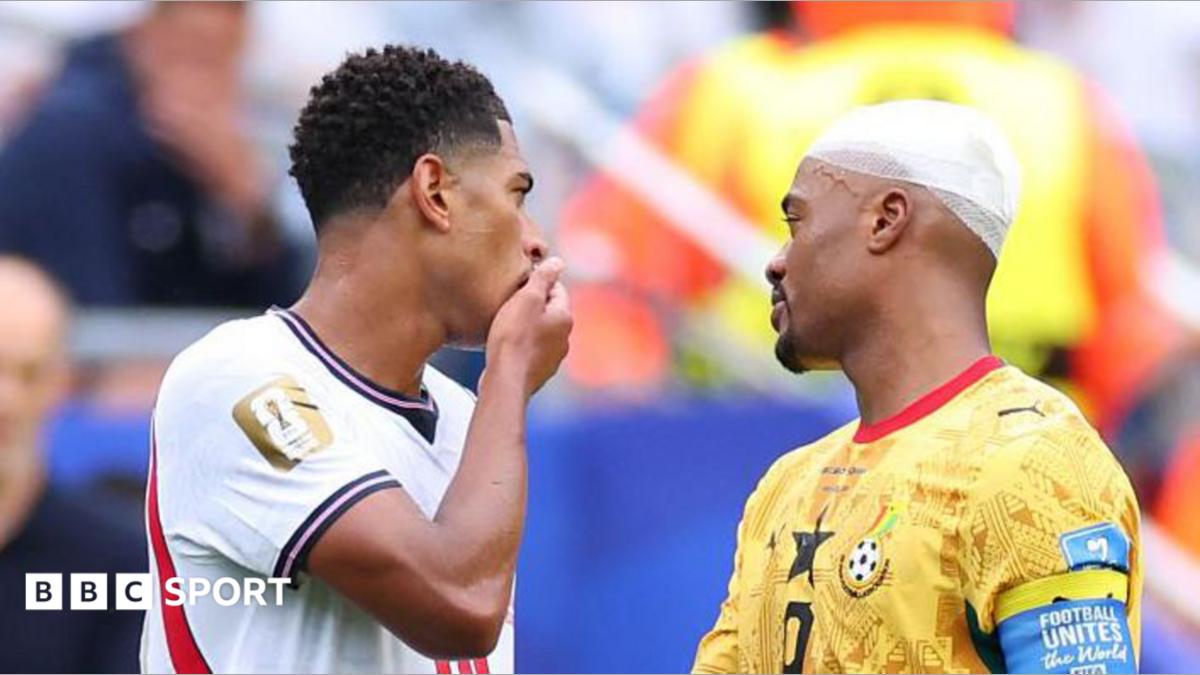
Football issues correspondentPublished19 minutes agoA picture of England midfielder Jude Bellingham covering his mouth while talking to Ghana's Jordan Ayew has caused controversy.
A law was brought in for the 2026 World Cup which says a player can be sent off if they hide their mouth when speaking to an opponent.
Fifa president Gianni Infantino requested it was introduced after Benfica winger Gianluca Prestianni was given a six-match ban by Uefa for homophobic conduct towards Real Madrid's Vinicius Jr during a Champions League game in February.
Paraguay's Miguel Almiron became the first player to be sent off for the offence against Turkey at the weekend when the video assistant referee (VAR) stepped in to advise a red card.
So why was Bellingham not shown a red card on a VAR review in Tuesday's 0-0 draw in Boston?
The context is key. Covering the mouth has not been banned. Doing so in a confrontation with another player has.
Before the tournament Pierluigi Collina, Fifa's head of referees, was quite clear.
"Players can continue to cover their mouth with an arm and the shirt because they may chat with friends," Collina said.
"It's normal to a chat before, during or after the match.
"So if the conversation is a friendly conversation, they can continue to do it without any problem.
"When the conversation is confrontational, covering the mouth means that you are doing something very wrong, potentially, and the sanction is the red card."
Throughout almost every game at this World Cup you will find examples of players talking to each other while covering their mouth. Even referees have been doing it.
Importantly, there was no animosity between Bellingham and Ayew - it was merely two players chatting.
Paraguay's Isidro Pitta had gone to ground claiming a bad challenge by Turkey's Ismail Yuksek.
This led to a melee between the two sets of players. Close by, Almiron covered his mouth when talking to Turkey's Mert Muldur.
Almiron and Muldur were not directly involved in the pushing and shoving, but the game was in a heated situation.
"This thing about covering the mouth is for us a very, very important rule," Infantino told SNTV on Tuesday following Almiron's dismissal.
"It's about respect. It's about the example that we should give.
"If you have nothing to hide, you don't cover your mouth when you speak to somebody.
"The rules have been made very clear to everyone."
There are questions about how reliable this law change is, however. There is the possibility that a player could use it to get an opponent sent off in a situation like this.
Almiron, for instance, did not appear to be acting aggressively, while Muldur immediately turned around to highlight it to an assistant referee.
Almiron has received a one-game ban and will miss Paraguay's final group game against Australia, with both teams likely requiring a point to reach the last 32.
The ban could have been longer if there was evidence of abusive language.
The new law is an opt-in, whereby a competition can choose whether to implement it. So far, it is only being used at the World Cup.
The difficulty in being consistent with the law, and the potential for it to be abused, means it might not be adopted by the domestic leagues.
No need to panic for England - but this was a reality check
Silly tackle, bad reaction - Tuchel defends Bellingham after Queiroz row
'VAR went for a coffee' - should Ghana have had penalty against England?