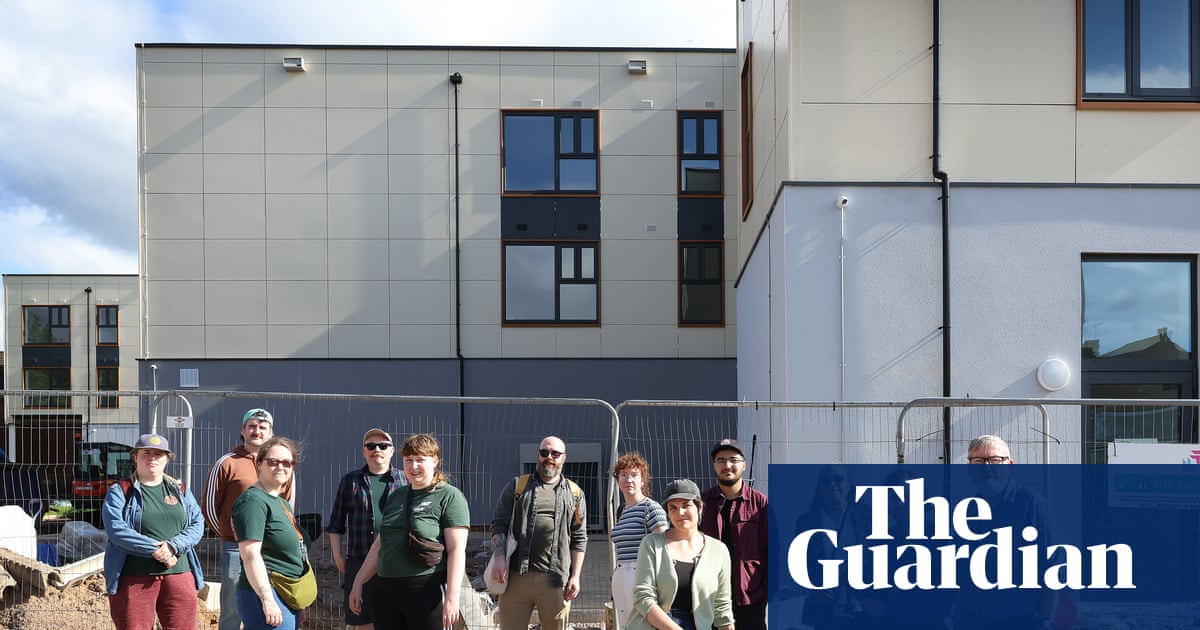
Prospective residents outside the Stirchley Cooperative Development, intended as ‘a national model for democratically managed housing’. Photograph: Martin Godwin/The GuardianView image in fullscreenProspective residents outside the Stirchley Cooperative Development, intended as ‘a national model for democratically managed housing’. Photograph: Martin Godwin/The Guardian‘The soul’s been ripped out of it’: Birmingham community housing scheme on brink over costs disputeRow over ‘landmark’ development in Stirchley has left people homeless and put businesses at risk, say locals
A housing development in Birmingham, touted as a model for community-owned housing in the UK, is at “serious risk of collapse” due to a dispute over construction costs.
The Stirchley Cooperative Development (SCD), which was founded by local residents and businesses in Birmingham in 2016, was meant to provide 39 affordable and landlord-free homes owned and run by the people who live and work there by 2024.
Prospective residents described it as a “landmark community housing project” that was “intended to be a national model for community-owned, democratically managed housing”.
It was hoped the development would give residents and business owners greater control over their home and work environments, in the face of rising rents and house prices in Stirchley, an increasingly sought-after area in the south-west of Birmingham.
However, a dispute with GreenSquareAccord (GSA), the housing association that owns the land on which the development is built, has put the project under threat.
Residents said problems emerged when GSA took on construction responsibilities for the site in 2024, after the former contractor went bust, leading to a series of delays and increasing costs.
The original plan was for GSA to sell the land to the residents – who negotiated its purchase – when the project was completed. But in March, GSA said it would no longer pass on ownership of the development to the community due to a “£1.16m shortfall”.
View image in fullscreenThe delayed development in south-west Birmingham remains empty and fenced off. Photograph: Martin Godwin/The GuardianJohn Holmes, an 80-year-old retired lecturer, is one of several prospective residents affected by the change. He wanted to be involved in the development due to his work in the youth sector and his belief in communal living. But with the project in limbo, he says he is now homeless and relying on friends and family for places to stay.
“We’re still waiting, with no certainty that it’s going to go ahead at the moment,” he said. “We were trying to make a difference and develop something for ourselves.”
In a statement to the Guardian, a GSA spokesperson said the projected costs of the development “rose due to interest costs, inflationary pressures and challenges during construction” and that it is committed to “reaching the right outcome” with the Stirchley residents and business owners who had hoped to move in.
Sean Farmelo, 34, who hopes to run his Birmingham Bike Foundry cooperative business from one of the commercial units on the ground floor of the development, believes the problems emerged due to GSA’s “mismanagement”. He said the constant delays and cost increases had left six people homeless and businesses at risk of insolvency.
“The community is being forced to pay for construction problems that [GSA] have had,” he said. “Any offer that we’ve given them is way above market value already, and they’re still trying to get extra money for construction delays that are caused by their own mismanagement.
“If an organisation that relies on public money – such as a housing association – says they are going to do something and makes a major commitment around community-led housing, then they should stick that through and not just try to off-load any problems when the going gets tough.”
View image in fullscreenBusiness owners Rachel Kershaw and Sean Farmelo and retired lecturer John Holmes have all been left in limbo by the row over costs. Photograph: Martin Godwin/The GuardianAnother cooperative company hoping to move in is Loaf, a local bakery. Its co-director Rachel Kershaw said the delays and cost overruns had left residents and business owners distrustful of GSA’s ability to honour its agreements.
“It’s been exceptionally soul-destroying,” she said. “A lot of work has gone into this in the background of making this a community-based development, and now it just feels like the soul’s been ripped out of it and we have no control.”
Kershaw, 37, said she had been forced to give the bakery’s nine staff members reduced wages since February due to the delays and cost impacts, with the business able to stay afloat thanks only to regular pop-ups. “We’re basically treading water,” she said.
In an effort to retain ownership of the project, locals are now seeking loans through non-equity and non-transferable bonds, to bridge the funding gap.
View image in fullscreenWest Midlands mayor, Richard Parker. Photograph: Christopher Furlong/Getty ImagesTheir dispute with GSA has been backed by Richard Parker, the West Midlands mayor, and local MP Al Carns. Both said they had written to GSA calling for “urgent action”, and for the housing association to fulfil its obligations.
Parker said SCD “has spent years working to create affordable homes, secure local businesses and build something genuinely owned by the community”. He added: “That is now being torn apart.
“It’s not acceptable for a large housing provider to walk away from its commitments because it failed to manage the costs and budgets of a project it was responsible for, then expect a small community organisation to carry the consequences.”
Carns, Labour MP for Birmingham Selly Oak, described the situation as “disappointing” and said residents had put “years of work, money and trust into this project”.
He said he would “keep doing everything I can to get this project back on track and in the hands of the community where it belongs”.
The GSA spokesperson said: “We appreciate this is not the outcome SCD and our partners had expected but, as a not-for-profit social housing provider, it would be irresponsible to absorb the shortfall which would ultimately compromise investment in homes and services for our customers.
“We are seeking only to cover costs with the sale of the development, not generate a profit.”