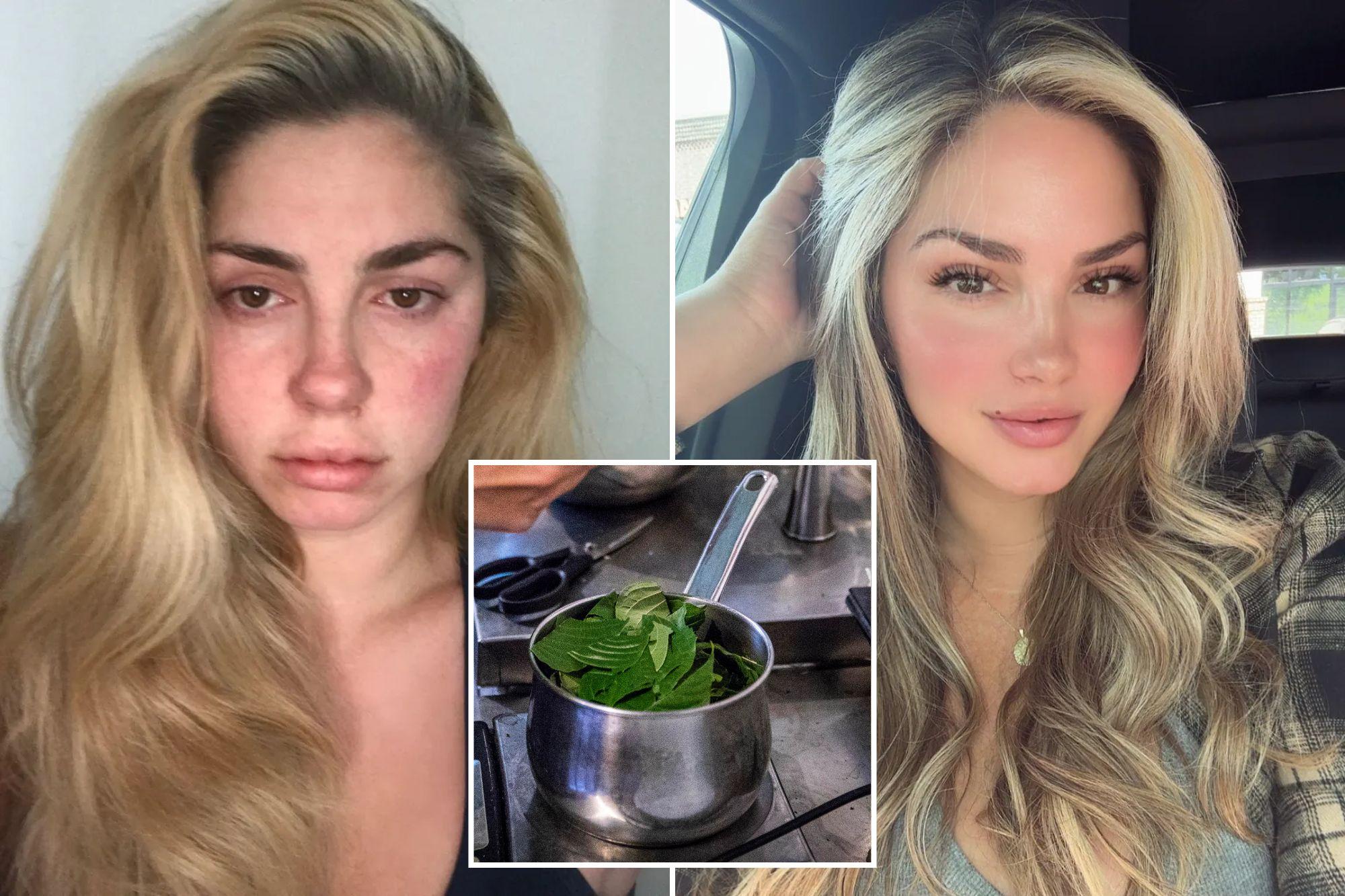
Add The New York Post on Google Stay-at-home mom Bari Sinoyannis thought she was buying a natural, plant-based alternative to pain relievers when she picked up kratom powder at a North Carolina smoke shop in 2022.
“The fact that it’s labeled as a natural alternative to pain medication was why I fell for it. I was like, you know what? I’m gonna try it. And pretty much immediately I was addicted,” the 37-year-old told The Post. “I was like, oh, this is a miracle drug. This is curing my pain. This is curing my depression. Everything’s better now. Until it wasn’t.”
What Sinoyannis didn’t know is that, even though it can be casually picked up at a convenience store, gas station, or smoke shop, kratom is a highly addictive substance that can cause severe withdrawals and catastrophic side effects.
The psychoactive plant extract from Southeast Asia is sold in powder, drinks, gummies, capsules, teas and energy shots. It is advertised for its purported pain-relieving ability and as a natural aid for depression and anxiety and it can make people feel alert, energetic, and more talkative.
Over the course of the next several years, Sinoyannis gradually became so addicted to kratom, she needed to take doses all day and through the night just to feel normal, costing her up to $600 a week. Over time, she upgraded from kratom powder to 7-OH, a derivative compound found in the kratom plant that is highly potent and more concentrated.
“If I didn’t wake up a million times throughout the night to dose, I would go through withdrawal in the morning,” she explained.
Kratom can cause withdrawal symptoms, such as sweating, restlessness, nausea, anxiety, and an inability to sleep, according to Johns Hopkins.
“It didn’t matter how much I took, I was still going through withdrawals. Between doses, I would be on the floor vomiting,” Sinoyannis admitted. “My kids had to witness me going through withdrawals every few days. My husband almost left me because of it. They had to go to the neighbor’s house when the ambulance had to come get me.”
In January, she decided enough was enough and enrolled in a 32-day rehab program. Over the course of her detox, three roommates also addicted to kratom dropped out because the withdrawal was so intense. Now that she’s enjoyed a few months of sobriety, Sinoyannis can’t help but wonder why such a life-changing drug was so readily available.
“The fact that you could buy it literally anywhere was part of why I trusted it,” she said. “At least with heroin and fentanyl, you have to buy it on the street, and you know what you’re taking is bad. With this stuff, soccer moms are on it because they thought it was natural.”
Because it’s so readily available, people who consume kratom often assume it’s not a particularly dangerous substance. A 2026 survey by University of Michigan found that more than five million Americans have used kratom, including 100,000 children aged 12 to 17.
One popular brand of Kratom-infused drinks, Feel Free, bragged in a press release about selling a quarter of a billion dollars worth of their product in the US in 2025. A two-serving bottle currently costs about $13 on their website.
Kratom products are popular enough to be sold at 7-11 stores in many states. Retail scanning service SPINS found that in-store kratom sales jumped by 21% from 2023 to 2024, to reach $441 million nationwide.
Industry estimates place the total number much higher when internet sales and other avenues are included, claiming it is an eye-watering $2 billion industry annually.
Kratom is not regulated under the Controlled Substances Act, meaning it’s up to local jurisdictions to ban it.
So far, only seven states have done so: Alabama, Arkansas, Connecticut, Indiana, Louisiana, Vermont, and Wisconsin. Tennessee will join them on July 1. Their reasons for banning are because the compound can quickly lead to dependence and cause potentially life-altering side effects.
Kratom can cause nausea, dizziness, sweating, vomiting, and weight loss. It can also cause confusion, psychosis, and delusions — and even lead to death. Between July 2016 and December 2017, the CDC identified 152 overdose deaths in individuals who had kratom in their system at the time. Kratom was positively deemed the cause of death for 91 of them by medical examiners.
Still, Matthew Farmer assumed kratom wasn’t a huge deal because it seemed so socially validated.
“It was everywhere you go, and I was kind of looking for an escape,” Farmer, 32, of Fredericksburg, Virginia, told The Post. “The clerk may not even know what they’re doing, but they’re basically giving people a bag of dope.”
Within a couple months, he was using daily. People around him started to notice something was off, as he began to struggle with depression, brain fog, and loss of appetite.
“People can tell when you are not yourself, even when you don’t notice it as much at the time,” Farmer, who works at a convenience store, said. “My social life horribly suffered for it. At work, at the first possible moment, I would just straight up walk off and go to the bathroom and take some kratom, because I always had it in my pocket.”
“It was just dehumanizing. It was embarrassing. I knew it was hurting me, but I was still doing it,” Farmer, who has now been sober for just over a month after spending six months weaning off, said.
Kratom can even be found in bars that bill themselves as “sober” or “alcohol-free.”
In 2020, Pasha Kalachev ventured into one such bar around the corner from his Bushwick apartment, where he tried a kratom-infused drink billed as a healthy alternative to alcohol. He felt a mild high and a rush of productivity.
“I was like, oh, this is a fantastic feeling, and I can stay productive, and there’s no hangover,” the 35-year-old software engineer said. “It doesn’t feel like you are consuming anything heavy. It can really feel like a free lunch in that sense.”
The city has quietly cracked down on such bars over the past several years, but still at least 300 exist across the United States, according to one directory. Kalachev, a software engineer, started heading to the bar once a week for kratom until COVID-19, when he found himself stuck in his apartment and ordering kratom to his home in bulk.
He tried cutting out kratom, realizing its benefits were shrinking as his tolerance grew, but quickly learned he couldn’t.
“Within 24 hours, I fell into the most painful state of physical agony that I’ve ever been in. I thought I had poisoned myself,” he recalled. “I was afraid I had broken my body. I really thought that I manipulated the chemistry of my brain to the point that kratom is now this inexorable part of me that I have to consume it to just exist.”
It was the beginning of a long struggle to break kratom addiction that only ended last year. 28-year-old Chris Oflyng hasn’t been so lucky. The Wisconsin lawn care specialist has been struggling with kratom addiction on and off since learning about the compound in a YouTube video when he was just 19.
“There was an excuse, like, oh, well, I’m not using harder drugs. I would take it a lot. I would take it instead of drinking,” he told The Post. But soon he couldn’t even make it through a short flight without sneaking a hit.
“I started struggling with the paranoia of keeping the substance with me,” he said. “I’m just spending all this f—king money on kratom,” he recalled, estimating that he’s spent as much as $150 a day on the product.
“I got off of it for a while and then I got addicted to it again. I would throw it away, and then I’d, like, go and get it again,” he said. “I love life so much. That’s what’s so heartbreaking about it.”
Kratom has also been promoted as a way to break addictions to other potentially more dangerous substances, including opioids like heroin, fentanyl, oxycodone, and morphine.
Destiny Torgerson decided to try kratom on a friend’s recommendation while pregnant in 2020 to help stave off her cravings for heroin after a few months of sobriety from that substance.
“Everyone really pushed that it was safe and good,” the 29-year-old from Iowa said. “They would tell me it’s just like coffee. It’s just a plant.” But, after giving birth, she realized she was addicted to the kratom itself.
“It wasn’t even 10 hours without a dose before I was sweating and sick and shaky,” she said. “I wasn’t able to stop.”
Though it did help her curb her heroin cravings, it was causing a whole new collection of cognitive issues. Her memory practically disappeared, as she found herself trailing off mid-sentence, forgetting what she wanted to say. She locked her keys in her car eight times in just one week.
Again and again, she failed to quit kratom despite her best efforts. In 2024, after four years, she begged her doctor for help, and was only able to get off the substance with help from prescription medications like gabapentin and Suboxone.
Looking back, she thinks that breaking her kratom addiction was even more difficult than stepping away from heroin.
“I was able to successfully wean off heroin on my own [without prescriptions], but not kratom,” she said. “A lot of people that I know personally switched one addiction for another, like I did.”