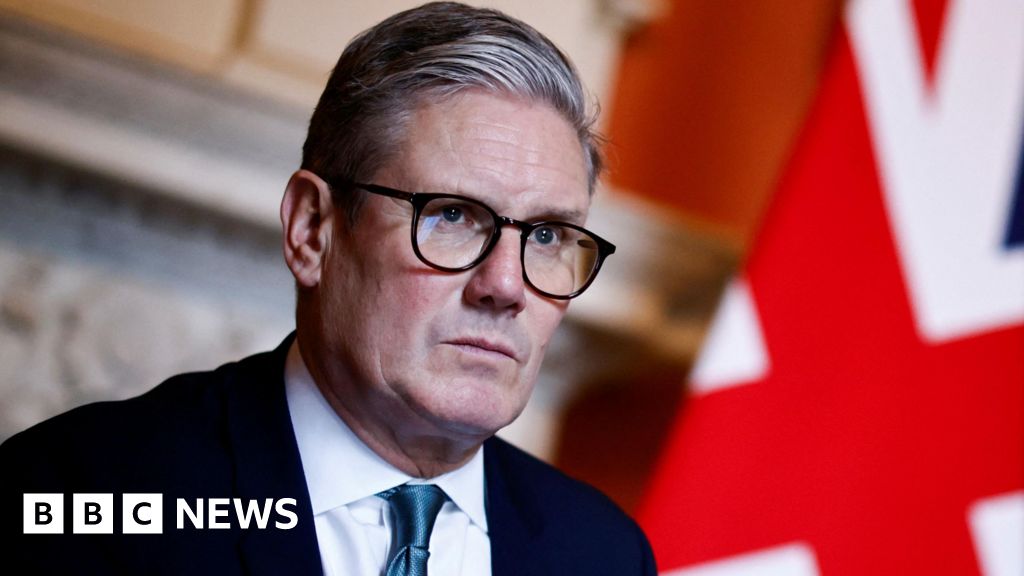
ShareSaveAdd as preferred on GoogleBecky MortonandBrian Wheeler,political reportersGetty ImagesFew politicians have endured a more dramatic fall from grace than Sir Keir Starmer.
Less than two years ago, he was celebrating a landslide general election victory and was seemingly set to dominate British politics for years to come.
Now he has been ejected from power by his own party and instead of ushering in a "decade of national renewal," as he had promised, he is contemplating a return to the back benches.
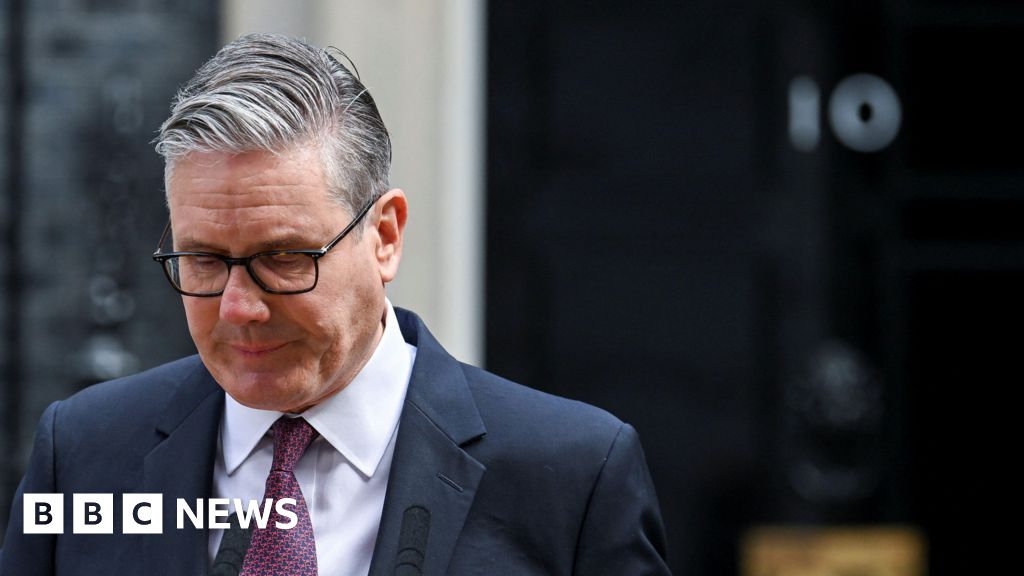
In an emotional resignation speech, delivered at a lectern outside his Downing Street front door, he said his party had asked "whether I am best placed to lead us into the next general election".
"I have heard the answer of my parliamentary party to that question, and I accept that answer with good grace."
The scale of Labour's victory in 2024 puts Sir Keir in very rarefied company - only two previous Labour leaders, Tony Blair and Clement Attlee, had managed to win elections with three-figure parliamentary majorities.
But it was achieved on an historically low share of the national vote, and Sir Keir's popularity with the electorate nosedived within weeks of him arriving in Downing Street, after a series of mis-steps and policy U-turns, and never really recovered.
The fact that he will go down now in history as Labour's shortest-serving prime minister will be a bitter pill for him to swallow.
Sir Keir Starmer was always an unusual Labour leader. He had come late to politics, only becoming an MP in his 50s after a high-flying career in law.
Unlike most of his predecessors, he had not spent decades honing his political skills and building alliances with colleagues. It was not always clear where he stood on the political spectrum.
He saw this lack of baggage as a strength, once boasting that there would never be such a thing as Starmerism.
But the growing army of critics among his own MPs felt that he lacked a clear ideology and was, simply, not very good at politics.
He had set out his stall as a sensible, pragmatic leader who would always act in the national interest - a serious man for serious times. His procedural, methodical style was summed up by his Culture Secretary Lisa Nandy, who dubbed him "Mr Rules".
But his opponents claimed he lacked the communication skills to get Labour's message across. In an age when authenticity and emotion dominate politics, he could come across as stiff and wooden.
In his election victory speech outside 10 Downing Street in 2024, Sir Keir promised to restore trust in politics and return the country to "calmer waters".
Signalling a clean break with what he had called the chaos and sleaze of the Tory years, he vowed to "restore service and respect to politics, end the era of noisy performance, tread more lightly on your lives and unite our country".
But what followed was one of the shortest honeymoon periods in British political history.
The new prime minister and his chancellor, Rachel Reeves, spent their early days in Downing Street warning that the scale of the economic problems they had inherited from the Conservatives was far worse than they had expected. Taxes would have to rise.
Sir Keir later admitted that this had been a mistake and they should have given voters more hope.
But it was the government's decision, in July 2024, to axe winter fuel payments for 10 million pensioners, which pollsters would later identify as the moment Sir Keir's personal ratings began to go into freefall.
John McTernan, political strategist and former adviser to Tony Blair, told the Financial Times: "You get one chance to make a first impression. People looked at that and thought 'Now you've told us who you are'. Anger has curdled into contempt."
Sir Keir did a U-turn on winter fuel payments in May last year, by which time he had established a pattern of reversing policies that had not gone down well with the public or his own, increasingly mutinous, MPs.
The most frequent complaint was that Sir Keir lacked a strong enough sense of purpose, that he did not know what he wanted to achieve with power.
This was despite a series of relaunches and the setting out of "missions" and milestones" for his government to achieve a fairer, more prosperous Britain.
In speeches and interviews, he would speak about his burning desire for social justice, and how his humble origins had shaped his political beliefs.
Born in Oxted, Surrey, his Labour-supporting parents named him after the party's first leader, Keir Hardie.
In September 2022, when he was still in opposition, he told the BBC: "My dad worked in a factory and my mum worked as a nurse, and I actually do know what it is like to sit around the kitchen table not being able to pay your bills.
"I remember our utilities, our phone being cut off because we couldn't pay the bill, so I know what is going through people's minds."
References to his father being a toolmaker became something of a running joke in his speeches, but he also spoke movingly about his mother, who suffered from Still's Disease, a rare form of inflammatory arthritis which eventually left her unable to walk or eat.
He excelled at school and became the first in his family to go to university, studying law at Leeds University and later Oxford.
A high-flying career as a human rights lawyer followed, with Sir Keir appointed director of public prosecutions - the top prosecutor in England and Wales - in 2008.
He was later awarded a knighthood for his time in office.
It was through his job he met his wife, Victoria, who now works in occupational health for the NHS.
He had entered politics at the age of 52, when in 2015 he was elected to the safe Labour seat of Holborn and St Pancras in north London.
His first front bench role was shadow immigration minister under Jeremy Corbyn.
He was among dozens of shadow ministers who resigned in the aftermath of the 2016 Brexit referendum in an attempt to oust Corbyn.
In his resignation letter, Sir Keir - who had supported Remain - said the referendum result was "catastrophic for the UK" and a new leader was needed to address the challenge of Breixt.
However, when Corbyn survived the leadership challenge, Sir Keir returned to serve as his shadow Brexit secretary.
After Corbyn quit following the disastrous 2019 general election, Sir Keir won the contest to replace him.
He won over party members on a left-wing platform which included pledges to renationalise the water industry and scrap university tuition fees.
Almost all of these promises were abandoned when he got the job, with him arguing that Labour's policies must be affordable to win the trust of voters.
And he later turned on Corbyn, throwing him out of the party for suggesting the scale of antisemitism under his leadership was overstated and barring him from standing as a Labour candidate.
He initially struggled to make an impact as Labour leader, after winning the contest in the middle of a Covid lockdown, delivering his victory speech in a video message from an empty room.
But his lowest ebb in opposition came after the 2021 Hartlepool by-election, when the former Labour stronghold fell to the Conservatives for the first time in its history.
Sir Keir seriously considered standing down but was persuaded by aides and his wife to stay on.
Chris Ward, a former close aide, told Starmer's biographer Tom Baldwin: "Keir kept saying that he felt he would have to go, that the result showed the party was going backwards and he saw it as a personal rejection. I told him it was far too soon for that kind of thing, but it was a rocky few hours."
Starmer himself is reported to have told friends: "I'm not fulfilling some lifelong dream here. I could happily work in the bookshop or something."
But not long after, Labour's fortunes began to change.
Helped by public anger over parties at Downing Street during the pandemic and the economic turmoil of Liz Truss's mini-Budget, Labour saw its poll ratings rise.
When the general election came in 2024, Sir Keir's strategy of ditching Corbyn-era policies and presenting Labour's priority as economic stability paid off.
He fought the 2024 election campaign on a single word slogan: change. And he put his own political brand - steady, competent and embodying the highest moral standards - front and centre.
But it did not take long for the shine to come off Sir Keir's squeaky clean image.
Just three months into his premiership, he paid back more than £6,000 worth of gifts and hospitality he had received since becoming PM, including tickets to see Taylor Swift.
While within the rules, reports of ministers accepting thousands of pounds worth of freebies from wealthy donors did not sit well with the public.
The row contributed to the resignation of Sir Keir's chief of staff, Sue Gray, who had been tasked with preparing Labour for government and then delivering on its priorities.
Gray's critics blamed her for the dysfunction of the Downing Street operation in its early months.
But the resignation was also the result of an internal power struggle between Gray and the man who would replace her: Morgan McSweeney, who had masterminded Labour's 2024 election victory.
While Sir Keir faced troubles at home, he won praise for how he navigated the world stage.
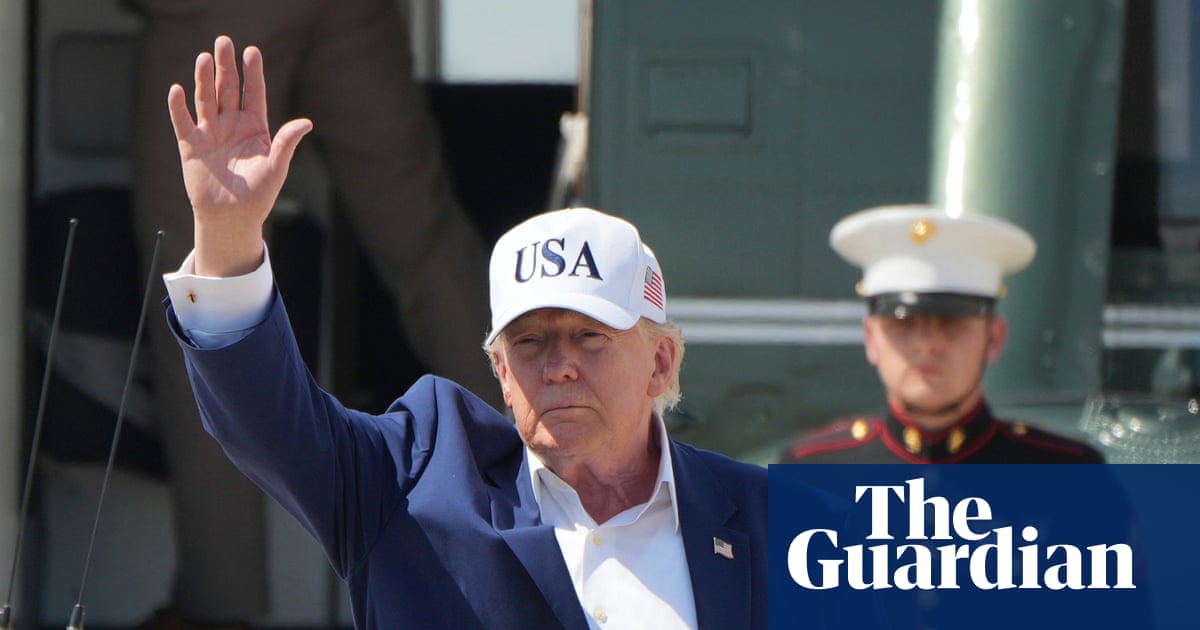
He built an unlikely friendship with US President Donald Trump, as well as playing a leading role among European countries in negotiations to end the war in Ukraine.
However, his focus on foreign affairs and the frequency of his trips abroad also led critics to label him "never here Keir".
The special relationship between the UK and the US became increasingly strained after Sir Keir refused to be drawn into the war with Iran - although polling suggested the PM's approach had the backing of voters.
On the domestic front, Sir Keir faced strikes by doctors, while the number of migrants crossing the Channel in small boats continued to rise.
Despite having made economic growth his top priority, it remained sluggish and effects of wars in Ukraine and Iran intensified the the cost-of-living pressures facing the country.
This challenging backdrop, as well as missteps by the government, were exploited by Reform UK, which overtook Labour in the polls in spring 2025 and has maintained its lead since then.
In May last year, Nigel Farage's party saw electoral success at the expense of Labour, winning control of its first councils and mayoralties, as well as the Runcorn and Helsby by-election.
Rumblings over Sir Keir's leadership continued to grow as his personal poll ratings hit record lows.
In the autumn, the government was rocked by the sacking of Lord Mandelson as US ambassador over his links to convicted sex offender Jeffrey Epstein, as well as the resignation of Deputy Prime Minister Angela Rayner for failing to pay enough tax when buying a flat, a charge she was subsequently cleared off by HMRC.
Speculation Sir Keir could face a leadership challenge continued, as allies of the prime minister told journalists he would fight any attempts by Labour MPs to remove him.
The row over Lord Mandelson's appointment reignited after the latest tranche of documents released by the US as part of the Epstein Files unearthed new evidence of the depth of the relationship between the pair.
The scandal led to the resignation of Sir Keir's chief of staff McSweeney, who had been pushing for Lord Mandelson to get the job of US ambassador despite his continued friendship with Epstein being public knowledge at the time.
But it was also the beginning of the end for Sir Keir himself.
Anger bubbled over again when it emerged Lord Mandelson was given security clearance for the role, despite concerns being raised by vetting officials.
Although Sir Keir was not made aware of this until April, it led to accusations he misled Parliament when he claimed "full due process" was followed during the appointment.
The saga also raised further questions about Sir Keir's grip over the Downing Street operation and his judgement in appointing Lord Mandelson in the first place.
While he hung on for several more weeks, the PM's authority was ebbing away.
Some polls suggested he was the most unpopular prime minister in British history.
It was not clear to Sir Keir and his inner circle quite why he was so disliked by voters, although polling guru Sir John Curtice pointed out that the public had never taken him to their hearts, even before the 2024 election.
"Sir Keir Starmer has never been a popular leader," said Curtice.
Jonathan Hinder, Labour MP for Pendle and Clitheroe, told the Times: "The sense you pick up from conversations with voters is that Keir simultaneously doesn't stand for anything and yet is incredibly sanctimonious, his style embodying the HR proceduralism that people can't stand from their workplace."
Election results in May - which saw Labour kicked out of power in Wales, suffer its worst ever result in the Scottish Parliament and lose almost 1,500 councillors in England - were the final straw for many of the party's MPs.
More than 100 of them went public with calls for him to stand down, and Wes Streeting quit as health secretary, criticising the government's "drift" and lack of "vision".
Starmer dug in, promising bolder action and arguing that the country was starting to turn the corner under his leadership, with NHS waiting lists falling and reductions in legal migration and small boat crossings.
He announced plans for a ban on social media for under 16-year-olds - seen as an attempt to secure a political legacy - and his supporters pointed to initiatives like more free breakfast clubs in schools as evidence that the government was tackling the cost of living.
Above all, he warned against plunging the country into the chaos and instability of a leadership campaign.
But Streeting was by now openly campaigning to replace him. A further blow came when his widely-respected defence secretary John Healey resigned in protest over defence spending plans.
However, it was the return to Westminster of Andy Burnham that proved to be the final nail in the coffin for Sir Keir's premiership.
Burnham, who had long coveted the top job, fought the Makerfield by-election with the aim of becoming an MP again so he could challenge for the Labour leadership.
His resounding defeat of Reform UK in an area that had just voted for Farage's party in local elections was seen by many Labour MPs as proof that he was the man to lead their party into the next general election.
In his resignation speech, Sir Keir did not mention his would-be nemesis by name, and announced that there would now be a contest to select a new Labour leader. It remains to be seen if any other candidates emerge.
Standing at the lectern outside his front door, he said: "Walking up this street two years ago was the proudest moment of my life."
There was little hint of bitterness in his brief address, as he listed what he had achieved in the past two years in his familiar dry style and promised to give his successor his full support.
It was only as he came to the end of his speech that the emotion so rarely seen during his time in office bubbled to the surface.
"When I leave the biggest job in the country, I shall spend more time on the most important job, being the best husband I can to my fantastic wife, Vic, who has been a rock by my side through good times and bad, and being the best dad I can to my beautiful children, who are my pride and my joy."