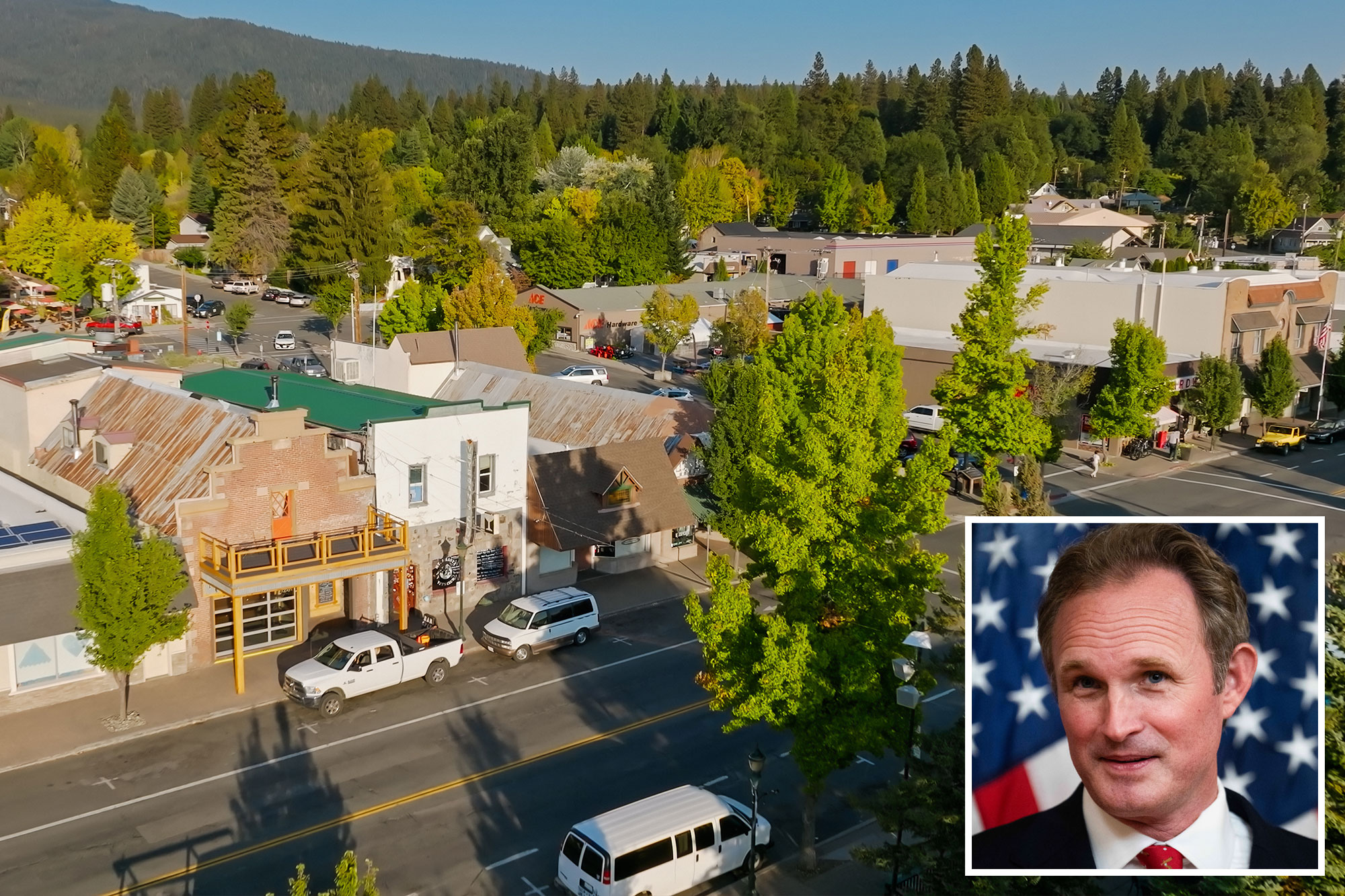
Add The California Post on Google California’s newest congressman is reviving a push to carve out parts of the Golden State and create a brand-new state for residents who feel abandoned by Sacramento.
Rep. James Gallagher, who was sworn into Congress this month after winning a special election to represent California’s sprawling 1st Congressional District, said rural communities should “seriously consider” whether they want to remain part of California following the passing of the controversial redistricting measure known as Proposition 50.
“I think we have to seriously consider whether or not we want to continue as a part of a state like that, right? And that maybe we want our own self determination,” Gallagher said during an interview with KCRA’s Ashley Zavala.
The Republican lawmaker argued the U.S. Constitution provides a path for new states to be formed and suggested the effort would begin with counties and local governments formally backing the idea before eventually seeking approval from both the California Legislature and Congress.
“I don’t think this is something that would happen overnight, but I do think it is something that should be a serious discussion,” Gallagher said when asked if he seeks to push for this at a national level.
“If it continues to move forward, I think we do look at taking that next step,maybe it’s introducing some federal legislation providing for that federal consent,” he added.
Gallagher did not specify which counties could ultimately seek to leave California, though he said “six counties have already said that they do” support the concept and have signed onto a resolution he previously introduced.
The proposal echoes the decades-old “State of Jefferson” movement, an effort largely centered in far Northern California and southern Oregon that argues rural communities have been overshadowed by the state’s urban centers.
Supporters of that movement have historically included residents in counties such as Modoc County, Lassen Countyand Siskiyou County, though it is not clear whether those are the same counties Gallagher now envisions joining a new state.
Many conservatives in those regions say they have long felt ignored by Sacramento and argue their interests — from water rights and timber revenues to wildlife management and agriculture — are routinely sacrificed in favor of policies crafted for coastal metropolitan areas.
The frustration has intensified in the wake of Proposition 50, a voter-approved measure that redrew congressional districts and, according to critics, diluted the voting power of rural Republican voters by pairing them with heavily Democratic areas around the Bay Area, including wealthy and liberal Marin County.
Gallagher framed the fight as one over representation.
“When you are proposing to take away our very voice, our very ability to elect a person of our choice, when you put party over people, then I think we have to seriously consider whether or not we want to continue as a part of a state like that,” he said.
The congressman argued residents in Northern California, the Central Valley and the Inland Empire increasingly feel “overlooked and underrepresented” by state leaders.
“Many people in Northern California feel like we want something better than what we’ve been given,” Gallagher said. “And I think other people in this state as well, as I said, the Central Valley and the Inland Empire, for example, feel very overlooked and underrepresented by the state of California.”
He pointed to Democratic-backed environmental and economic policies — including restrictions on gas-powered vehicles, the extension of the state’s cap-and-trade program and resistance to suspending the gas tax — as evidence that Sacramento is out of touch with rural communities.
“That sort of obstinate attitude, arrogant attitude towards these parts of the state continues to this day, and it’s a problem,” Gallagher said.
The congressman’s embrace of secession predates his arrival in Washington.
While serving as Assembly Republican leader last year, Gallagher introduced a resolution that would have split California into two separate states.
Unlike earlier State of Jefferson proposals focused almost exclusively on the rural north, Gallagher’s plan drew an east-west divide that would have placed much of inland California — including portions of the conservative Inland Empire — into a separate state.
The measure was largely symbolic and had little chance of advancing in the Democrat-controlled Legislature, but it highlighted growing tensions between California’s urban centers and inland communities.
At a Sacramento news conference in August 2025, Gallagher said “forgotten people” in inland counties had lost their voice under the state’s Democratic supermajority.
He blasted then-Gov. Gavin Newsom over his redistricting plans, dubbing the effort a “Gavin-mander” and warning it would erase rural representation.
“Gavin, let my people go,” Gallagher declared.
Later that month, speaking at a rally protesting progressive legislation, Gallagher escalated his rhetoric further.
“Make no mistake, we are fighting tyranny here in California,” he told supporters. “We will never surrender our rights that are given by God. And if they do, we will do what we have to do to secure our liberty and to secure our rights into the future.”
California voters approved the mid-decade congressional redistricting plan to counter similar partisan redistricting efforts in Republican states like Texas to balance the gerrymandering, according to Newsom.
Whether Gallagher’s latest push gains traction remains to be seen.
Creating a new state would require approval from both the California Legislature and Congress — a politically daunting hurdle.
But for Gallagher and many of his supporters, the campaign appears to be as much about sending a message as it is about redrawing the map.