3-MIN READ3-MINAdvertising partnerPublished: 12:00am, 16 Jun 2026[The content of this article has been produced by our advertising partner.]
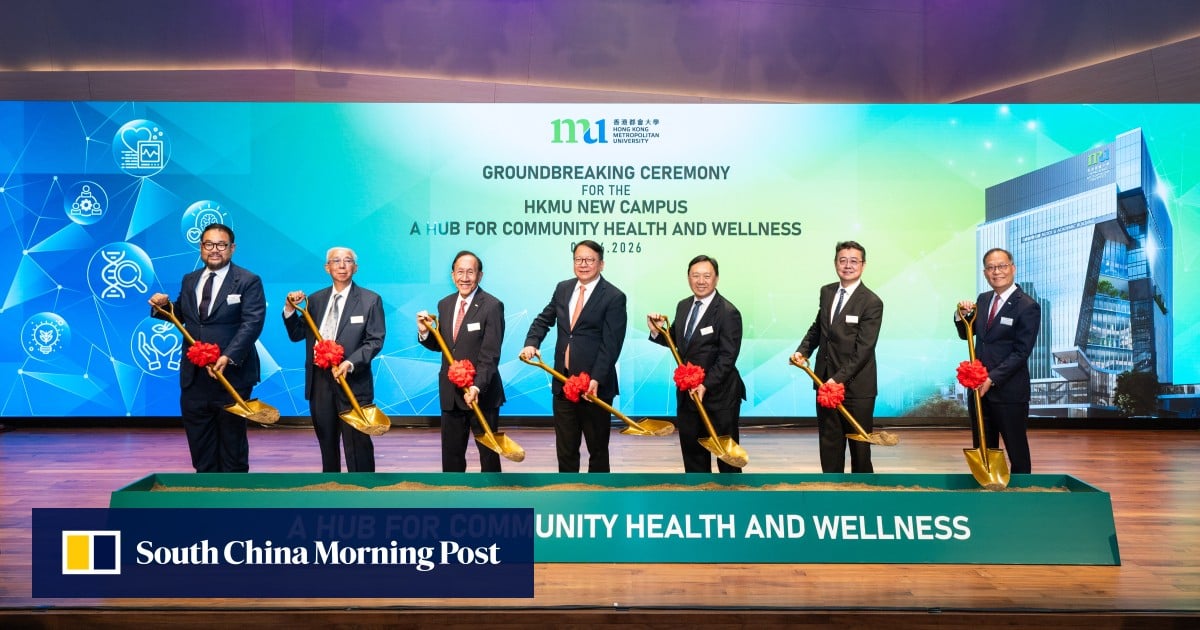
Last Tuesday (9 June), Hong Kong Metropolitan University (HKMU) held a groundbreaking ceremony for its new campus on a slope site at the junction of Sheung Shing Street and Fat Kwong Street in Ho Man Tin, marking the official commencement of the new campus development project and a new chapter for both the University and the surrounding community. Positioned as “A Hub for Community Health and Wellness”, the new campus will serve as a teaching and research base for HKMU to nurture outstanding professionals for Hong Kong and the nation, advance interdisciplinary education, and serve as a vital platform for the University to promote community health education and services. It will contribute to the long-term development of the University and the broader society.
The groundbreaking ceremony was officiated by Hon Chan Kwok-ki, Chief Secretary for Administration of the Government of the Hong Kong Special Administrative Region (HKSAR); Dr Eddy Fong Ching, HKMU Pro-Chancellor; Ir Dr Conrad Wong Tin-cheung, HKMU Council Chairman; Dr Philip Wu Po-him, Secretary of the Wu Jieh Yee Charitable Foundation; Mr Jason Wu Shang-hong, Governor of the Wu Jieh Yee Charitable Foundation; Prof. Hon Lau Chi-pang, Chairman of the Legislative Council Panel on Education; and Prof. Paul Lam Kwan-sing, HKMU President. Approximately 200 guests, faculty members and students attended the ceremony to witness this important moment.
Ir Dr Conrad Wong Tin-cheung stated in his speech: “The new campus complex will provide our faculty and students with advanced teaching and research facilities, creating an ideal environment for research and learning. This is a significant step in deepening the integration of education, technology and talent cultivation and a clear demonstration of the University’s proactive response to the National 15th Five-Year Plan and its commitment to supporting Hong Kong’s goal of becoming an international innovation and technology hub.”
He noted that students will be able to study real data from this project and gain hands-on experience in advanced construction technologies, including green building, low-carbon construction, Building Information Modelling (BIM), and lifecycle management. “By turning this project into a living classroom, we demonstrate the unique strengths of a university of applied sciences.”
In the new campus, two of the pedestrian footbridges will be accessible to the public and will be equipped with barrier-free lifts, connecting the adjacent HKMU Main Campus and Jockey Club Institute of Healthcare, and facilitating convenient access between the campus and the local community for students, staff and residents. The campus will also feature additional plants and green walls to enhance the greenery of the campus and its surroundings, demonstrating the University’s commitment to sustainable development.
The campus will integrate teaching, research and student activity spaces, featuring multiple state-of-the-art facilities, including an interdisciplinary research centre, a versatile auditorium with a capacity of approximately 600 seats, multimedia lecture halls and classrooms, a library and outdoor learning spaces.
Prof. Paul Lam Kwan-sing stated that the new campus will further strengthen the University’s teaching and research capabilities, with two key facilities—an integrated health centre and an interdisciplinary research centre—playing vital roles. The health centre will provide workplace training for students in nursing and related disciplines while also offering health services to the community; and the research centre will drive impactful research for society as HKMU continues to grow as Hong Kong’s leading university of applied sciences.
He added that the new campus is anchored in the University’s commitment to “comprehensive health”, which recognises that health extends beyond physical wellbeing to include mental, psychological, social and environmental dimensions. Therefore, programmes offered in the new complex will span clinical healthcare, psychology, early childhood education, sports and business management. “The new campus will further advance this holistic approach to teaching, research and community engagement,” he said.