Skip to main content Close Ukraine Mideast conflict France France 24 live See all shows Latest Newscast Closed-captioned Newscast TV guide Headings
Just after sundown on Tuesday, the new moon began to make the rounds of the earth, setting the starting date for the holy month of Ramadan for either February 18 or 19, depending on the country. But in France, a squabble over when to call the crescent sighting split Muslim leaders, prompting rival date announcements and in turn sparking major confusion. “Agree please, or I’ll go out and check the moon myself!,” one frustrated worshipper posted on social media.
Issued on: 18/02/2026 - 18:31Modified: 18/02/2026 - 18:41
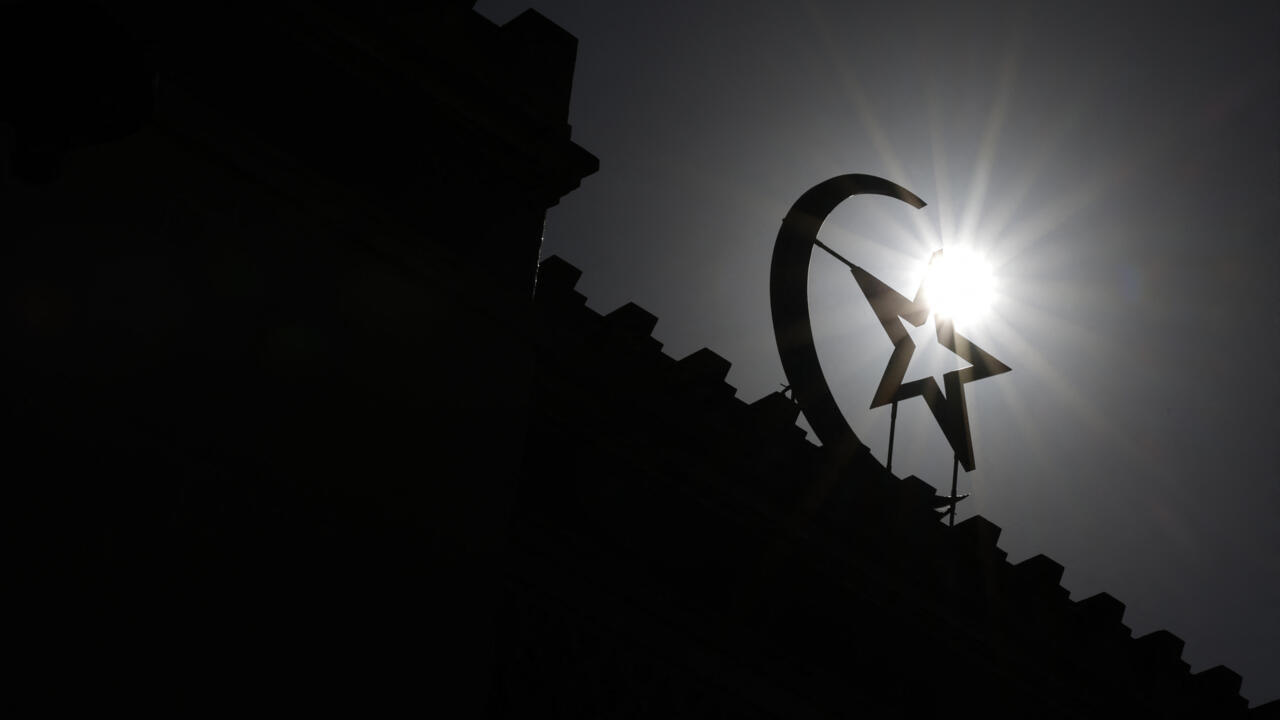
By: Louise NORDSTROM The star and crescent can be seen over the Grande Mosquée de Paris in the French capital on September 9, 2025. The Muslim holy month of Ramadan runs from February 18-19 to March 19, 2026. © Ian Langsdon, AFP This year’s Ramadan, the near month-long Islamic ritual of performing a daily fast from dawn to dusk, had not even begun before a dispute broke out between France’s main Islamic bodies over its official start date.
While the Grande Mosquée de Paris – a century-old Islamic institution in France – declared that the fasting period would begin on February 18, France’s official Muslim council, the Conseil Français du Culte Musulman (CFCM), countered with another date: February 19.
Social media immediately blew up with comments from confused worshippers in France, which is home to some 6 million Muslims.
“Is it tomorrow or not?” one worried user asked on X after seeing the conflicting statements, while another urged France’s Islamic institutions to come together and agree on one single date. “Or I’ll go out and check the moon myself!”
The French Maghreb-focused media platform Mediaterranee.com said the rival dates were likely to disrupt families whose members usually come together to break the first fast together. “Families find themselves divided between those who begin the fast a day earlier and those who wait until the next day,” it said.
Although it is not uncommon for countries to pick different dates for Ramadan – some follow the strict visibility tradition, while others rely on scientific calculations, or a mix of the two – it is unusual for different dates to be set for the same country.
The Grande Mosquée said it came to its February 18 conclusion after “combining scientific calculations and lunar observations”. Its start date will therefore coincide with that of Saudi Arabia – the birthplace of Prophet Mohammed – and countries like the United Arab Emirates, Qatar, Oman, most Gulf states and Libya.
Statement from Mosquée de Paris on February 17, 2026. © FRANCE 24, screengrab The CFCM, on the other hand, used strict astronomical criteria, meaning it set the date for a day later, along with Algeria, Belgium, Jordan, Turkey, Pakistan, Indonesia, Australia and some other countries.
A third institution, the French Muslim Theological Council (CTMF), further muddied the waters by adding a new argument to the mix: visibility conditions had been met in French Polynesia before sunrise on Wednesday morning, declaring it the reason for which February 18 should be considered Ramadan's official start date.
But although the date clash between the Grande Mosquée and the CFCM may boil down to different methodologies, the disagreement also reflects a long-standing rivalry between France’s key Islamic institutions.
The Grande Mosquée is France’s oldest mosque, inaugurated in 1926 to honour the fallen Muslim soldiers who fought for France in World War I, and was long the Islamic institution in France. Over the past few years it has also hosted an imam training centre.
The CFCM was founded in 2003 on the initiative of then interior minister Nicolas Sarkozy. It was meant to serve as the state’s only interlocutor on issues related to Muslim worship in France, and make sure the country's 1905 law on secularism was respected. But infighting between its main branches – the Morocco-linked National Federation of Muslims of France (FNMF), the Muslim Brotherhood-aligned Union of Islamic Organisations of France (UOIF), and the Algeria-backed Grande Mosquée de Paris – quickly weakened the body.
This confusion is likely to recur at the end of Ramadan, when the date of Eid al-Fitr is set 30 days after its official beginning.
Page not found The content you requested does not exist or is not available anymore.