play Live Sign upShow navigation menuplay Live Click here to searchsearchSign upFeatures|Islamophobia‘Looked so real’: How AI is being weaponised against India’s Muslim womenExperts say a trend is reshaping online harassment: the use of AI to generate sexualised imagery and propaganda targeting Muslim women.
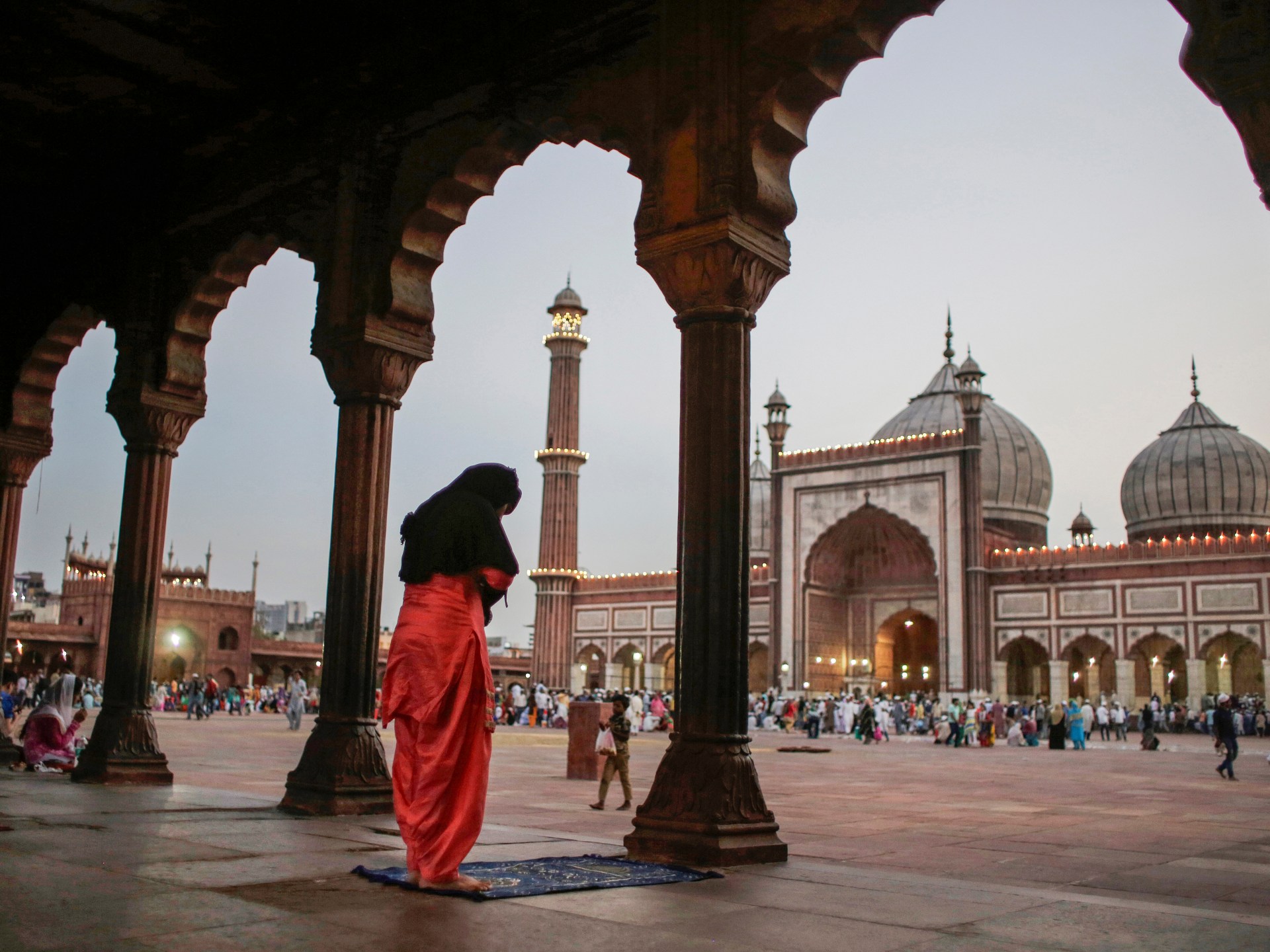
xwhatsapp-strokecopylinkgoogleAdd Al Jazeera on GoogleinfoA Muslim woman prays at the Jama Masjid in New Delhi, India [File: Altaf Qadri/AP]By Jyoti ThakurPublished On 15 Jun 202615 Jun 2026New Delhi, India – When Samreen Ayoub first saw the video, she was stunned.
The freelance model from India-administered Kashmir was scrolling on her phone last year when a friend sent her a clip circulating on Instagram.
The video appeared to tell the story of her life in New Delhi, complete with a narrator’s voice, scrolling captions and headlines like a television news segment. But it was entirely fabricated.
“It was proper stalking,” Ayoub, 24, said. “They had followed my life from my first semester to the last at the university.”
The video stitched together photographs from Ayoub’s time as a student at New Delhi’s Jamia Millia Islamia University – images drawn from everyday moments of campus life, including group projects, farewell gatherings and selfies with classmates.
The voiceover, generated using artificial intelligence, falsely claimed she was a Muslim woman “selling her body” to Hindu men. It misidentified people in the photographs and labelled her own brother as her “pimp”.
“It looked so real that if someone, even my parents, saw the video, they would think it was real,” Ayoub said.
She is one of several Muslim women who have experienced what researchers described as a pattern that is becoming increasingly visible: the use of AI to generate sexualised imagery and propaganda.
Al Jazeera reached out to several Muslim women who have been targeted. They declined to speak on the record, citing shame and the risk of retraumatisation.
The trend to sexualise images and videos of Muslim women is unfolding alongside India’s growing engagement in global conversations on AI governance, including a high-level AI Impact Summit held earlier this year in New Delhi that focused on innovation and regulatory frameworks.
A study by the Washington, DC-based Center for the Study of Organized Hate (CSOH) analysed 1,326 publicly available AI-generated images and videos collected from 297 public accounts on X, Facebook and Instagram from May 2023 to May 2025. The researchers found that sexualised depictions of Muslim women generated the highest engagement – more than 6.7 million interactions across the platforms.
“Generative AI has made the transformation of sexual fantasy into imagery possible at speed and at no cost,” said Zenith Khan, coauthor of the study and a digital research analyst at the CSOH. “Image generators and deepfakes allow individuals to convert hostile narratives into highly realistic visual material with minimal technical expertise.”
Researchers are not the only people tracking the trend.
Meri Trustline, an online safety helpline run by the Mumbai-based RATI Foundation, has also seen a growing volume of such cases. The helpline’s 2024 report revealed a concerning pattern: While media attention tends to focus on celebrities and politicians, women not in the public eye are also being targeted through images that, although artificially generated, have the capacity to result in real harm.
Front-line counsellors at the helpline, including Salman Mujawar, whose work with survivors forms the basis of much of the organisation’s published evidence, said they have documented a rise in the number of such cases.
Since its inception in 2022, Meri Trustline has handled more than 482 cases, roughly 10 percent of which involved digitally manipulated material – a share that has been growing as AI tools become more accessible.
“These violations are muted by shame, fear and trauma,” Mujawar said. “Incidents are rarely revealed even to close family members, let alone featured in larger public discourse.”
Ayoub’s video circulated across multiple social media accounts within hours. Abusive comments, threatening phone calls and accusations about her character followed quickly.
“It felt like a digital lynching,” she said. “Not one but more than a dozen accounts were posting that video everywhere, and hundreds of others were resharing it.”
The data set compiled by the CSOH includes AI-generated memes portraying Muslim women in religious attire in sexually suggestive scenarios as well as fabricated pornographic imagery targeting journalists and activists. Across many of these images, researchers observed a recurring visual pattern: a “Muslim-coded woman” paired with a “Hindu-coded man”.
“In these narratives, Muslim men are often depicted as violent or morally corrupt,” Khan said. “Meanwhile, Muslim women are portrayed as submissive or ‘rescued’ by men from the majority community.”
This imagery, researchers argued, is not incidental to political discourse – it is a part of it.
Sahana Udupa, a media anthropologist at Ludwig Maximilian University of Munich, described the phenomenon as part of a broader “pornification of politics” targeting women and minority communities. Right-wing digital cultures, she said, combine humour, memes and sexualised imagery to normalise abuse.
“These practices form an ecosystem,” Udupa said. “They thrive on group celebration and collective aggression.”
That ecosystem, scholars noted, has deeper ideological roots than mere misogyny. Writing in the peer-reviewed South Asia Multidisciplinary Academic Journal, researcher Soma Basu argued that what is unfolding is the politicisation of the sexual itself.
Muslim women’s bodies have become battlegrounds for communal dominance – a dynamic that found its most visible expression in the “Sulli Deals” and “Bulli Bai” controversy, mock-auction platforms that targeted Muslim women in India and which Basu links to both formal support from officials of the governing Bharatiya Janta Party (BJP) and informal backing from the party’s digital volunteers.
Khan’s research arrives at a similar terrain from a different angle. “In many South Asian cultures, women are portrayed as the honour of the family,” she said. “So attacking Muslim women visually becomes a way of portraying Muslims as inferior.”
Khan herself found the research deeply affecting. “As a Muslim woman and a researcher, it had a profound impact on me,” she said.
“I remember being quite horrified when I saw images of a woman wearing a headscarf being represented as soft porn. As a woman, you already deal with misogynistic behaviour daily. This is another layer added to your identity.”
Responding to these concerns, Atif Rasheed, a BJP politician, said AI “can be used both positively and negatively” and called for stronger regulations to prevent its misuse. He called deepfake and sexually explicit content “very disappointing” and said there should be strict action against the perpetrators.
However, he rejected viewing the issue through a religious lens, saying the BJP “respects women of all religions” and the “Sulli Deals” and “Bulli Bai” cases were handled in accordance with the law.
The Sulli Deals and Bulli Bai episodes, which occurred in 2021 and 2022, used doctored images. Both triggered widespread outrage and police investigations.
Indian authorities arrested Aumkareshwar Thakur, accused of creating the “Sulli Deals” handle, and Niraj Bishnoi, identified as the creator of “Bulli Bai”, in January 2022. Both Thakur and Bishnoi were granted bail by a New Delhi court on “humanitarian grounds” two months later.
Researchers believe the rise of generative AI has dramatically expanded the scale and speed of harassment of Muslim women online. New applications allow users to upload photographs and automatically generate sexualised images. Such tools are widely available online, often for free, and require no technical expertise.
“There is a very long history of technology being used to target and harass women, especially minority women,” said Eviane Leidig, director of research and outreach at the CSOH. “What is different now is the extent of violation and the scale of harm that AI tools enable.”
For those already living with sustained harassment, the emergence of AI-generated imagery has added a new dimension of fear.
Afreen Fatima, 27, a researcher and activist who has faced online abuse since speaking out against India’s Citizenship (Amendment) Act in 2019, was among the dozens of Muslim women whose photos were uploaded and “auctioned” on Sulli Deals.
The law, declared by the United Nations as “fundamentally discriminatory” against Muslims, seeks to fast-track Indian citizenship for non-Muslim minorities who arrive in India from neighbouring Muslim-majority countries before 2025.
Four years after the Sulli Deals controversy, the abuse has hardly subsided. Anonymous accounts, often using common Hindu names, continue to seek her out with abusive messages, rape threats and targeted harassment, some tied to her work, despite her limited social media presence.
“Every few days, there is a message from some random account with rape threats or death threats,” she said.
The prospect of AI-generated sexual imagery has intensified that fear. “When I read about these images, it felt very personal. They create a fear psychosis.”
Fatima said hate online has also shaped how she navigates public spaces.
“I feel uncomfortable travelling alone,” she said. “When you see these kinds of fantasies circulating online about Muslim women, you start wondering whether someone might attack you in real life.”
After the video went viral, Ayoub’s professional opportunities began to disappear.
“As a model, your reputation matters,” she said. “If negative comments appear on your profile, brands stop approaching you.”
For four or five months, fake accounts flooded her profile with abusive comments, deterring potential clients. The harassment also changed her relationship with social media.
“Instagram used to be a safe space for me,” she said. “Now I don’t feel safe there, and I limit what and how I post.”
Ayoub reported the incident to the police cybercrime unit in New Delhi, filing written complaints. “Nothing happened,” she said, adding that most of the abusive content was removed only because her friends reported those accounts en masse.
Legal experts said India’s existing laws struggle to keep pace with AI-generated content. “The harm is real even when the image itself is fabricated,” said Apar Gupta, lawyer and founding director of the Internet Freedom Foundation.
Under Section 66E of India’s Information Technology Act, criminal penalties apply to capturing or publishing images of a person’s private areas without consent. But if a target’s body was never actually recorded – in other words, if the image is entirely AI-generated – the provision may not apply.
“Even if the image is fake, it creates a permanent scarlet letter for women,” Gupta said.
Digital platforms, meanwhile, enjoy “safe harbour” protection as long as they remove illegal material once notified. But Gupta said many victims struggle to even get that far.
“Platforms don’t make it easy for you to report that this is my image, this is a deepfake, you need to remove it,” he said.
Without structural changes to platform design, algorithmic priorities and legal frameworks, AI-generated abuse will continue spreading faster than any legal system can respond to it, he warned.
In such a scenario, accountability remains elusive for targeted Muslim women.
“What I wanted most was to find the people behind those accounts,” Ayoub said. “They destroyed my reputation without even knowing me.”