Skip to main content Close Ukraine Mideast conflict France France 24 live See all shows Latest Newscast Closed-captioned Newscast TV guide Headings
France's President Emmanuel Macron said on Friday that a decision by the European Union to provisionally implement the Mercosur trade deal with South America was a "bad surprise". France has led opposition to the deal as farmers fear being undercut by cheaper goods from Brazil and its neighbours.
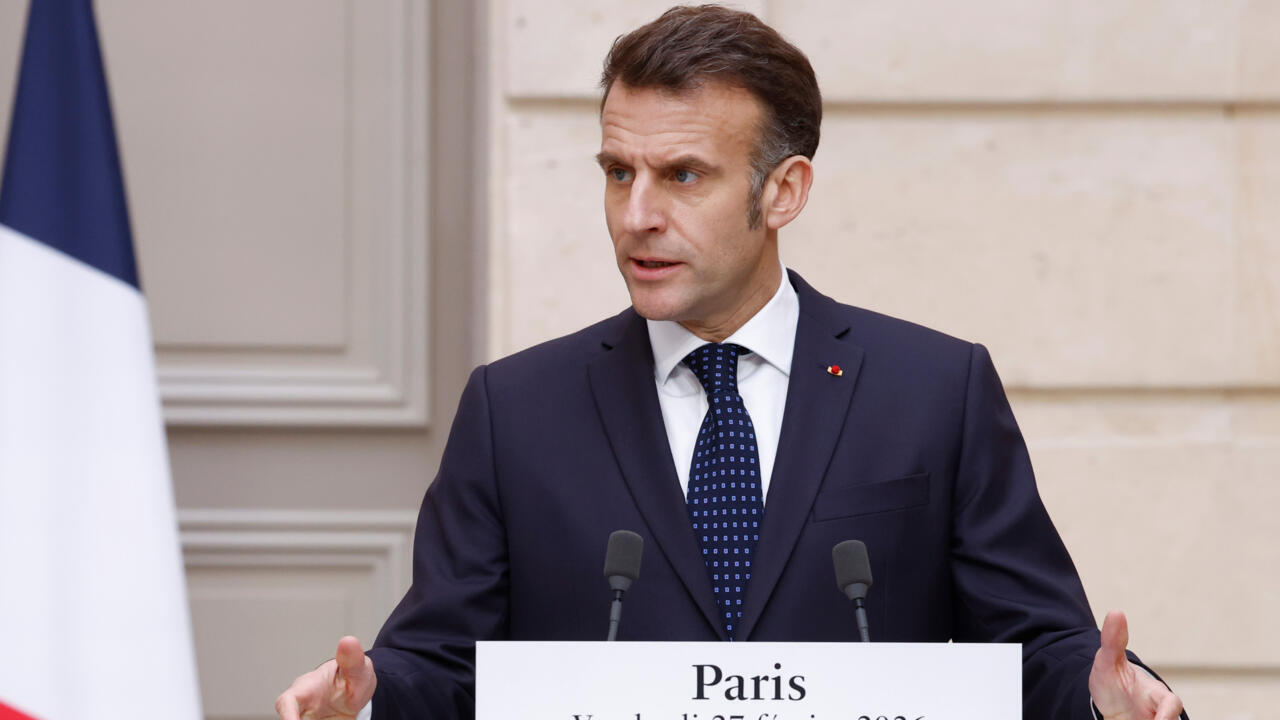
By: FRANCE 24 French President Emmanuel Macron speaks at the Elysee Palace in Paris, France on February 27, 2026. © Yoan Valat, AP President Emmanuel Macron denounced Friday the European Commission's "bad manners" following its decision to provisionally apply the Mercosur trade deal and called the move a "bad surprise" for France.
EU chief Ursula von der Leyen said earlier Friday that the European Union will implement the mammoth trade deal with the South American Mercosur bloc while waiting for a top court's ruling on its legality.
"The commission will now proceed with provisional application," von der Leyen said in Brussels, recalling that member states had given the EU executive power to do so.
"Provisional application is, by its nature, provisional," she added, saying: "The agreement can only be fully concluded once the European Parliament has given its consent."
"For France, this is a surprise, and a bad one," Macron said in a strongly-worded statement, adding the move showed "bad manners towards the European Parliament".
"The European Commission has made the unilateral decision to provisionally apply the agreement with Mercosur, even though the European Parliament has not voted on it. It is thus taking on a very heavy responsibility."
Speaking alongside Slovenia's Prime Minister Robert Golob, Macron said he would make sure "that what we have negotiated hard for over the last few months is respected".
"We will be uncompromising on compliance with these rules, because Europe has significantly tightened the rules on our producers in recent years," Macron added.
"And so I will never defend an agreement that is lax on imports and tough on what we produce at home, because it is inconsistent for European consumers and criminal for European sovereignty," he said.
France has led opposition to the deal and unsuccessfully attempted to block it over worries for its farmers, who fear being undercut by cheaper goods from Brazil and its neighbours.
Read moreProtesters say 'unliveable to be a farmer in France today' as they condemn Mercosur deal
Provisional application will begin on "the first day of the second month following the date on which the EU and Uruguay (as first Mercosur country to ratify) exchange notes verbales", EU trade spokesman Olof Gill later clarified.
French agriculture minister Annie Genevard said the decision was "very damaging to the functioning of our institutions and, above all, to the spirit of our European institutions".
But Gill said EU states had "empowered" the commission to take such a decision.
The deal will provisionally apply to the Mercosur countries that have ratified it, Gill told reporters, adding the commission anticipated remaining members Brazil and Paraguay would do so "soon".
Reacting to von der Leyen's announcement, French EU lawmaker Celine Imart accused the commission of "showing contempt" for farmers.
The deal between the EU and the four founding members of the Mercosur bloc – Argentina, Brazil, Paraguay and Uruguay – was a quarter century in the making.
The accord creates one of the world's biggest free trade zones and eliminates tariffs on more than 90 percent of trade between the two blocs, which together account for 30 percent of global GDP and over 700 million consumers.
Farmers across Europe remain unconvinced and are up in arms, including in Spain where they staged a protest against the deal in Madrid earlier this month.
Demonstrators carry a banner during a protest following the EU-Mercosur trade deal, in Madrid, Spain on February 11, 2026. © Albert Gea, Reuters The European Commission, however, insists it has fully addressed their concerns by approving a series of safeguards for its producers.
Von der Leyen stressed the deal offered "countless opportunities".
She added: "It allows our small and medium-sized businesses to access markets and scale they could only dream of before."
Major exports from the South American grouping to the EU include agricultural products and minerals, while the 27-country bloc would export machinery, chemicals, and pharmaceuticals with smaller levies.
Page not found The content you requested does not exist or is not available anymore.