In Ethiopia's Tigray region, displaced people remain trapped in limbo as tensions between Addis Ababa and Eritrea escalate. While fragile calm holds in Mekelle, many in Tigray fear war could return at any moment.
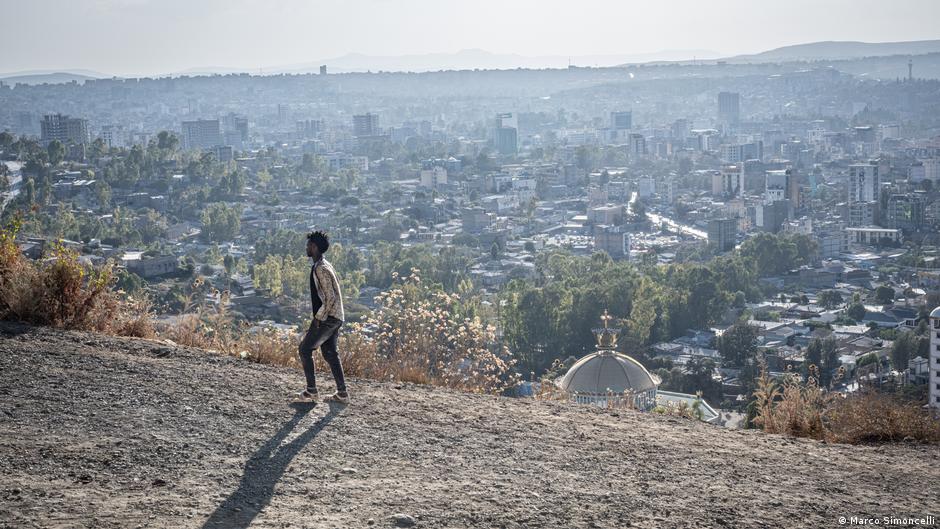
https://p.dw.com/p/59U92A young man walks along a hill overlooking Mekelle, northern Ethiopia, where uncertainty over the region's political and economic future weighs on many residentsImage: Marco SimoncelliAdvertisementIn the Tshehaye displacement camp, which was once a public school of Shire in Ethiopia's Tigray region, former classrooms have become living quarters. Families sleep inside cracked concrete structures where blackboards still hang on the walls. Outside, rows of tents fill the dusty, former schoolyard.
Outside one of these precarious shelters, a mother of three sits quietly. She asks not to be named. She was first displaced when war erupted in 2020. After the Pretoria Agreement formally ended the two-year conflict in 2022, she tried to return to her village in western Tigray — one of the parts of the region still under occupation by Amhara forces.
But her land had been taken. Living there had become impossible. Eight months ago, she fled again and came back to Shire.
Her husband, she says, had been arrested "because he is Tigrayan." After his release, the family followed him north.
"If it were possible, I would like to live in peace and return home, and cultivate my land as in the past," she says. "It is very difficult to live like this with my children."
Her fear is shared by thousands in Tshehaye. Across Tigray,around 800,000 people remain displaced and unable to return to their land, particularly in western Tigray. Their unresolved displacement has become one of the central sources of tension between the region and the federal government in Addis Ababa.
Life in the camp is harsh. Water is scarce. Food distributions are irregular. Medicines are limited. Humanitarian conditions have worsened following last year's aid cuts. Families rely on small rations and informal solidarity networks to survive.
"Shelters are built every month, with each new arrival of displaced people," says Hagos Gebremichael, the camp's coordinator. New families continue to arrive from western Tigray and from Sudan, where many had sought refuge during the war.
"Before, I lived a normal life there," he says. "Now I live here without support, without work, without anything. If no one takes me back home, I will not choose to die here. I would rather try to return, even if it costs me my life."
In late January, clashes erupted again in Tselemti between the Ethiopian National Defense Force (ENDF) and Tigray Defense Forces (TDF). Fighting was also reported near the southern border with Afar between the TDF and former TDF members following divisions within the Tigray People's Liberation Front (TPLF).
Drone strikes were reported during the clashes — echoing tactics used during the 2020–2022 war. Security analysts warn these localized confrontations risk expanding if political tensions continue to escalate.
In mid-February, the chairperson of the African Union Commission called for "immediate action to avoid an imminent war." Around the same time, Ethiopia's foreign minister publicly urged Eritrea to withdraw its troops from contested areas threatening to take action.
During the 2020–2022 war, Eritrean forces fought alongside Ethiopia's federal army against the Today, relations between Addis Ababa and Asmara have deteriorated. Accusations of interference and shifting regional alliances have deepened mistrust.
Videos circulating online appear to show significant troop movements near border areas. While Tigrayan officials deny any formal alliance with Eritrea, they have warned that if the peace agreement collapses, they would defend themselves, potentially reshaping old battle lines.
Any renewed confrontation between Ethiopia and Eritrea would likely unfold on Tigrayan soil.
The recent tensions have already reshaped movement across the region. When flights to Tigray were suspended for five days in late January, following military operations that included federal drone strikes, many residents rushed to leave.
"People were shocked by the recent tensions," says the manager of a bus company in Shire, who requested anonymity.
"Many were trying to leave Tigray, fearing they would be trapped again like during the previous siege." Buses heading toward Addis Ababa filled quickly.
In Mekelle, the regional capital, anxiety takes a quieter but equally pervasive form.
Outside banks, long lines form. Withdrawals are limited to small amounts. Drivers buy fuel on the black market. Some goods have disappeared from shop shelves, while others have become prohibitively expensive amid persistent inflation. The city's water system functions only intermittently.
Seife, who once worked as a tourist guide, now survives on irregular jobs in the city. "The lack of cash makes life extremely difficult," he says.
"Businesses demand cash because they cannot rely on bank transfers anymore. Everything depends on cash."
After the recent tensions escalated into clashes, he says, fear returned quickly. "The fragile peace we have could collapse. The war could start again."
The 2020–2022 war, which killed around 600,000 people according to widely cited estimates and was marked by grave human rights violations and alleged war crimes, formally ended with the Pretoria Agreement. Yet key provisions remain unimplemented.
Disarmament and reintegration processes are incomplete, while Eritrean troops continue to maintain positions in the north.
National elections are scheduled for June 1, but the TPLF remains excluded from the vote. Just days ago, Ethiopia's House of Federation removed five districts from Tigray's administrative oversight for the upcoming elections, a move that local officials say further inflames tensions.
Against this backdrop, deteriorating relations between Ethiopia and Eritrea have heightened fears that Tigray could once again become the epicenter of confrontation.
Near the Mekelle Martyrs Monument & Museum — a symbol of Tigray's past political dominance — Berhane, the municipal gardener, trims hedges and waters flower beds. The monument stands largely empty in the afternoon heat.
"We are waiting to see if there will be another war," he says. "I was born here. I want to build my life here. But I fear that something worse could happen."
Why can't Ethiopia and Eritrea be friends?To view this video please enable JavaScript, and consider upgrading to a web browser that supports HTML5 video