Add The California Post on Google He may be faster than a speeding bullet, but even Superman can’t outrun globalization.
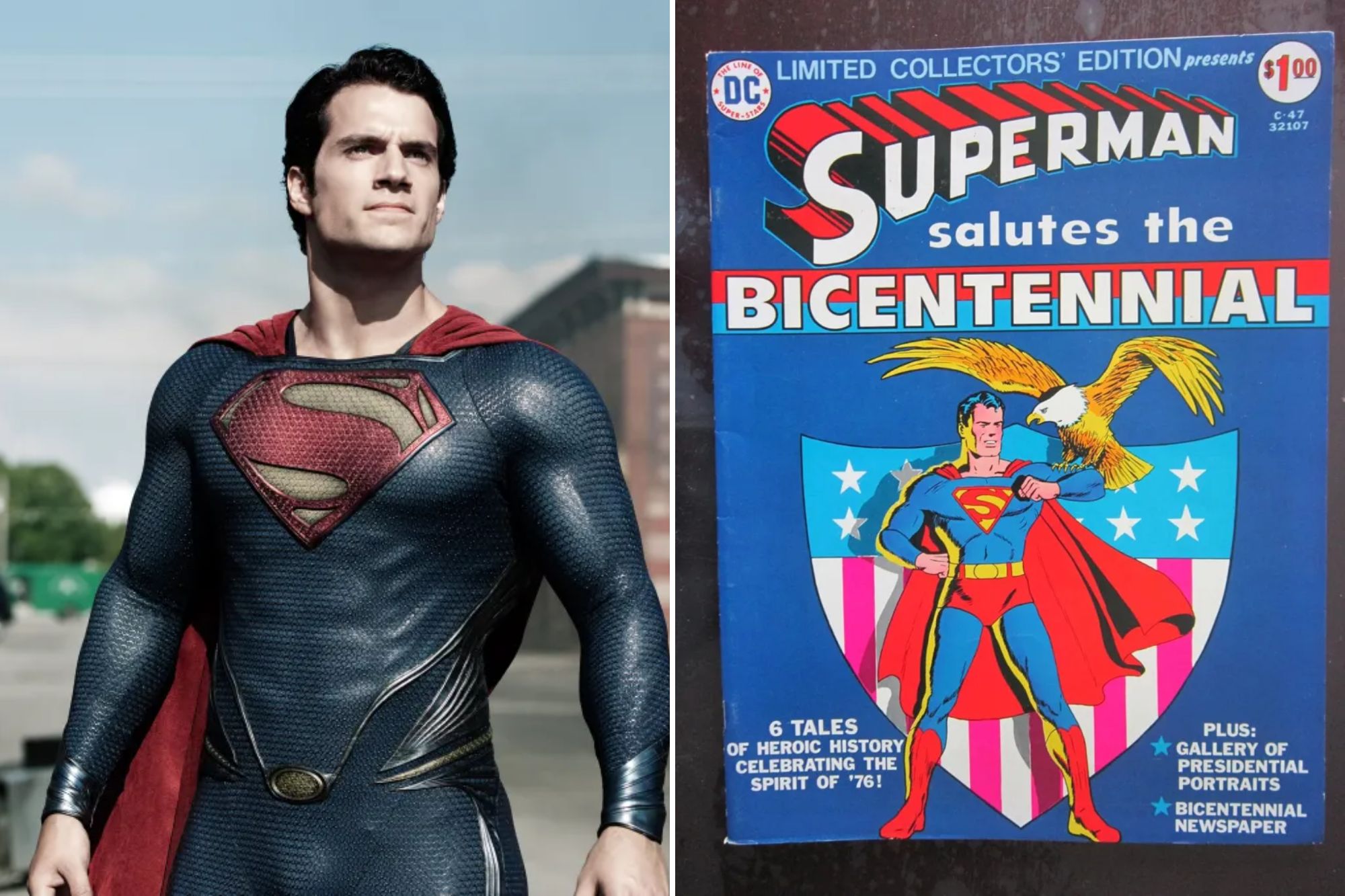
Back in the summer of 1976, one of my treasures was an oversize special edition comic book, “Superman Salutes the Bicentennial.” Reprinting a famous cover of the 1940s, with a bald eagle perched on Superman’s arm and a stars-and-stripes shield behind him, the publication contained six historical tales of the Revolution and the Spirit of ’76.
Today, a search of DC Comics’ website shows nothing celebrating America’s Semiquincentennial, by Superman or any other superhero.
One might have thought that 1976 would be a terrible time for comics to commemorate America. Hundreds of thousands of boys who had read Superman in the 1950s and ‘60s had been sent to Vietnam, where 58,000 of them died. Watergate and Richard Nixon’s resignation had shattered faith in the political system, while assassinations of Dr. Martin Luther King, Jr., and Robert F. Kennedy, followed by devastating riots, made a mockery of the “American Way.”
Yet DC Comics, along with tens of millions of Americans, did celebrate the country. Though its values had been severely tested, Bicentennial America also had seen the greatest growth of the middle class and national wealth in human history, as well as the final push to ensure civil rights for all citizens, fulfilling the “promissory note,” as Dr. King put it, of the Declaration of Independence and Constitution.
That America’s most famous fictional hero — a symbol of the country around the world — would celebrate, too, seemed only natural, and it inspired young readers like me.
California Post News: Facebook, Instagram, TikTok, X, YouTube, WhatsApp, LinkedInCalifornia Post Sports Facebook, Instagram, TikTok, YouTube, XCalifornia Post Opinion California Post Newsletters: Sign up here!California Post App: Download here!Home delivery: Sign up here!Page Six Hollywood: Sign up here!
This patriotic portrayal continued. Thirteen years later, in September 1987, DC put out a special comic with the New York Daily News to commemorate the bicentennial of the Constitution. Traveling back in time, Superman, along with three young Americans, foils Lex Luthor’s plot to hijack the Constitutional Convention and install himself as dictator of the United States.
Amid the action, Superman delivers a mini civics lesson, explaining that while the Constitution did not outlaw slavery or give women the vote, the Framers had the foresight to allow it to be amended to fit the times.
Next to “Schoolhouse Rock,” Superman probably provided more civics education to young readers than most elementary classrooms could have hoped to do.
Times indeed have changed. In 2011, DC used Action Comics’ 900th issue as a platform to have Superman renounce his American citizenship, perhaps believing he felt more comfortable in Davos than Dubuque.
A decade later, DC officially changed Superman’s motto to “truth, justice and a better tomorrow,” a mash-up of adventure series and soap opera.
Given such changes, it’s no surprise that DC seems intent on ignoring America’s 250th.
California Post News: Facebook, Instagram, TikTok, X, YouTube, WhatsApp, LinkedInCalifornia Post Sports Facebook, Instagram, TikTok, YouTube, XCalifornia Post Opinion California Post Newsletters: Sign up here!California Post App: Download here!Home delivery: Sign up here!Page Six Hollywood: Sign up here!
That says more about DC than it does its most famous character. It seems the editors at DC no longer understand there is a reason that Superman was created in America, and not France or China. (DC Comics did not reply to a request for comment.)
The original Superman of the 1930s was most definitely a product of the American soil. Dreamed up during the Depression in Cleveland by two Jewish teenagers who were the children of immigrants, Superman represents a patriotic faith in America’s values, not least because he himself is the ultimate immigrant.
The only survivor of the doomed planet Krypton, Jerry Siegel and Joe Schuster’s Man of Steel represents the essence of the American story, from colonists onward, seeking to make a more perfect world.
Today’s comics, however, have consciously turned their back on the country of their birth. Even in the 1970s, they tackled social problems like drug addiction and racism, but without losing faith in America.
In 1976, banners proclaiming “DC Comics Salutes the Bicentennial” adorned not just Superman, but other titles.
Now, Superman is rootless: in America, but not of it, by DC’s standards.
DC’s editors no longer seem to realize that Superman still inspires people around the world precisely because he represents uniquely American values that have transcended our borders, such as “all men are created equal,” regardless of race, creed or planetary origin.
Back in 1976, DC Comics president Sol Harrison “got it.” Superman “has become the United States’ greatest ambassador overseas,” Harrison wrote in that special Bicentennial issue, and “from Arabia to Zambia, millions have formed their opinion of the American Way” through his adventures.
Superman remains uniquely American. At a time of domestic strife, he is a needed reminder to young Americans of the permanent values that have allowed us to self-correct and continue to strive to create a more perfect Union. Abroad, he still represents the ideal of the land of opportunity that continues to draw millions to our shores.
Let Superman celebrate America on our 250th — it will inspire others to do so, as well.
Michael Auslin is the author of National Treasure: How the Declaration of Independence Made America. He is the Payson J. Treat distinguished research fellow at Stanford’s Hoover Institution.