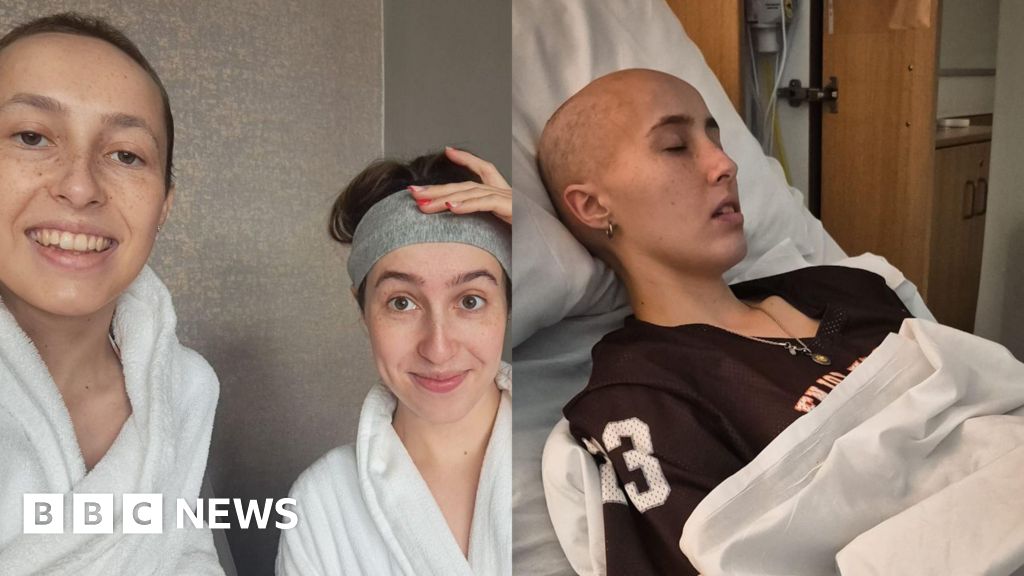
ShareSaveAdd as preferred on GoogleAmy MackrillBBC WalesCollect/PA Real LifeCaitlin Leggett and her twin sister Grace are trying to raise £500,000 for treatment abroad after Caitlin's leukaemia returnedA woman given six months to live after her leukaemia returned says the thought of leaving her identical twin sister alone is "unthinkable".
Caitlin Leggett, 24, from Cardiff, was diagnosed with acute myeloid leukaemia (AML) - an aggressive cancer of the white blood cells - in April 2025, with a persistent rash the only sign that something was wrong.
She went into remission after chemotherapy and later had a stem cell transplant, but was told in May the cancer had returned and that treatment options in the UK were unlikely to be curative.
Caitlin is now pursuing potentially curative treatment abroad - most likely in the US - where treatment and associated costs could reach £500,000.
"We're only 24 - nobody expects this to happen... Being twins as well, you're not supposed to have one twin not be there," said Caitlin's sister Grace.
"We've gone through life together and I don't want our story to end here."
The sisters, who have always been close and lived together at university, only discovered they were identical twins after Caitlin's diagnosis.
They had been believed to be fraternal twins because they developed in different amniotic sacs, but doctors found their markers were exactly the same while assessing Grace as a potential stem cell donor.
While the news came as a surprise, it also complicated Caitlin's treatment as Grace was no longer eligible to donate her stem cells to her sister due to their near-identical DNA.
Before becoming ill, Caitlin had planned to join the Army and train as an intelligence officer after graduating in July 2024.
She had a medical assessment booked for April 2025, but in March developed a rash which did not clear with pharmacy creams.
Blood tests were taken and she was told to attend the Teenage Cancer Trust unit at the University Hospital of Wales in Cardiff the following day, where she realised the news was serious.
While waiting to find an alternative donor from the register, Caitlin achieved remission in May 2025 after two months of chemotherapy. But in August, she was told the cancer had returned to her skin.
She later took part in a clinical trial in Manchester using menin inhibitors, which successfully put her into complete remission before a planned stem cell transplant.
However, a week before the transplant date in December 2025, the cancer returned to Caitlin's skin again.
She was still able to have the transplant, after receiving extra full-body radiotherapy and was told she was in remission once more in January 2026.
Caitlin was then scheduled for monthly bone marrow monitoring for three months, to check that the cancer had not returned.
These were set to decrease to quarterly tests from March 2026, "but I wasn't too happy about that", she said.
"I didn't feel like it was safe to just go straight to three, so I persuaded my consultant to give me an extra one in May.
"On that extra one, they found that the leukaemia had come back."
According to the NHS, symptoms of AML can include looking pale, feeling tired or weak, breathlessness, unusual and frequent bruising or bleeding and losing weight without trying to, but Caitlin said she experienced none of these - just the unusual rash, which can also be a sign of blood cancer.
After learning that treatment would involve a stem cell transplant, replacing the destroyed cancerous cells with healthy stem cells from a donor, the twins' whole family was tested to see if any of them could be a match.
According to blood cancer and blood disorder charity DKMS, more than 2,000 people each year in the UK need a blood stem cell transplant, but just 7% of the entire eligible population in the UK are registered as potential donors.
Since May, Caitlin has taken part in another drug trial for Bleximenib and is waiting to see whether her body responds. Her doctors say there is another drug trial option in case it is not successful - but she has been advised that these treatments are not curative.
She has also been told that a second stem cell transplant cannot be performed in the UK and doctors have predicted her current treatment plan will help her survive for six more months.
As a result, Caitlin is now pursuing curative treatment abroad - specialised leukaemia treatment in America or CAR-T cell therapy, a type of immunotherapy, in China or Singapore - both of which would cost hundreds of thousands of pounds.
The sisters have set up a fundraising page in the hopes of raising £500,000 to cover the treatment and accompanying travel costs.
"It's incredibly difficult to think about," Caitlin said.
"At 24, I always assumed I had my whole life ahead of me. There are so many things I still want to do, places I want to see and memories I want to make with the people I love.
"I don't want to miss out on the future we always thought we'd share together."