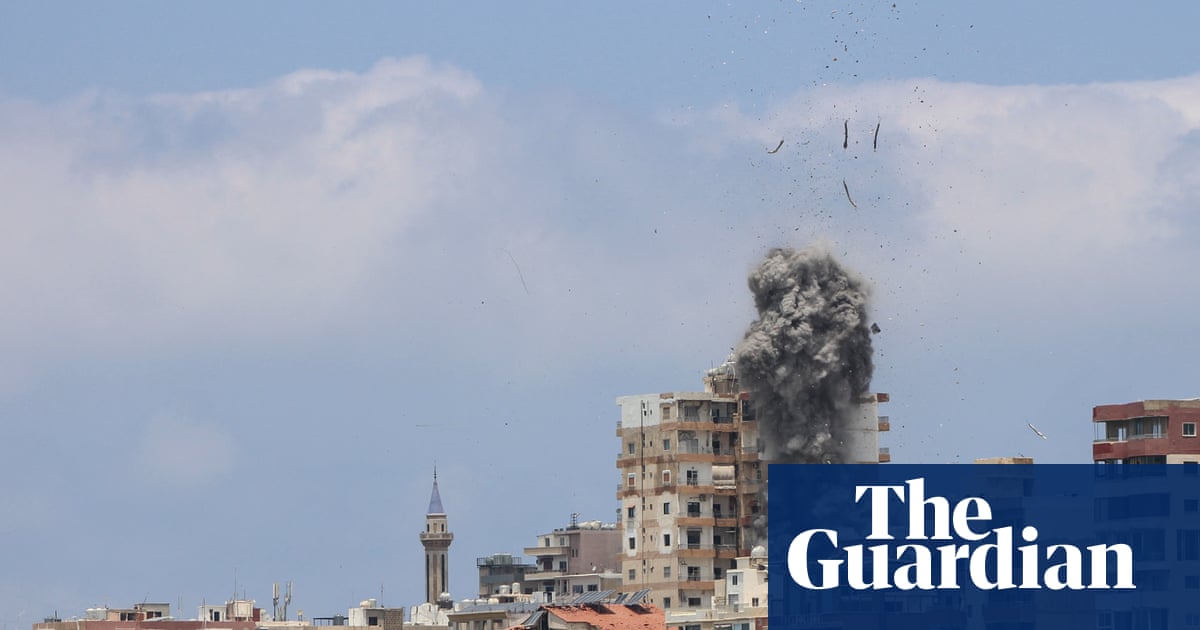
Israeli airstrikes on Tyre killed eight and injured at least 32 people on Tuesday morning. Photograph: Kawant Haju/AFP/Getty ImagesView image in fullscreenIsraeli airstrikes on Tyre killed eight and injured at least 32 people on Tuesday morning. Photograph: Kawant Haju/AFP/Getty ImagesIsraeli attack on Tyre in Lebanon kills eight as evacuation ordered for Christian quarterPeople flee historic district of ancient city after airstrikes hit residential areas and damage archaeological sites
Israel has bombed the city of Tyre, killing eight and injuring at least 32 people, and struck dozens of other villages in south Lebanon as it issued forced evacuation orders for the historic Christian quarter of the ancient city for the first time.
Israel struck the al-Masaken neighbourhood without warning on Tuesday morning, sending smoke plumes high above the city’s buildings and igniting fires. Further airstrikes were carried out across the city and a series of bombings hit Abbasieh, a village north of Tyre.
Hezbollah claimed responsibility for attacks on Israeli soldiers in the Lebanese village of Maroun al-Ras. The Israeli army said it had killed a “terrorist” who had crossed the border from Lebanon into Israel and opened fire on Israeli soldiers – the first time in this round of fighting that a fighter from Lebanon had crossed the border. It was unclear if the gunman was affiliated with Hezbollah.
View image in fullscreenPeople packed their vehicles to flee from Tyre after Israel’s evacuation warning on Tuesday. Photograph: Mahmoud Zayyat/AFP/Getty ImagesShortly after the bombings in Tyre, Israel issued a forced evacuation warning for Palestinian refugee camps in the city, as well as for the Christian quarter, claiming members of Hezbollah had infiltrated the area and could attack.
Hundreds of people fled the Christian quarter after the forced evacuation announcement, with cars packed with mattresses and belongings jamming the narrow streets of the historic port neighbourhood. The Christian quarter had not been struck by Israel previously and had been considered a safe zone amid a city otherwise under bombardment. Many Shia Muslim residents of the city had moved there in hope of safety. Last week, the Lebanese army was deployed to the district as displaced people arrived, to show that Hezbollah had no armed presence in the area and to try to prevent Israeli attacks.
View image in fullscreenIsraeli airstrikes on Sunday hit near the archaeological site of Tyre’s Roman hippodrome. Photograph: Kawnat Haju/AFP/Getty ImagesChristian religious leaders from three different denominations in Tyre called on the international community and the Lebanese state to prevent Israel from attacking the neighbourhood. The leaders appealed to the global community to “take immediate and serious action to spare the old quarter of Tyre from destruction and human tragedies”.
“The old city is not merely a residential area,” the clergy said. “It is the historical and human heart of Tyre, home to thousands of civilians, including families, children and the elderly.” They added that attacking the neighbourhood would constitute a humanitarian “catastrophe”.
View image in fullscreenPeople work to clear debris after Israeli airstrikes on Sunday near the Roman hippodrome in Tyre. Photograph: Kawnat Haju/AFP/Getty ImagesThe city has also hosted thousands of people displaced from their villages in southern Lebanon as the Israeli army advanced northwards. The most recent strikes and evacuation orders have pushed many people into their second or even third displacement, and caused a renewed wave of displacement for the residents of Tyre’s Palestinian refugee camps, some of whom had returned from northern Lebanon after not finding shelter. Tyre is considered one of the world’s oldest cities and hosts many archaeological sites, including a Unesco world heritage site. Sunday’s attack damaged Roman ruins and other archaeological sites in Tyre, including at al-Bass, have been damaged by earlier Israeli strikes.
“Some archaeological artefacts were damaged when rubble fell on them, as debris fell over a large area, impacting a large number of elements at the site – columns, capitals, column bases, mosaics,” Ali Badawi, a regional director of archaeological sites at Lebanon’s ministry of culture, told AFP.
The ministry had placed enhanced protection blue-shield emblems on heritage sites in Tyre in March – signs that, under The Hague convention, afford archaeological sites protection during armed conflicts. Israel has also damaged the nearly 1000-year-old Beaufort castle, as well as blown up multiple historical buildings in different parts of southern Lebanon in recent months.
16:00Why Lebanon is divided over the war with Israel – videoThe current round of fighting started on 2 March after Hezbollah launched rockets at Israel in retaliation for the killing of Ayatollah Ali Khamenei, the supreme leader of Iran, triggering an Israeli invasion of southern Lebanon. Israeli strikes have killed at least 3,666 people in Lebanon while Hezbollah has killed at least 30 Israeli soldiers in southern Lebanon and three Israeli civilians.
The Lebanese government and Israel are negotiating in Washington to reach an end to the conflict, though Hezbollah – the party fighting Israel – is not participating in the talks. Last week, Hezbollah rejected a ceasefire proposed by the Lebanese government and Israel.
The war in Lebanon is one of the main obstacles preventing progress in the Iran-US ceasefire talks, as Iran has insisted that any ceasefire must be on all fronts, including Lebanon. Both the US and Israel have rejected Iranian attempts to link the two fronts, though the US president, Donald Trump, has reportedly grown frustrated with Israel’s war in Lebanon in recent weeks as it has spoiled talks with Iran.