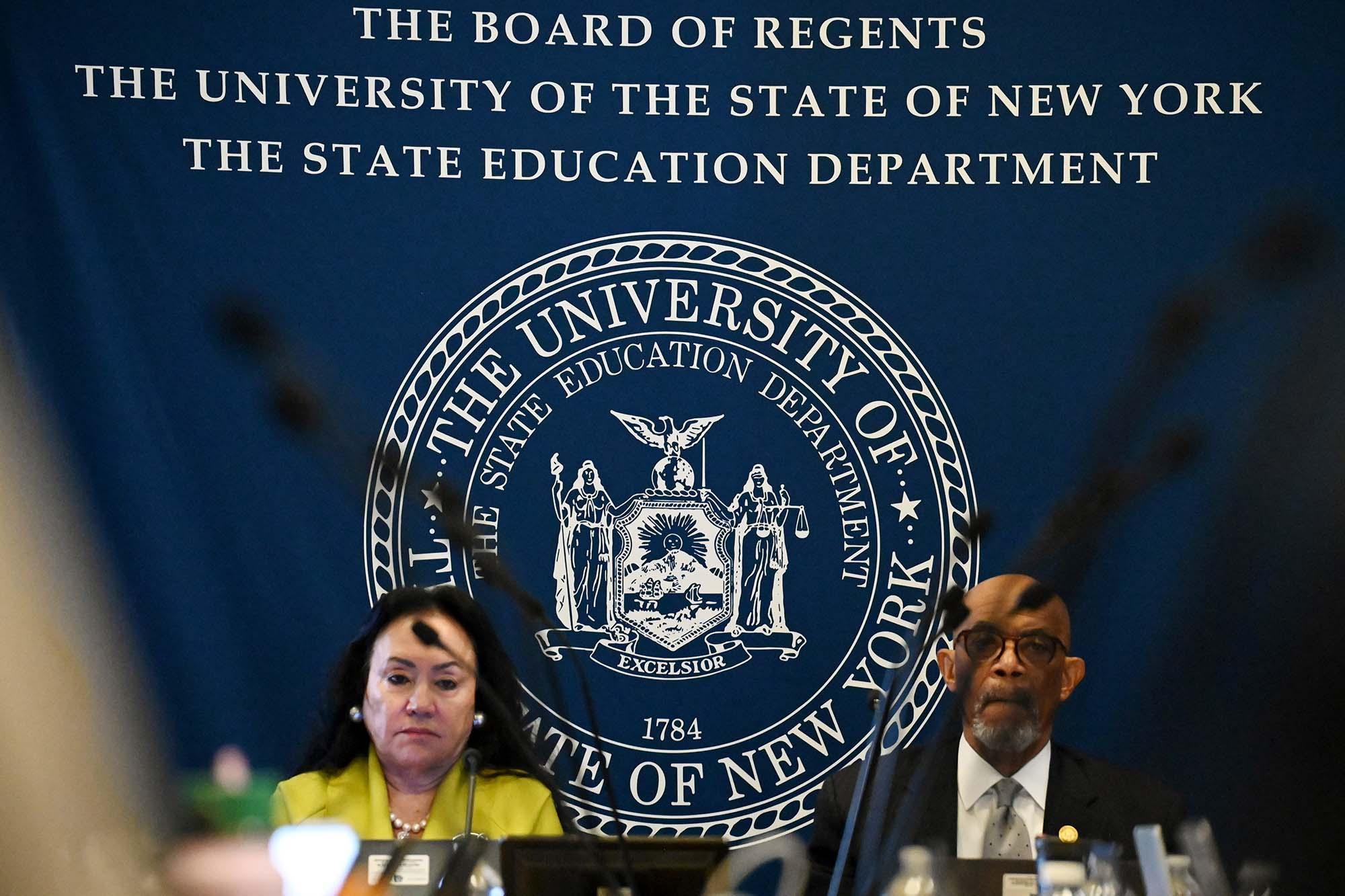
Make New York Post a Preferred Source State Education Commissioner Betty Rosa, left, and New York State Board of Regents Chancellor Lester Young Jr., right, preside over a meeting on Sept. 14, 2026, at the state Education Department in Albany, New York. Albany Times Union via Getty Ima American education has been lifted in recent years by its embrace of the “science of reading.”
Across the country, states have rewritten laws governing how schools teach kids to read — with transformative results.
They’ve invested in retraining teachers, and are insisting that future teachers are well-versed in classroom practices grounded in extensive scientific research.
New York, apparently, is finally getting around to it.
Last week, the state Board of Regents adopted new regulations requiring New York’s teacher prep programs to align their coursework with the science of reading.
It’s a welcome development, if embarrassingly overdue.
But the Regents are giving the 85 education schools they oversee until 2028 to comply.
The “science of reading” is shorthand for decades of research into how children learn to read.
It emphasizes teaching them the relationship between letters and sounds (phonics), helping them read effortlessly and accurately (fluency), and developing the vocabulary and background knowledge they need to understand what they read.
Sounds obvious, but much of what researchers have long known about effective reading instruction has been slow to find its way into America’s schools and classrooms.
Consider Mississippi, once a chronic education punch line that ranked near the bottom nationally in reading achievement.
In 2013, it passed landmark literacy legislation that’s made it a national model.
As recently as 2003, only four states significantly outperformed New York in fourth-grade reading on the National Assessment of Educational Progress, aka “The Nation’s Report Card.”
Today we find ourselves looking up at Mississippi.
Most sobering of all, poor fourth graders in the Magnolia State are now better readers, on average, than their counterparts in New York.
This ought to be a five-alarm fire in Albany: Nearly three-fourths of New York City’s public-school students are economically disadvantaged.
They’d literally be better off going to school in Mississippi.
Unlike many of the problems that plague New York, this one is within the state’s power to address.
More than 90% of the state’s elementary-school teachers are prepared in its own teacher training programs.
Albany cannot plausibly claim that the quality of its teaching force is beyond its control when it regulates virtually every path into the profession.
A survey of hundreds of New York educators last year by the Science of Reading Center at SUNY New Paltz found that a mere 8% received substantial preparation in evidence-based reading instruction in their teacher training programs.
Last year, the National Council on Teacher Quality gave failing grades to roughly half of the 38 New York teacher preparation programs it evaluated — and another 51 programs declined to make their materials available for review at all.
NCTQ also found that New York’s elementary teacher licensure exam inadequately tests prospective teachers’ knowledge of essential components of reading instruction.
Imagine if we failed to teach nurses how to safely administer injections, or hired air traffic controllers who don’t know how to guide planes.
The bottom line is that New York has been quite successful at ensuring its teachers are credentialed — but not at ensuring they are well prepared.
To her credit, Gov. Kathy Hochul made reading instruction a priority with her Back to Basics initiative, enacted in 2024.
In January, SUNY — whose 17 teaching programs graduate more than 5,000 students annually — adopted its own science-of-reading requirements and gave its education schools until the end of this year to comply.
If SUNY can manage it in a year, why do the Regents deem two more years necessary?
Every year the state dallies, another cohort of children falls behind, never to catch up.
New York City has lost roughly 200,000 K–12 students in little more than a decade.
Rochester, Buffalo, Syracuse and Yonkers have also seen substantial enrollment losses.
For generations, New York could count on its economic dynamism and cultural attractions to draw educated and ambitious people from elsewhere.
We ought to be at least as concerned with our capacity to produce them ourselves.
It’s not as if the Regents have been sleeping on the job.
In 2017, they eliminated a certification exam designed to assess prospective teachers’ literacy skills.
In 2021, they instructed school districts to pursue diversity, equity and inclusion “with fidelity and urgency.”
They’ve devoted years making it easier to earn a New York high school diploma.
By 2028, the same year the Regents expect education schools to get serious about teaching kids to read, they intend to stop requiring kids to pass Regents exams to graduate.
New York’s education establishment is apparently capable of urgency.
Robert Pondiscio is a senior fellow at the American Enterprise Institute and a former New York City public school teacher.