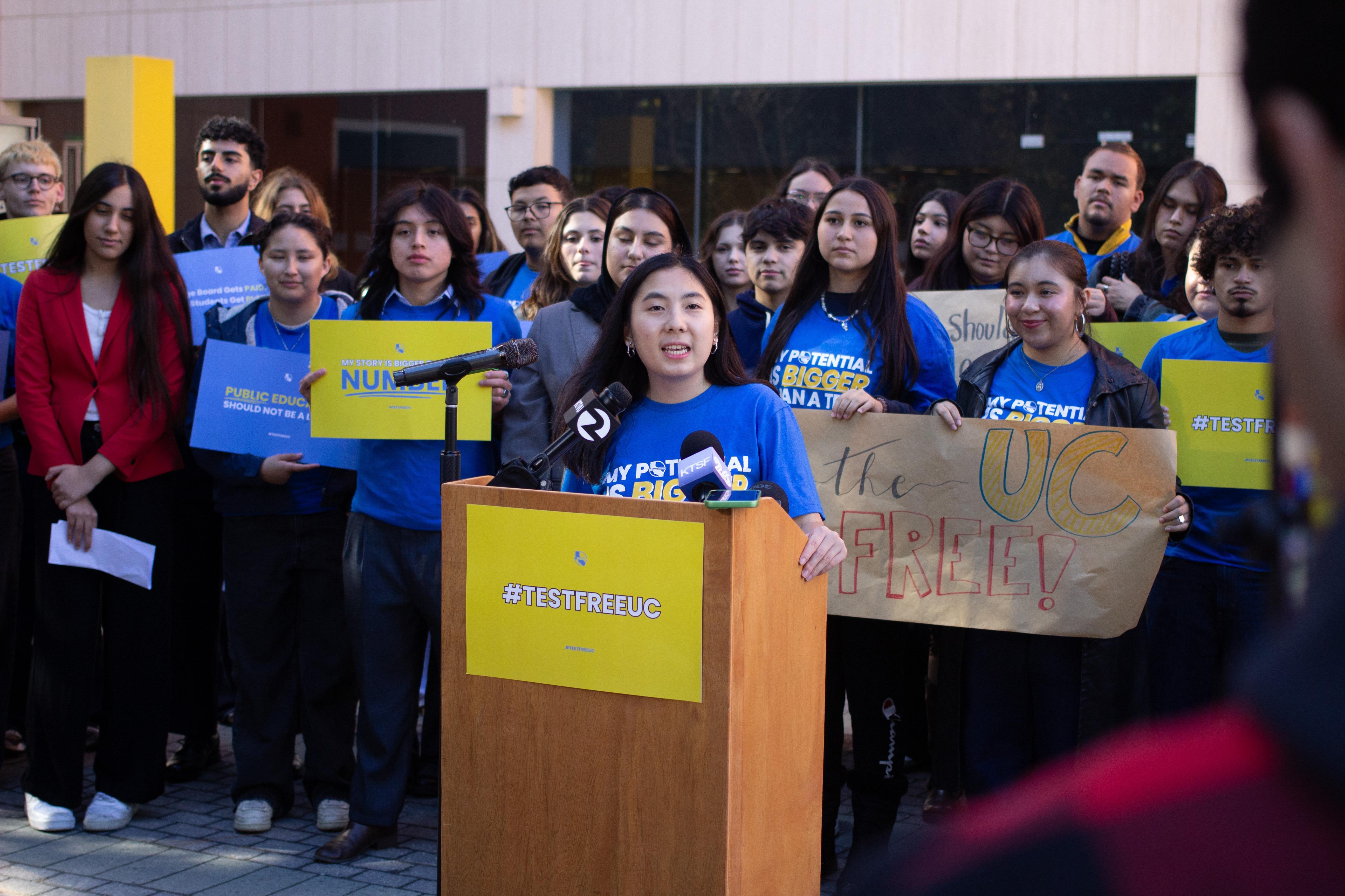
Make California Post a Preferred Source Nearly 100 University of California students rallied at UC San Francisco on Tuesday demanding that the system keep the SAT and ACT out of admissions, even as math professors warn that a growing number of incoming freshmen can’t do middle-school math.
The rally, organized by the UC Student Association, held a press conference urging the UC Board of Regents to keep the test-free admissions policy it adopted in 2020. They argued the exams shut out low-income students and students of color.
Earlier in the day, students spoke during public comment at the Regents meeting.
“So rather than blaming students, the UC needs to look itself in the mirror, assess the landscape and timeline which we are in, and decide how we are to move forward in a way that truly centers student experience, equity, and access,” Candice Phan, UCSA president and a UC Davis undergraduate, said.
On Phan’s own campus, the head of the math department sees it very differently.
“Standardized testing is the only objective method available in the admissions process that compares student preparedness across different schools,” Joel Hass, professor and chair of the UC Davis Department of Mathematics, told The California Post. “It provides essential information to the admissions process.”
Hass signed an open letter this spring in which UC math faculty, joined by hundreds of colleagues in other science fields across the state, called for bringing back the SAT/ACT math requirement for STEM applicants starting with the 2027 admissions cycle. He told The Post he would go further.
“I believe we should reinstate standardized tests for all applicants,” he said.
The faculty letter paints a grim picture of what’s showing up in UC lecture halls.
It cites a UC San Diego faculty and administration report finding that over the past five years, the number of freshmen whose math skills fall below high school level jumped nearly thirtyfold. Seventy percent of those students tested below middle school level. That’s roughly one in every 12 members of the entering class.
At UC Berkeley, 20% to 30% of first-semester calculus students who took a diagnostic test showed “severe preparation deficits” three years in a row, according to the letter.
Professors wrote that instructors are now forced to “reteach middle-school mathematics” while also trying to teach the college-level material students need for science, engineering and economics.
Hass said the UC San Diego findings match what he sees.
“This is consistent with my observations and with all data that I have seen,” he said. “I attribute it to a combination of poor practices in K-12 education and a failure of the processes of the UC admission system.”
Asked whether grade inflation has left straight-A students arriving unable to do algebra, Hass said, “The UC San Diego study indicated that this is the case for some high schools.”
He also said today’s students are being held to a lower standard than earlier generations.
“There is considerable evidence that the bar is lower than in past years,” he said. “The responsibility for this lies with the K-12 system and with UC admissions procedures.”
The faculty letter blames “severe grade inflation” and “AI-assisted application essays” for making GPAs and essays, the backbone of UC’s current admissions system, unreliable measures of who is ready for college-level STEM work.
Students at Tuesday’s rally argued the problem is not who gets in but how little help they get once they’re there.
“At UC Santa Cruz, when the campus lost its HSI funding, we saw over 40 tutors be cut in classes that have the highest failure rates, including math, chemistry, and engineering,” UC Santa Cruz undergraduate Francisco Ornelas told the Regents. “It is absurd to assume students will succeed when you continuously cut resources that are supposed to support them through their classes.”
UCSA wants UC to put more money into student support and strengthen the A-G course requirements high school students must complete to qualify, instead of bringing back a test it says favors wealthier families.
“Those who have the money and resources to pay for tutoring, prep academies, and online services consistently do better than those who do not have the means of acquiring these resources,” said Anika, a Bay Area high school junior who plans to apply to UC.
“These would help, but not be sufficient,” he said. “The current admissions system sends a very weak and inconsistent signal of which students are prepared for a UC education and which are better served by the CSU or Community College system. These changes would not affect that.”
He dismissed the argument that the SAT simply measures family wealth and discriminates against minority students.
“This is based on a misunderstanding,” Hass said. He pointed to a 2020 report by the UC Academic Senate’s Standardized Testing Task Force, which he called “the definitive study of the use of standardized testing at UC.”
“In fact the use of standardized testing can lead to increased opportunities for all students, including those from low-income groups and those attending low-performing schools,” he said.
He gave the same answer to concerns that testing would hurt diversity in STEM programs: “The view that it would harm diversity is based on a misunderstanding.”
Hass warned that the cost of doing nothing falls hardest on the underprepared students UC admits.
“Being admitted without necessary preparation can derail a student’s educational trajectory, causing unnecessary failure and discouragement,” he said.
UCSA has been pushing back on the faculty campaign for months.
In a July letter to Regents Chair Maria Anguiano, the group said UC freshman applications jumped 19% in the year after the SAT/ACT requirement was dropped. It also said graduation and persistence rates did not fall as the student body grew more diverse.
The group called the UC San Diego report’s framing “extremely problematic,” in part because it listed “the expansion of admissions from underresourced high schools” among the causes of falling math preparation.
“A preparation gap is not automatically an admissions problem,” said Denise Luna, director of higher education policy at EdTrust-West. “The UC has an important choice to make, will they: Identify gaps and provide effective support? Or identify gaps and exclude students?”
Jessie Ryan, president of the Campaign for College Opportunity, said “talent, determination, and potential cannot be reduced to a test score.”
UCSA says Tuesday’s rally kicks off a yearlong campaign to keep UC test-free.
Several elite universities, including MIT, Harvard, Yale and Stanford, have brought back testing requirements since the pandemic. Hass said UC is falling behind.
“Many leading universities have realized that dropping standardized testing was a mistake, and have reinstated these tests,” he said. “If UC keeps dropping standards then the value of a UC degree will continue to decline.”
If the Regents don’t act, he warned, “they risk abandoning UC’s role as a leading public university, harming its students, and turning UC into a second-rate university.”
The UC Board of Regents will vote by June 2027 on whether to bring back the SAT/ACT, after the Academic Senate finishes its review.
California Post News: Facebook, Instagram, TikTok, X, YouTube, WhatsApp, LinkedInCalifornia Post Sports Facebook, Instagram, TikTok, YouTube, XCalifornia Post Opinion California Post Newsletters: Sign up here!California Post App: Download here!Home delivery: Sign up here!Page Six Hollywood: Sign up here!